The yellow oleander's pale yellow flowers are elegant and subtle, fully displaying the vibrant feeling of spring
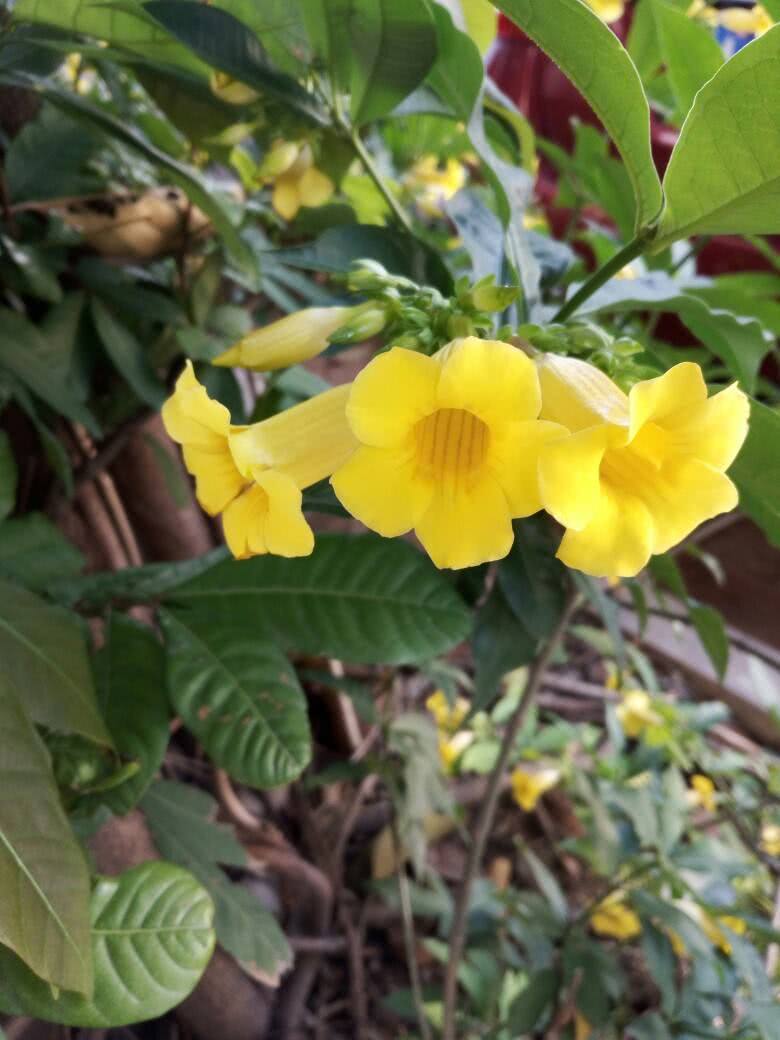
Yellow oleander: An evergreen shrub, the plant grows upright, reaching about 2 m in height, though container-grown plants are generally kept to around 1 m. Leaves are borne in whorls of 3 to 5, elliptical or oblanceolate-oblong, 5 cm to 12 cm long and 1.5 cm to 4 cm wide, covered with short soft hairs. The inflorescence is a cyme, the flowers golden yellow with orange-red stripes in the throat, the corolla broadly funnel-shaped with 5 lobes overlapping to the left or right, the base of the corolla swollen, with 5 stamens borne inside. The capsule is spherical and bears long spines. The flowering period is from May to June. Native to the southern United States and Brazil, it is distributed across tropical America, and was introduced and cultivated in China. Used for garden landscaping, the plant is dense, the foliage deep green, and the flowers bright and brilliant, very eye-catching. It is suitable as a medium-to-large container plant for decorating living rooms, balconies, parks, shopping malls, conference halls and other large indoor spaces, with excellent results.
Yellow oleander
Growth habits:
It prefers high temperatures, high humidity and full sun, and tolerates partial shade slightly. It is suited to fertile, well-drained soil. It is not cold-tolerant and dislikes frost; when exposed to prolonged low temperatures of 5-6°C, the branches and leaves are damaged. It prefers fertile, moist sandy loam, and grows poorly in heavy clay soil; it dislikes waterlogging and saline-alkaline soil. It is relatively tolerant of wet conditions but not of drought, and the soil should be kept consistently moist. The optimum growth temperature is 18-30°C, and it can grow normally even above 35°C. During the winter dormant period the optimum temperature is 12-15°C, and it must not drop below 10°C; below 5°C the plant suffers cold damage.
Yellow oleander
Ornamental value:
The yellow oleander is a semi-climbing evergreen shrub of the genus Allamanda in the dogbane family (Apocynaceae). Its leaves are borne in whorls of 3, initially tinged with purple and later turning emerald green, quite attractive. The flowers often cluster several together at the tips of the shoots; the floral tube is long and slightly swollen at the base, shaped like a trumpet, lemon yellow to golden yellow, with reddish-brown speckled stripes inside, and glossy. When in full bloom the plant is covered in golden blossoms, magnificent and quite spectacular. The plant is dense, the foliage deep green, and the flowers bright and brilliant, with a fairly long flowering period, opening from June to August. In the hot summer, a slack season for flowers, it blooms brilliantly all over the branches, adding to the garden scenery. It is suitable for container planting to decorate doorways, halls, balconies, living rooms and other spots, and also suitable for planting in beds, flower borders or at the base of buildings; combined with colorful flowers, it can enrich the garden scenery. It can also be planted in parks, industrial and mining areas, green spaces, in front of steps, on hillsides, beside ponds and along roadsides in groups or as a flowering hedge, for ornamental use in gardens and along roadsides. The flowers can also be cut for use as cut flowers, for vase arrangements or wreaths.
Yellow oleander
Plant cautions:
The milky sap of the plant is toxic; poisoning in humans or livestock stimulates the heart and impairs the circulatory and respiratory systems, and pregnant animals that accidentally ingest it will miscarry.