The flowers of the Japanese ladybell nod downward, appearing very shy and delicate.
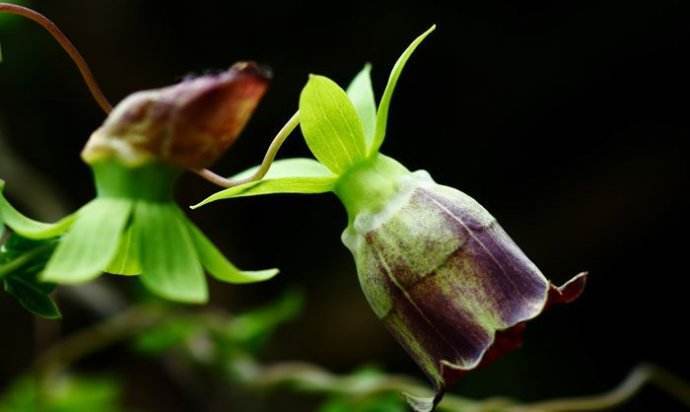
The Japanese ladybell is a perennial twining vine. It is distributed across the provinces of Northeast, North, East and Central-South China, growing in shaded, damp areas under shrubs on mountain slopes. Perennial twining herb, root thick and fleshy, obovate-fusiform; stem round; leaves on the stem rather small, alternate, with short petioles. Flowers usually solitary at the tips of branches; calyx 5-lobed, the calyx tube united with the ovary; corolla blue-green or pale yellow, bell-shaped; stamens 5, filaments slightly enlarged at the base; ovary inferior, 3-locular; style short, stigma 3-lobed. Capsule conical.
Japanese ladybell
Morphological characteristics:
The whole plant is smooth and hairless, or the stem and leaves occasionally sparsely pubescent. The stem base is somewhat nearly conical or cylindrical, its surface bearing numerous tuberculate stem scars; the root is often fleshy, fusiform, with a few fine lateral roots, about 10-20 cm long, 1-6 cm in diameter, grayish-yellow on the surface, with sparse concentric rings near the upper part and sparsely borne transversely elongated lenticels on the lower part. The stem twines, about 1 m long, 3-4 mm in diameter, often with numerous short slender branches, yellow-green tinged with purple. Leaves on the main stem alternate, lanceolate or rhombic-narrowly ovate, small, 0.8-1.4 cm long, 3-7 mm wide; at the tips of branchlets usually 2-4 leaves clustered, appearing nearly opposite or whorled; petioles short and small, 1-5 mm long; leaf blade rhombic-ovate, narrowly ovate or elliptic, 3-10 cm long, 1.3-4.5 cm wide, apex acute or obtuse, base attenuate, usually entire or with sparse wavy serrations, green above, grayish-green beneath, veins prominent. Flowers solitary or opposite at the tips of branchlets; pedicels 1-9 cm long; calyx adnate to the middle of the ovary, the tube hemispherical, the sinus between lobes acute and narrow, or gradually becoming broad and obtuse after flowering, lobes ovate-triangular, 1.3-3 cm long, 0.5-1 cm wide, apex acute, entire; corolla broadly bell-shaped, 2-4 cm long, 2-3.5 cm in diameter, shallowly lobed, lobes triangular, revolute, about 0.5-1 cm long, yellow-green or milky white with purple spots inside; disk fleshy, dark green; filaments subulate, slightly enlarged at the base, about 4-6 mm long, anthers 3-5 mm; ovary inferior. Capsule hemispherical in the lower part, beaked in the upper part, about 2-2.5 cm in diameter. Seeds numerous, ovate, winged, small, brown. Flowering and fruiting period July-August.
Japanese ladybell
Growing environment:
The Japanese ladybell prefers a cool climate; if it encounters high temperatures during the growing period, its above-ground parts tend to wither and become susceptible to disease. Seedlings prefer shade, while mature plants prefer ample sunlight.
Distribution range:
Produced in the provinces and regions of Northeast, North, East and Central-South China. Also distributed in the Far East region of the Soviet Union, Korea and Japan. It grows in shaded, damp areas along ditches under mountain shrubs or in broad-leaved forests. The type specimen was collected in Japan.
Japanese ladybell
Main values:
Besides being very useful as a medicinal herb, the Japanese ladybell is also excellent as an ornamental plant. It usually bears several flowers on one stem; the flowers are plain and elegantly colored, in pink, pale purple and pale yellow, with emerald-green leaves; the petals are slightly rolled outward or backward, and the Japanese ladybell, whose shape closely resembles a small bell or bronze clock, has an elongated form with nodding flowers that appear shy and delicate.
Alternative names gathered:
Milk tree, Grandma's head, Milk-juice radish, Milk codonopsis, Codonopsis, Mahalige-Cun-Aorihudai, Whorled-leaf codonopsis, Horn ginseng, Milk-leaf vine, Milking fruit, Vine ginseng, Dog ginseng, Duckweed ginseng, Taishan ginseng, Four-leaf codonopsis, Wild carrot, Mountain sweet potato, Dede bitter, White flesh, Milk belt, Turtle codonopsis, Big-head ginseng, Radish shell, Japanese ladybell ginseng, Stinky codonopsis, Milk potato, Milk ginseng, Milk lady, Goat's milk, Four-leaf ginseng, Milk potato, Nipple potato, Mountain sweet potato vine, Wild carrot, Mountain sea snail, Milk-promoting herb, Goat's milk, Earth codonopsis, Cow milk fruit, Goat's milk ginseng, Dog-head ginseng, Earth sand ginseng, Radish codonopsis, Milk ginseng, White python flesh, Wild carrot.