Passion fruit is called the king of juices, and it can climb, bloom and bear fruit in a pot on the balcony
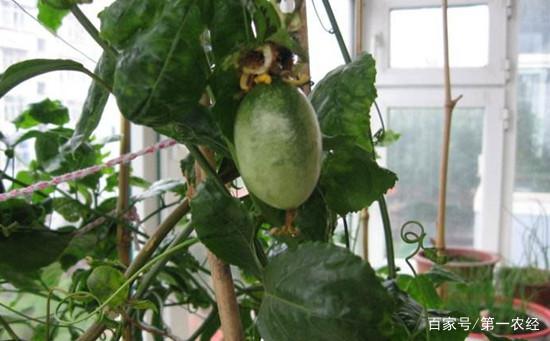
Nowadays, more and more friends like to keep some potted plants at home, such as ivy, pothos and spider plant, which are all good choices. They can not only green up the home environment, but also help purify the air. Of course, besides potted plants, you can also grow some fruits on the balcony in pots, such as watermelon and strawberry. So today, let me introduce a fruit known as the "king of juices". Plant one in a pot in summer, and it will climb, bloom and bear fruit, instantly turning your balcony into a mini orchard. Let's take a look!
[Passion fruit potting method one]
Passion fruit cannot be planted too densely. The scientific planting distance is a row spacing of 3m. Generally speaking, a medium-sized pot (basin-sized or bucket-sized) can only hold one plant, or the pot can be larger than that, but it must not be too small. As for depth, cultivation generally requires a depth of 60cm. Some families use foam boxes meant for growing vegetables, and these can also be used for cultivation. It should also be stressed that drainage must be ensured. You can drill holes in the bottom of the pot or box to ensure smooth drainage; generally, it can be planted in all four seasons.
The simplest planting method is to dry the seeds of a passion fruit you have eaten and put them into a pot. Before putting them into the pot, you can soak them in water for 1 to 2 days. If you want to increase the germination rate, you can first cultivate them in a small container, and after they sprout, put them into a large pot. If you choose the cutting method, use 1-year-old stems, insert them into a small pot with sand, and after they sprout, move them into a large pot. After potting, be careful to keep the soil moist. Passion fruit is a vine plant, so when potting it, be careful to set up a trellis; when fertilizing, be careful to increase the use of potassium fertilizer and do not overuse nitrogen fertilizer. It is best to apply fertilizer after flowering. Branch modification should be completed in summer. When flowering, pollination needs to be done by hand. Directly use a soft brush to apply pollen to the stigma, or dissolve the pollen sacs in water and spray. Passion fruit likes sunlight, so be careful to place it in the sun.
[Passion fruit potting method two]
Growing passion fruit in pots is super simple. Passion fruit is mainly grown by two methods: sowing and cuttings. To make potted passion fruit bear fruit early and easily, it is best to use cuttings propagated from branches for potted seedlings. The specific method is as follows: cut branches from high-yielding, healthy plants for cuttings; each cutting is generally best at two nodes or three nodes long, with the lower cut about 1cm from the node and the upper cut about 2cm above the terminal bud. When cutting the cuttings, leave half a leaf to one leaf on the upper part. After inserting, keep the seedbed moist. It is best to use a small plastic-film arch tunnel or a greenhouse for raising seedlings, and water them every day to maintain humidity; when the weather is sunny and the temperature is high, open them in time to release heat. After potting, apply appropriate phosphorus and potassium fertilizer, combined with proper pruning measures, to promote flowering and fruiting, and set up a trellis at the edge of the pot for it to climb. To suppress excessive growth, potted plants are more likely to bloom and bear fruit.
In addition, passion fruit loves light. When grown at home, it should be placed on a balcony, windowsill or rooftop with plenty of sunlight, and it needs 3 to 4 hours of direct sunlight each day. In winter, it can be moved indoors near a window. Spring, summer and autumn are the peak growing seasons, so the potting soil should be kept moist and watered thoroughly regularly, but there must be no waterlogging. Apply liquid fertilizer once every 2 weeks, preferably when the potting soil is relatively dry, to improve fertilizer efficiency. The fertilization concentration is generally: for decomposed organic fertilizer, about 3%; for inorganic fertilizer, about 0.1%. In winter, reduce watering, only keeping the potting soil from drying out, and stop fertilizing at the same time; potted passion fruit can rely on insects for pollination, and hand pollination is best. Passion fruit flowers are fully open around 10 a.m., and this is a good time to collect pollen. Pollination must be done after the flower is fully open and before 4 p.m. that day. Finally, enjoy the delicious food.
[Passion fruit potting method three]
For potted passion fruit, use a pot with a diameter of 50cm; the pot must not be too small. Passion fruit planted in the same year bears fruit in the same year, and it is best to plant it from February to March each year, when the climate is best. Passion fruit is a vining fruit tree with extending branches and vines, so during cultivation a trellis must be set up to facilitate management and harvesting! There are many forms of trellis construction. At present, horizontal trellises and single-line fence trellises are the main types. Passion fruit does not need heavy pruning every year. If pruned excessively, the main vine is likely to gradually wither, and in severe cases the whole plant dies. At the same time, every summer, branches that are too dense must be thinned, or branches hanging down and trailing on the ground should be cut off about 20-30cm above the ground to maintain good ventilation. The fertilization principle for passion fruit is a nitrogen, phosphorus and potassium ratio of 2:1:4. Within 15 days after flowering is the rapid fruit expansion period, so fertilizer and water management should be strengthened, especially increasing the application of potassium fertilizer, to promote rapid fruit expansion. In winter, whether in the south or the north, it is best to move it indoors to a warm place to overwinter; otherwise, the upper part of the main stem and many side branches will be frozen and withered, and in severe cases the whole plant may freeze to death.