Three arrows to save the banana price, COA calls for auction price to rebound to 15 yuan per kg next week
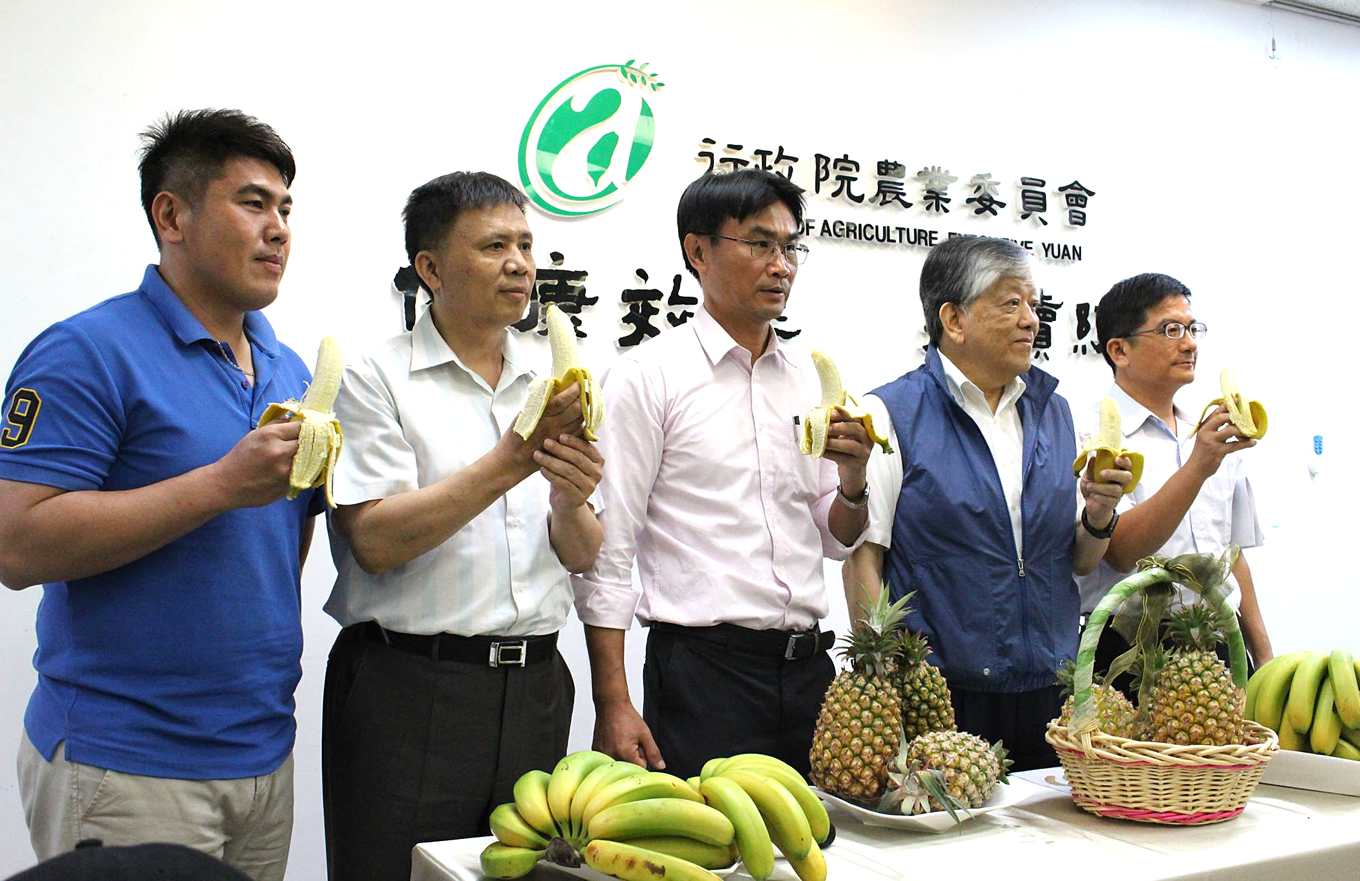
Banana prices have remained sluggish, and the Council of Agriculture (COA) has rolled out second-stage measures, expected to handle 11,060 metric tons of bananas to stabilize prices. COA Deputy Minister Chen Chi-chung, at a press conference today (the 4th), even called for the price to rebound to above 15 yuan per kg at auction next week.
The COA expects to handle 10,000 metric tons of bananas to stabilize prices
Chen Chi-chung said that this year the banana planting area decreased slightly, but because bananas have low water content and are subject to the substitution effect of other summer fruits, it is not easy to boost consumption, hence the problem of unsold stock. The COA has also rolled out various measures since April, and last week held a major press conference to announce four major measures, including strengthening marketing through major distributors, schools, and national group meal services, as well as procurement for processing and guidance for export, expected to handle 5,460 metric tons.
"But it is obvious the effort is not enough." Chen pointed out directly that yesterday morning the average price at the Taipei fruit and vegetable auction market was nearly 12 yuan, but after deducting the intermediate costs of green bananas at the production area, such as ripening, cartons, and transportation, about six yuan per kg, the production area price was only around six yuan, already below the cost of 6.4 yuan per kg. "Looking at the banana price trend over the past five years, this year's price is indeed on the low side," and the price is now at its lowest point; by handling 10,000 metric tons of bananas through the planned specific measures, prices can be stabilized.
Taiwan Agricultural Development Corporation to export 120 metric tons, 5,000 metric tons of substandard product to be diverted
The COA has launched second-stage measures. In strengthening processing, I-Mei Foods will come forward to purchase 100 metric tons of bananas. In strengthening exports, it is expected to handle 500 metric tons of bananas, with Taiwan Agricultural Development Corporation exporting to the Middle East, 12 metric tons per week for ten consecutive weeks, with export volume estimated at 120 tons, and the procurement price at the production area no lower than 12 yuan per kg; Guangsong Company will export 50 tons per week to China.
For the diversion of substandard product, green bananas graded as substandard at the production area will be diverted at a price better than the market rate, expected to be 5,000 metric tons. Su Mao-hsiang, Deputy Director-General of the Agriculture and Food Agency, explained that the production area price of secondary bananas is about one yuan, and the COA purchases them at three yuan per kg, and these bananas purchased by the COA are usually taken directly by collection centers to feed pigs, or taken back by farmers to feed pigs or use as fertilizer.
But how can it be ensured that the substandard product purchased by the government does not flow back into the market? Su said that the substandard bananas purchased must be cut and their surfaces damaged to avoid flowing into the market, and all are photographed for evidence.
I-Mei to purchase 200 metric tons, farmers actually get 10.5 yuan per kg at the production area
I-Mei Foods announced last Friday that it was willing to purchase 100 metric tons of Grade A Taiwan bananas (ripeness level five or six) at 16.5 yuan per kg, but they must be delivered by the seller to the designated freezer in Taoyuan City. Kao Chih-ming, General Manager of I-Mei Foods, said further at today's press conference that it will purchase an additional 100 metric tons of bananas from farmers, equivalent to an expected purchase of 200 metric tons, and the ripeness of the purchased bananas can be up to level four. The purchased bananas will also be made into high-value-added products, such as developing banana ice cream and banana chips with black soybean milk.
According to I-Mei's banana ripeness color chart, bananas can be divided into seven levels; the higher the level, the higher the ripeness, and the relatively greater the ripening cost. Kao explained that setting the purchase price at 16.5 yuan per kg takes into account that farmers can obtain a certain benefit; after deducting six yuan for ripening, cartons, and freight from 16.5 yuan, farmers at the production area can get 10.5 yuan.
How much banana has been purchased so far? Kao said that it was just announced last Friday, and people have already come one after another to discuss; banana purchasing will begin this week, mainly through negotiations with county and city agriculture bureaus and farmer groups, but individual farmers can also deliver directly to I-Mei.
However, Kao also admitted that freezing the purchased bananas is a big challenge; at this stage it is very difficult to find so many cold storage facilities on short notice, and moreover these purchased bananas must be frozen for several months, "these freezing costs are all difficulties." One pallet can hold 600 to 800 kg of bananas; moving one pallet in and out of the freezer costs 250 yuan, and the refrigeration fee is 25 yuan per pallet per day, "a quite high burden."
Qishan Fruit and Vegetable Marketing Cooperative: during the banana unsold period, they can be sold to China
Facing repeated surges in banana volume and falling prices, the COA also continues to estimate the production period and output from seedlings, hoping to achieve front-end seedling control, but the final decision still rests in farmers' hands. Kuo Tai-cheng, Manager of the Qishan Fruit and Vegetable Marketing Cooperative, pointed out that although the COA does seedling control, it can only advise farmers, and what is feared is that farmers keep side shoots to continue planting. "We can only look at the farmers' choice, but some farmers are blind; when they see a good price they plant more, thinking that if they plant there is a chance."
Kuo Tai-cheng took over the family's banana business; in addition to growing his own, he also purchases bananas from farmers and exports to Japan and China. At present he purchases green bananas at the production area from farmers at 12 yuan per kg, exporting 70 metric tons of bananas per week, with Japan and China each accounting for half.
"We have been doing export business since my father's generation, operating for more than twenty years." Kuo stressed that when bananas are in abundant production, "export is the first choice, not corporate subscription or anything like that." Only by pushing Taiwan's agricultural products abroad can farmers' problems truly be solved. "We have always insisted that no matter how difficult it is, we still have to export the goods."
Taiwan bananas are priced higher than the international market, so they mainly go to the Japanese market. Kuo pointed out, "China has a good impression of Taiwan bananas, but the price is relatively high." If Taiwan bananas are in abundant production and unsold, they should be sold to China; once the Taiwan price comes down, they become competitive in the Chinese market, and the shipping distance from Taiwan to China is short, "ship today and it can arrive tomorrow." China's demand is large, with a target export of 500 metric tons, "forty to fifty tons a week, and 500 tons can be reached in three months."