Effects of Rhizome Node Number of Polygonatum cyrtonema on Yield and Growth and Development
Effects of Rhizome Node Number of Polygonatum cyrtonema on Yield and Growth and Development
In production, Polygonatum cyrtonema is mostly propagated by rhizomes, and because its rhizomes are bead-like or form nodular blocks, they are often called "seed rhizomes" [5]. The quality of the seed rhizome directly affects emergence and growth. If the seed rhizome is too small, growth is relatively slow, and it easily causes later-stage missing plants and weak seedlings, leading to reduced yield; if the seed rhizome is too large, the seed cost is high, increasing the risk of disease and pest infection [10-11]. Yang Zilong et al. [12] found that each segment of Polygonatum rhizome used for propagation must have 2-3 nodes. Bi Sheng et al. [13] showed that each segment of Polygonatum seed rhizome used for propagation should have 2-3 nodes and a length of 8-12 cm. Dai Qin et al. [14] selected robust rhizomes with a yellow and lustrous color, free of pests and diseases, without broken skin and with terminal buds as planting material for Polygonatum cultivation, cutting the young tender apical part into several segments, each with 2 nodes and 1-3 bud eyes. However, at present, artificial cultivation of Polygonatum cyrtonema still has problems such as large differences in seed rhizome quantity and non-standard seed use. This study relied on the National Basic Drugs Needed Traditional Chinese Medicinal Material Seed and Seedling Breeding (Sichuan Guang'an) Base, conducted a single-factor randomized block experiment on the index of seed rhizome node number, and aimed to ascertain the effects of seed rhizome node number of Polygonatum cyrtonema on its yield and growth and development indices, so as to provide a basis for large-scale and standardized planting of Polygonatum cyrtonema.
1 Materials and Methods
1.1 Test materialsRobust seed rhizomes of Polygonatum cyrtonema (free of pests and diseases and without mechanical damage) were provided by the National Basic Drugs Needed Traditional Chinese Medicinal Material Seed and Seedling Breeding (Sichuan Guang'an) Base.
1.2 Test methods
1.2.1Experimental design. The seed rhizomes of Polygonatum cyrtonema were divided into 6 treatments according to node number: A (node number 2), B (node number 3), C (node number 4), D (node number 5), E (node number 6), and F (node number 7).
1.2.2Field experiment layout. The experimental site was the National Basic Drugs Needed Traditional Chinese Medicinal Material Seed and Seedling Breeding (Sichuan Guang'an) Base. The experiment adopted a single-factor randomized block design, with a plot area of 10 sq m, row spacing of 30 cm, plant spacing of 15 cm, and depth of 8 cm, planting about 220 plants. The experiment set up 6 treatments, each repeated 4 times, for a total of 24 experimental plots. Planting was carried out on March 1, 2014. Except for the experimental factors, all field cultivation and management techniques were carried out in accordance with the standardized production technical regulations for Polygonatum.
1.2.3Experimental measurement items and methods. The experiment combined field investigation with harvest yield measurement. According to the growth period of Polygonatum cyrtonema, relevant factors affecting the yield and quality of Polygonatum cyrtonema were observed and recorded, including emergence time, emergence rate, field growth vigor (plant height), and the occurrence of pests and diseases. Harvesting and yield measurement were carried out on October 10, 2015. The entire experiment used unified harvesting and unified processing, the yield of each experimental plot was measured, and SPSS data analysis software was used for statistical analysis of the experimental data to obtain the relationship between each index and node number.
2 Results and Analysis
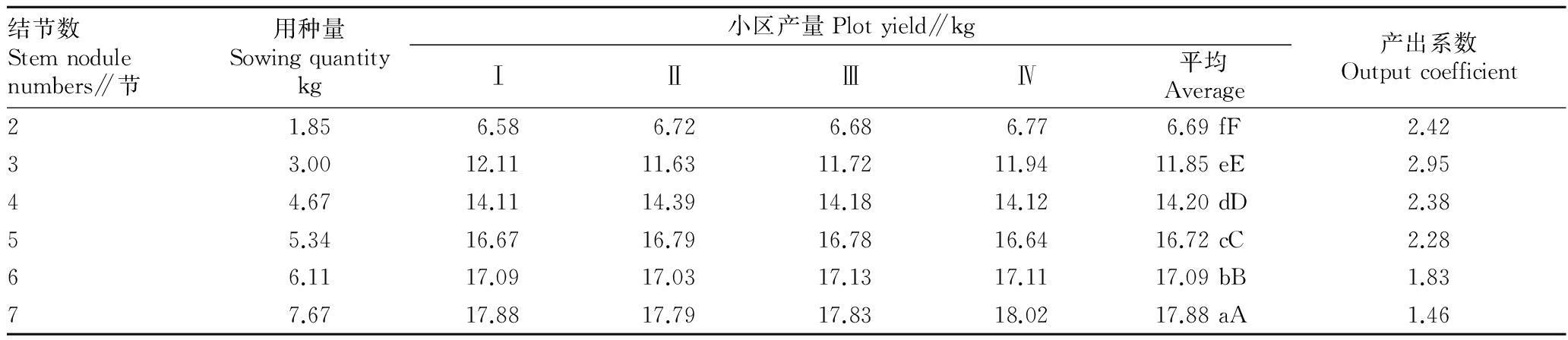
2.1 Effects of Seed Rhizome Node Number on the Yield of Polygonatum cyrtonema、and OutputUnder the 6 treatments with different node numbers (Table 1), the seed rhizome with node number 7 had the highest seed quantity and yield, which were 7.67 and 17.88 kg respectively; the seed rhizome with node number 2 had the lowest seed quantity and yield, which were 1.85 and 6.69 kg respectively. The seed rhizomes of Polygonatum cyrtonema with node numbers 2, 3, 4, 5, 6, and 7 reached significant and extremely significant differences at the 0.05 and 0.01 significance levels; yield gradually increased with the increase in node number, but the output coefficient first increased and then decreased, and the output coefficient was highest when the node number was 3, at 2.95. The results showed that the yield of Polygonatum medicinal material gradually increased with the increase in node number, but the output coefficient first increased and then decreased, indicating that the node number of Polygonatum cyrtonema seed rhizomes of different specifications had a relatively large effect on output, and node number 3 was the most suitable specification for the output of Polygonatum cyrtonema.
Table 1 Yield of Polygonatum cyrtonema under seed rhizome treatments with different node numbers
Table 1 Yield of Polygonatum cyrtonema Hua on different processing nodule numbers of stem
Note: SSR test, lowercase letters indicate significant differences at the 0.05 level, and uppercase letters indicate significant differences at the 0.01 level. Output coefficient = (average plot yield - seed quantity) / node number
Note:SSR test,the lowercase letters indicate significant differences in the 0.05 level,and the capital letters indicate significant differences in the 0.01 level.Output coefficient=(Plot average yield-sowing quantity)/stem nodule numbers
2.2 Effects of Seed Rhizome Node Number of Polygonatum cyrtonema on Growth and Development
2.2.1Emergence time. Large-scale production of Polygonatum cyrtonema usually requires relatively uniform emergence time to facilitate unified field management. As can be seen from Table 2, emergence was fastest when the node number was 4 and slowest when the node number was 2, at 56 and 90 d respectively. The emergence times of node numbers 3 and 4 were very uniform, with a difference of 5 d; the emergence times of 4 and 5 differed by 9 d; the emergence times of node numbers 5 and 6 were also relatively uniform, with a difference of 8 d; while the emergence times of node numbers 2 and 7 differed relatively greatly, with a maximum difference of 15 d. This indicated that node number had a great effect on the emergence of Polygonatum cyrtonema and was an important index, and the experiment showed that emergence was fastest when the node number was 4, and node number 4 was the most suitable specification for emergence.
Table 2 Effects of Seed Rhizome Node Number of Polygonatum cyrtonema on Growth and Development
Table 2 Effects of stem nodule numbers on growth of Polygonatum cyrtonema Hua
Note: SSR test, lowercase letters indicate significant differences at the 0.05 level, and uppercase letters indicate significant differences at the 0.01 level. Output coefficient = (average plot yield - seed quantity) / node number
Note:SSR test,the lowercase letters indicate significant differences in the 0.05 level,and the capital letters indicate significant differences in the 0.01 level.Output coefficient=(Plot average yield-sowing quantity)/stem nodule numbers
2.2.2Seedling survival rate. The seedling survival rate affects seed quantity and yield. Field statistical observation began 14 d after planting, as shown in Table 2. For each treatment, in a yield measurement area of 40 sq m across 4 replicates, 880 plants were planted at a spacing of 30 cm x 15 cm. The survival rate of seed rhizomes with node number 3 was relatively high; after 14 d, 864 plants survived, with a survival rate of about 98.20%; the survival rate of seedlings with node number 4 was only slightly lower than that with node number 3, at about 97.56%, and the survival rates for node numbers 3-5 were all greater than 96.00%; the survival rate of seed rhizomes with node number 2 was the lowest, at only 92.25%. This indicated that 3-5 nodes was the most suitable specification for seedling survival.
2.2.3Occurrence of pests and diseases. The main disease of Polygonatum cyrtonema is leaf spot, which occurs in summer and autumn. When the disease occurs, irregular yellow-brown spots appear on the leaves and stems, and the leaf margins are purplish red; afterward the lesions spread, the leaves wither and turn yellow, and in severe cases yield is affected. For the disease (Polygonatum leaf spot), only 46 plants were found in total, and the results are shown in Table 2. The main insect pests are cutworms and white grubs, which bite seedlings and rhizomes. The occurrence of insect pests at this experimental base was relatively light. Except for 15 and 18 plants found in the plots with node numbers 6 and 7 respectively, the occurrence of pests and diseases in all other plots was below 5 plants. The reason the occurrence of disease in Polygonatum cyrtonema seed rhizomes with node numbers 6 and 7 was serious may be related to more bud eyes on the seed rhizomes, which increased the probability of pathogen infection. This indicated that seed rhizomes that are too large are not conducive to the prevention and control of pests and diseases, and fewer than 6 nodes was the most suitable.
2.2.4Field growth vigor. As can be seen from Table 2, when the seed rhizome node numbers were 3, 4, and 5, the plants after seedling establishment were robust with a dark green color, good growth vigor, and uniform plant height, and the differences in field growth vigor observations were not obvious, with plant height at 54-56 cm, significantly different from the plant height of node numbers 6 and 7. The growth vigor of node number 2 was relatively good, but the plant height was not as uniform as that of the plots with node numbers 3, 4, and 5; plants with node numbers 6 and 7 grew relatively slowly and were relatively short and small. This indicated that 3-5 nodes in Polygonatum cyrtonema was more favorable for plant growth and development.
2.2.5Comparison of tuber appearance. As can be seen from Table 2, there were no significant differences in the length and node base diameter of Polygonatum cyrtonema seed rhizomes with node numbers 3, 4, 5, 6, and 7, and all were significantly greater than node number 2. The tuberous root length of Polygonatum cyrtonema with node number 2 was 10.23 cm, and the node base diameter was 2.95 cm; the tuber lengths of node numbers 3, 4, 5, 6, and 7 were all greater than 13.50 cm, and the node base diameters were all greater than 3.00; the tuber length and node base diameter were the largest when the node number was 5, at 15.65 and 4.13 cm respectively, and after the node number exceeded 5, the tuber length and node base diameter of Polygonatum cyrtonema gradually decreased. This indicated that a node number of 3-5 was favorable for the growth and development of the tuberous roots of Polygonatum cyrtonema.
3 Conclusion and Discussion
This study found that the seed rhizome node number of Polygonatum cyrtonema had a certain effect on yield and growth and development. When the node number was 3, the output coefficient was the largest, basically consistent with the test materials selected by Yang Zilong et al. [12] and Bi Sheng et al. [13] in high-yield cultivation of Polygonatum, namely 2-3 nodes per segment and a length of 8-12 cm; neither study clarified the reason for selecting seed rhizomes with 2-3 nodes, and the reason for material selection may have been based on experience accumulated over many years in Polygonatum cultivation. The results of this study verified the rationality of their material selection and provided a statistical basis for their research results. Dai Qin et al. [Jishan Huayao] found that in imitation wild cultivation of Polygonatum cyrtonema under moso bamboo forests, each segment had 2 nodes and 1-3 bud eyes. There is a certain difference from the 3-5 nodes found in this study, and the reason may be that Polygonatum is more suitable for imitation wild cultivation, so the selected seed rhizome node number can be appropriately reduced. Under the premise of not pursuing large-scale output, this advantage is reflected in the following: first, the imitation wild environment is similar to the natural growth conditions of Polygonatum, with relatively fewer pests and diseases, and basically no need to use pesticides; second, the vegetation under the bamboo forest is abundant, and the soil has good moisture retention and water retention performance, so normal rainwater, night dew, and the humid air in the forest can meet the growth needs of Polygonatum. In this experiment, it was also found that the disease infection rate was high when the node number was more than 6 nodes, making it unsuitable for large-scale production. This may be related to the cultivation and management measures at the experimental site. Although the probability of insect pests and diseases at this base was small, it differed greatly from the wild environment, and multiple watering and fertilizing were required throughout the growth period, and a high-humidity environment could increase the probability of infection, which needs further study.
In summary, in the artificial cultivation process of Polygonatum cyrtonema seed rhizomes, when the seed rhizome node number is 3-5, it not only reduces the seed quantity but is also beneficial to increasing yield and to growth and development, and is suitable for large-scale and standardized production.