Key techniques for high-quality rain-sheltered cultivation of Zuijinxiang grape in Jingning, Zhejiang
High-quality rain-sheltered cultivation techniques for Zuijinxiang grape in Jingning, Zhejiang
1 Overview of the trial site
The trial site is located in Taoyuan Fruit Gully, Taoyuan Village, Dongkeng Town, Jingning County, Zhejiang Province. The site has an altitude of 600m, a frost-free period of about 215 days per year, an average annual temperature of 17.1°C, an annual sunshine duration of 1683.2 hours, and annual rainfall of 1513.5mm. The soil is sandy loam with a deep soil layer and a pH value of 6.2, making it very suitable for high-quality grape cultivation. The base has a contiguous area of 5.3hm2 under protected cultivation. The grower is Lei Liqing of the Jingning Shejia Taoyuan Professional Cooperative, who has extensive grape-growing experience.
2 Main trait performance
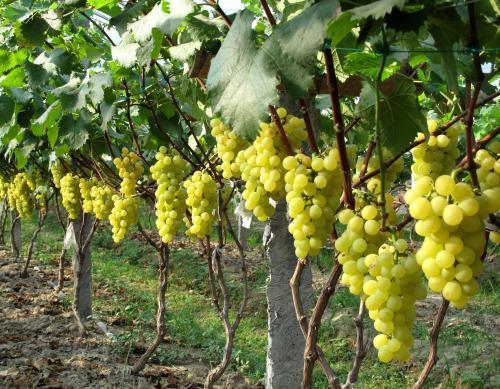
In the Jingning area, Zuijinxiang grape flower buds begin to sprout in early April, blooms in mid-May, berries begin to color in mid-June, and can be harvested and sold on the market in late July. The soluble solids content is 18.7%-21.3%, the fruit growth and development period is about 100 days, and leaf fall begins in early December. The clusters are very large, with an average cluster weight of 803.7g and a maximum of 1836 g, conical in shape, and the clusters are compact. The berries are very large, obovate, with an average single berry weight of 13.23g and a maximum of 19.2g. When fully ripe, the skin is golden yellow, ripening uniformly and uniform in size, with a prominent navel, moderate bloom, and medium-thick skin. The skin separates easily from the flesh, and the flesh separates easily from the seeds. The juice is abundant, with no pulp sac, a strong aroma, and top-grade quality. Organic acid is 0.59%, and the vitamin C content per 100g of fresh fruit is 5.72mg. The budbreak rate is high, budbreak vigor is strong, and shoot development is vigorous. The internodes are short, and the tissues are plump and robust. This variety has a habit of a second crop; improper cultivation and management can easily produce stiff berries and low yield.
Figure 1 Fruiting performance of Zuijinxiang grape in Jingning, Zhejiang
3 Cultivation techniques
3.1 Orchard establishment and planting
Select grade-2 or better seedlings with plump buds, robust growth, well-developed roots, and no pests or diseases for planting. Before planting, dig trenches according to a row spacing of 2.5-3m and apply fertilizer. The trenches are 30-50cm deep and 60-80cm wide. Apply 2000kg of livestock manure or 1000kg of commercial organic fertilizer per 666.7m2, mix in 100kg of phosphate fertilizer and apply it into the trench, then fill with soil and shape it into a steamed-bun-shaped planting ridge. Mark the planting points with phosphate fertilizer, and plant on a sunny or cloudy day. When planting, spread the seedling roots outward, fill with soil, water thoroughly, and cover the entire ridge in strips with 80-100cm wide black plastic film. Also promptly open three ditches: the perimeter ditch, waist ditch, and bed ditch (Figure 2).
Figure 2 Schematic diagram of drainage ditches
3.2 Selection of facilities and trellis type
Use a simple standard steel-pipe multi-span greenhouse: ridge height above 3.5m and shoulder height 2.0m. Single-cross flying-bird trellis: composed of posts, one crossbeam, and 6 wires. Posts: spacing 4m, height 2.4-2.5m, buried 50-60cm in the soil, post cross-section 8x8-10cm; the end posts at both ends must tilt outward about 30° and be secured with anchor stones. Crossbeam: length 150-170cm (row spacing 2.5-3m), installed 20-30cm above the first wire. Wires: the first wire is located 120-140cm on the post; on the crossbeam, one wire is stretched at 35cm from the post and another at 70-80cm, with a total of 4 wires on the trellis surface.
3.3 Training and pruning
Use a single-cross flying-bird trellis inside the rain-shelter greenhouse. In the first year after planting and sprouting, select and retain 1 of the most vigorously growing new shoots as the trunk, and remove the other buds. When the new shoot grows to 20cm, insert a bamboo pole vertically and tie the new shoot to the bamboo pole. When the new shoot grows to 120-130cm, pinch the tip. After lateral shoots sprout, retain 2 at the top to form two arm canes and train them into fruiting mother branches. Along both sides of the arm canes, arrange lateral canes at 45°-60°, growing toward the first wire on the trellis surface, and press them flat onto the second wire, with lateral cane spacing of 20cm. During winter pruning, shorten the arm canes by leaving 5-6 buds, and prune off all lateral shoots. From 20-30 days before spring budbreak, apply a 5-7 times diluted calcium cyanamide extract or dormancy-breaking agent to the fruiting mother branches to break dormancy; do not apply to the 2 buds at the cut. When new shoots grow to 3-4cm, remove excess buds in batches; after flower clusters appear or after 5 leaves and 1 heart, gradually remove excess shoots. When new shoots grow to about 40cm, tie them to the wires at equal spacing of 18-20cm. When new shoots grow to 7 leaves and 1 heart, pinch the tip, remove lateral shoots, and retain 1 terminal lateral shoot; when it reaches the beginning of flowering, leave 3-5 leaves and pinch the tip to protect the fruit, remove secondary lateral shoots, and retain 4-5 leaves on the terminal lateral shoot before pinching again. To promote ripening, remove old leaves at the base during the hard-pit stage. Remove tendrils promptly. Prune from 1 month after natural leaf fall until January of the following year.
Cluster management. Zuijinxiang clusters are relatively loose and show uneven berry size. Timely flower thinning, fruit thinning, and cluster shaping are key to ensuring quality. Generally, retain one cluster per fruiting shoot, and do not retain fruit clusters on weak shoots. From 3-5 days before flowering, pinch off the cluster tip and remove lateral shoots. For clusters treated for seedlessness, retain 4-7cm of the cluster tip. When thinning fruit, remove berries that are small, deformed, have thin and weak stalks, or grow inward. Shape into a cylindrical form and retain 70-80 berries per cluster.
3.4 Fertilizer and water management
Zuijinxiang has vigorous vegetative growth and relatively weak reproductive growth. In normal management, fertilizer and water management should be strengthened to promote cane maturity and increase fruit set rate. Apply 1000-2000kg of organic fertilizer and 60-80kg of nitrogen, phosphorus, and potassium compound fertilizer per 666.7m2. Fertilization should follow the principle of applying thin fertilizer frequently. Apply ternary compound fertilizer once 10-15 days before budbreak to promote budding, topdress once with ternary compound fertilizer after budbreak and before flowering, topdress once with ternary compound fertilizer after fruit set as a fruit-sizing fertilizer, topdress once with potassium and calcium fertilizer before berry coloring, and after fruit harvest, before leaf fall and hilling soil for winter protection, topdress once with a mixture of potassium fertilizer and organic fertilizer, and appropriately apply some boron, zinc, magnesium, and calcium micronutrients to restore tree vigor and promote flower bud differentiation.
3.5 Pest and disease control
At the grape bud woolly-bud stage, spray the ground, grape trellis, and buds with a eradicant of 3-5°Be lime sulfur, which has a special effect on controlling anthracnose and also kills overwintering eggs. At the leaf expansion stage (2 leaves and 1 heart stage), use bifenthrin to control green plant bug. At the 8-10 leaf stage, focus on controlling rachis blight, using 70% thiophanate-methyl or 800-fold meiningling solution, etc. Before and after flowering, focus on controlling gray mold, rachis blight, white rot, powdery mildew, grape clearwing moth, and grape tiger longhorn beetle. From before flowering to early flowering, spray 800-fold nongliling or 600-fold 50% procymidone plus 1000-fold borax solution; after flowering (at fruit drop stage), spray 1000-fold shijiale plus 500-fold monopotassium phosphate plus 3000-fold 20% fenvalerate emulsion. After fruit set and before bagging, focus on controlling white rot, while also controlling powdery mildew, anthracnose, downy mildew, and other pests and diseases, and treat the fruit clusters with baobei plus imazalil plus difenoconazole. After bagging, use copper preparations to control leaf diseases. From after fruit harvest to before leaf fall (early to mid-September), focus on controlling hornworms, leafhoppers, downy mildew, and other problems. Use 400-fold bibei solution to prevent downy mildew, and 3000-fold 10% jianmie emulsion to kill insects.