How to renovate and upgrade old apple-pear orchards? Technical details
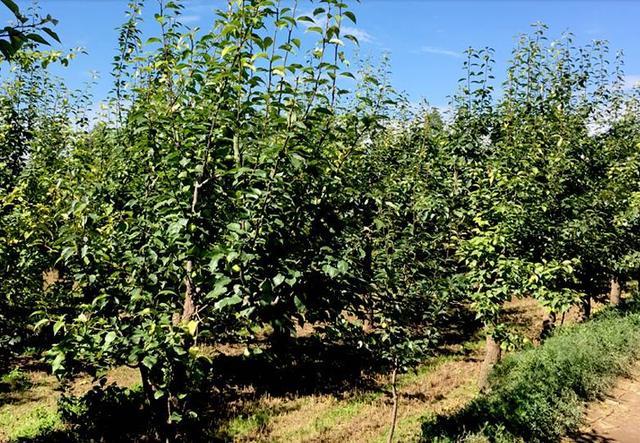
How to renovate and upgrade old apple-pear orchards? Renovation and upgrading technology for old apple-pear orchards
Fund projects:Jilin Province Science and Technology Innovation and Entrepreneurship Project for Returned Overseas Students (2013), Special Project for the Construction of the Modern Agricultural Industry Technology System (CARS-29).
1 Thinning
In orchards at full bearing stage established in the 1990s, the planting spacing was 2.5 m x 6-7 m. In orchards that have not been thinned, the trees cross each other severely between plants, so thinning should be carried out gradually. For trees to be thinned, first thin out or cut back the crossing or overlapping branches extending between plants, so that the main branches, lateral branches or fruiting branches extending into the row spaces bear excessive fruit; this can both control tree vigor and allow normal fruiting. This is carried out step by step over 3-4 years until it no longer affects the normal expansion of the canopy of the permanent trees.
2 Tree shape transformation
The original two-tier central leader form is labor-intensive and labor-consuming, and the yield is also low. During transformation, directly remove the second tier and change it to a single-tier open-center form, or when pruning leave a stub of 30-40 cm and train the vigorous shoots that emerge into a central leader of about 2.5 m to change it to an inverted umbrella form; this can effectively solve the problems of canopy shading and poor ventilation and light penetration.
3 Renewal pruning
3.1 Main branch renewal
For main branches affected by canker or weakened in vigor, cut them back to a position with a vigorous branch and vigorous bud on an upward-growing branch, or directly use a vigorous upright shoot sprouting from the base on the back, pull it to about 45 degrees and leave it unpruned, then in the second year carry out moderate heading (leaving about 40 cm) on the extension shoot, thin out competing branches, then spread the angle to about 70 degrees, remove the shoots on the back, and leave other branches unpruned (Figure 1). In the third year, cut the extension shoot leaving about 30 cm, head back at a vigorous outer bud to train a lateral branch, thin out excessively dense branches, and other branches can be trained into fruiting branch groups.
Figure 1 Renewal of scaffold branches
3.2 Lateral branch renewal
Renew lateral branches that have aged with a bare zone longer than 50 cm, or whose vigor has weakened and fruiting sites have decreased due to canker and other reasons. At the base of the lateral branch, retain a strong vigorous one-year-old branch, or a vigorous one-year-old upright or slanting branch 50 cm from the trunk (diameter over 1.3 cm); leave it unpruned or lightly tip it (cutting about 10 cm) and then pull the branch to 45 degrees. In the second year it can be trained into more than 70% medium and short fruiting branches, leaving 2-3 fruits per branch and thinning out the rest. In the third year it can be trained into a well-filled lateral branch over 3 cm thick and about 1.5 m long. From the third year onward the fruit load can be increased year by year, and the angle opens naturally.
3.3 Renewal of branch groups
On both sides of the main and lateral branches, leave one fruiting branch group about every 40 cm, distributed in a staggered manner, and thin out excessively dense one-year-old branches. Retain the one-year-old branches kept for training as fruiting branch groups and leave them unpruned; in the second year flatten the branch groups that have formed flower buds and they begin to bear fruit; for overly long fruiting branch groups, carry out renewal pruning to prevent branch groups from crossing. For thin and weak branch groups, cut them back to an upright plump bud or thin them out; the several branches emerging around the saw cut the following year can be used to train fruiting branches, thinning out upright vigorous shoots and retaining slanting, moderate branches to train as fruiting branch groups (Figure 2). For moderate branch groups, use a combination of heading and leaving unpruned to achieve moderate growth and avoid bare bases.
Figure 2 Fruiting branches sprouting from scaffold branches
4 Arranging pollinizer trees
In most orchards in the Yanbian area, few or no pollinizer trees were planted when the orchards were established, and in some orchards, because pollinizer trees had low economic returns, they were all changed to the main cultivar, relying almost entirely on artificial pollination. However, as labor costs rise and labor shortages become more and more serious, arranging pollinizer trees is essential. To solve this problem, the method of top-grafting pollinizer branches was adopted. The grafting period is early April, top-grafting pollinizer branches onto one-year-old branches in the middle and upper part of the canopy, grafting 3-4 pollinizer branches per tree, with a high survival rate; in the second year they can bloom and play the role of pollinizer trees (Figure 3). The first choice for pollinizer trees is Yanxiang pear, as well as the traditional Chaoxianyangli or Xiehuatian, etc.
Figure 3 Top-grafted pollinizer branches
5 Integrated pest and disease control
The main targets are pear scab and pear psylla, which are seriously damaging in the Yanbian area. Good management during the dormant period and the early stage of occurrence achieved the goal of being economical and effective. Around Qingming, during the peak emergence period of overwintering pear psylla adults, spray 100-200 times diluted machine oil emulsion to effectively reduce the overwintering adult population; at the early bud stage, spray 5 degrees Be lime sulfur mixture to control newly hatched pear psylla nymphs and eggs, and at the same time it also controls the overwintering pear scab conidia at leaf scars and bud bases and serves to clean the orchard. When petals begin to fall, spray spirotetramat and difenoconazole and other pesticides, which can effectively control pear psylla nymphs and the early occurrence of pear scab. At the same time, use hanging mating disruption dispensers for the pear fruit moth to carry out biological control of the pear fruit moth, and afterward carry out related pest and disease control according to climate changes.
6 Fertilization management
Apply base fertilizer in early spring and topdress with chemical fertilizer in mid-July. Carry out balanced fertilization according to the fertilizer rates recommended by the "Pear Tree Balanced Fertilization Expert System" developed by Professor Zhu Liwu of Anhui Agricultural University under the National Pear Industry Technology System: for every 100 kg of fruit produced, apply 0.4-0.6 kg of pure nitrogen, with the ratio of nitrogen : phosphorus : potassium = 2 : 1 : 2, which both reduces the amount of fertilizer and stabilizes tree vigor, achieving the goal of improving quality and efficiency.