What are the key technical measures for organic apples during the full bearing period?
Key technical measures for organic apples during the full bearing period
Organic orchards are currently the highest level of fruit tree production. Organic fruit tree production started relatively early in the world; organic cultivation was already carried out in the UK in 1931, while China is still in the initial stage. Organic apple cultivation helps provide consumers with healthy, nutritious, safe and environmentally friendly fruit; effectively prevents pollution of the production environment; breaks through international trade barriers and promotes the globalization of apple sales. It is the only way to improve the competitiveness of the apple industry, promote sustainable industrial development, and make the apple industry bigger, stronger and better.
According to the production requirements of organic orchards and the actual fruit industry production situation in Jingning, the following key technical links should be well implemented during the full bearing period of Jingning apples:
1 Soil, fertilizer and water management
1.1 Orchard soil management
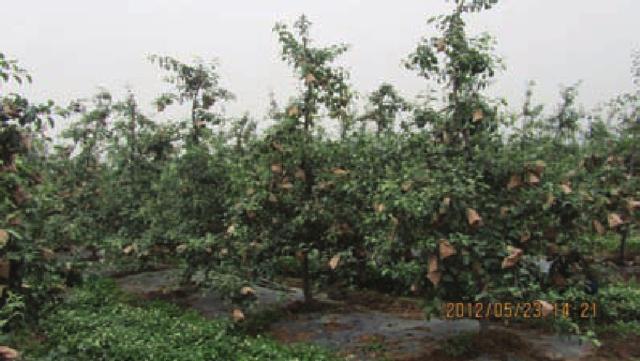
Change the traditional clean cultivation system to a no-till mulching system, and implement inter-row grass growing (Figure 1). Sow red clover, white clover, ryegrass between orchard rows or use natural inter-row grass. Grass can be sown in spring or autumn. In spring, sowing can be done from late March to April when the temperature is stable above 15°C; in autumn, sowing from mid-August to mid-September is suitable. The sowing depth is 0.5-1.5 cm, and the seeding rate is 0.5-1.0 kg per mu. If the weather is dry during spring sowing, appropriately supplement water or cover with a small amount of grass to ensure uniform emergence. In the first year after planting, weeds should be frequently removed during the seedling stage. After the second year, when the grass height reaches 30 cm, mow it leaving 2 cm, and cover the tree base with the cut grass to protect soil structure and the microbial environment, reduce soil erosion, increase soil organic matter content, increase soil aggregate structure, reduce soil bulk density, reduce evaporation, and improve soil water and fertilizer retention capacity. After 4-6 years, combine with autumn base fertilizer application and plow it under in steps for renewal.
Figure 1 Grass cultivation in organic apple production
1.2 Fertilizer management
Fertilization should return to organic fertilizers, and the use of chemical fertilizers must be strictly prohibited. Organic fertilizers that can be used in organic orchard production include: farmyard manure, green manure, biogas residue, biogas slurry, cake fertilizer, barnyard manure, organic straw, compost, and factory organic fertilizer. Farmyard manure must be composted at high temperature before it can be applied to the orchard (Figure 2) [Jishan Huayao]. Unfermented human feces and urine, etc. must not be applied directly to the orchard.
Figure 2 Composting of farmyard manure in organic apple production
Organic fertilizer application time: apply fully decomposed farmyard manure at 3-5 tons/mu in late September; apply enzyme bacteria biological organic fertilizer at 250 kg/mu in late May to increase tree nutrient accumulation, and apply factory organic fertilizer once as a supplement in July. The main fertilization method is trench application. When fertilizing, dig a fertilization trench 25-40 cm deep and 20-30 cm wide around the outer periphery of the canopy. After applying organic fertilizer, mix the fertilizer and soil thoroughly. Dilute biogas slurry with an appropriate amount of clean water and spray it as a topdressing to supplement nutrients, promote growth and fruiting. When farmyard manure is insufficient, factory organic fertilizer can be applied.
1.3 Water management
Jingning County should focus on mulching for moisture conservation, gradually improve measures such as sand and gravel, crop straw, weeds, and black film mulching, and promote supporting water cellar technology in orchards, effectively overcoming drought, especially the adverse effects of spring drought and summer drought, promoting healthy growth of fruit trees, and facilitating high yield, high quality and high efficiency.
Sand mulching cultivation: Sand mulching has the effects of increasing temperature, conserving moisture and reducing water evaporation. Use 20 cubic meters of clean river sand per mu, covering the whole orchard to a thickness of 3-4 cm. After sand mulching, orchard soil water evaporation can be effectively reduced, the utilization rate of natural precipitation can be improved, and robust tree growth can be ensured. At the same time, because sand mulching effectively increases the diurnal temperature difference, it is very conducive to sugar accumulation, and the quality of apples under sand mulching cultivation is very good.
Grass mulching cultivation: Through grass mulching, soil water evaporation can be effectively controlled and the utilization rate of natural precipitation can be maximized. At the same time, after the covering grass decomposes, it can effectively increase soil organic matter content and enhance soil water retention. Generally, corn stalks or wheat straw are used to cover the whole orchard at a thickness of 15-20 cm. After the grass decomposes in 3-4 years, plow it into the soil; the effect is very ideal.
Film mulching cultivation: Plastic film mulching cultivation has the advantages of low investment, low cost and good moisture conservation, especially black plastic film, which has the effect of conserving moisture and suppressing weeds, and is widely used in Jingning. Generally, after fertilizing the soil during the early spring freezing period, cover the whole orchard, which can effectively alleviate the current tight water supply situation.
2 Flower and fruit management
2.1 Adopt comprehensive measures to increase fruit set rate
In recent years, frost, strong winds and blowing sand weather have occurred frequently. In addition, Jingning County has a single cultivated variety, and low fruit set rate has become one of the prominent problems in production. Comprehensive measures should be taken to increase the fruit set rate and lay a foundation for high quality and high yield.
First, an adequate number of pollinizer varieties should be provided. For orchards lacking pollinizer trees, pollinizer trees or pollinizer branches can be added by top grafting to improve pollination capacity.
Second, release bees during the flowering period or raise mason bees in the orchard to promote pollination.
Third, for orchards lacking pollinizer varieties, supplementary pollination can be carried out. Use 10-12 g pollen, 0.3 g sugar, and 5 kg water, spray-pollinate with a sprayer; for small amounts, use a brush, etc. for point pollination.
2.2 Flower and fruit thinning
On the premise of determining the appropriate fruit retention amount, thinning excess flowers and fruits can save tree nutrients, ensure robust trees, and improve fruit quality (Figure 3). In recent years, Jingning County has mainly adopted the one-time fruit thinning and fruit setting method, making full use of medium and short fruit branches and drooping branches to bear fruit, removing diseased and insect-damaged fruits, deformed fruits, and fruits with calyx facing upward, completing this within 20 days after petal fall. For Fuji apples, the fruit spacing is about 25 cm.
2.3 Fruit bagging
Fruit bagging is one of the important measures to improve fruit quality. Bagging starts in mid-June and ends at the end of June. Remove bags 15-20 days before fruit maturity. When bagging, choose lead-free environmentally friendly double-layer paper bags to improve the bagging effect.
2.4 Timely harvesting
Begin harvesting when the fruit coloring degree is above 90% and the soluble solids content is above 12%. Wear gloves during harvesting, harvest from the top of the tree first and then the lower part, from the outer part first and then the inner part, and harvest in stages and batches to improve marketability.
3 Pest and disease prevention and control
According to the production technical requirements for organic fruit, pest and disease prevention and control should adopt new control technologies combining physical and biological methods, and the use of chemical pesticides is strictly prohibited.
3.1 Agricultural control
Through comprehensive measures such as increasing organic fertilizer application, reasonable flower and fruit thinning, optimized pruning, timely irrigation and ground mulching, rejuvenate tree vigor and improve the tree's resistance to pests and diseases.
Through plowing, pests and pathogens overwintering in the soil can be turned to the surface and killed by freezing, drying, or being pecked by natural enemies, and pathogens and pests overwintering in dead branches, fallen leaves and weeds on the surface can be deeply buried underground and suffocated because they cannot emerge normally, reducing the overwintering population.
After leaf fall in winter, prune diseased and insect-damaged shoots, clean up weeds, dead branches and fallen leaves around the orchard, and burn them in a centralized manner to reduce the overwintering population.
3.2 Physical control
During the growing season (April-September), hang frequency-vibration insect-killing lamps, turn them on from 19:00-21:00 each day and turn them off from 5:00-6:00 the next morning to trap and kill noctuid moths and phototactic pests; use fly traps to trap and kill fruit flies; hang yellow sticky insect boards to control flies, aphids and whiteflies and other pests. Yellow sticky insect boards can be made by cutting fiberboard into strips of 100 cm x 20 cm, coating them orange-yellow, then coating them with a layer of sticky oil (mixed with No. 10 machine oil plus a little butter), and hanging them between rows. After they are covered with insects, recoat with oil (recoat once every 7-10 days); hang sugar-vinegar liquid (1 part brown sugar, 2 parts vinegar, 0.4 part white liquor, 0.1 part trichlorfon, 10 parts water) to trap and kill scarab beetles; use bagging to control fruit ring rot and anthracnose; spread an appropriate amount of lime in the orchard in spring to control fruit bitter pit.
Figure 3 Flower thinning in organic apple production
After leaf fall in autumn, before the soil freezes, and before bud break in early spring of the following year, whitewash the tree trunks once each time to eliminate pathogens and pests overwintering on the trunks (whitewash formula: 10 parts quicklime, 2 parts lime sulfur mixture, 1 part table salt, 2 parts clay, 35-40 parts water).
For older trees with loose and rough bark on the trunks, scrape off the brown bark layer during the dormant period until green is visible but white is not, which can greatly reduce the overwintering pest population of pear star caterpillar, apple fruit borer, peach fruit borer, hawthorn red spider mite, etc.
During the growing season, promptly remove tent caterpillar egg masses, break the hard cocoons of yellow stinging caterpillars on trunks and branches, scrape off gypsy moth egg masses on trunks, wipe off scale insect egg sacs and larvae, and prune off powdery mildew diseased shoots.
3.3 Biological control
By growing grass in the orchard, improve the ecological environment, attract, protect, reproduce and utilize natural enemies such as minute pirate bugs, lady beetles, green lacewings, and predatory thrips, so as to achieve pest control by insects and maintain ecological balance; in winter, use measures such as tying grass bundles at the base of trunks or piling grass in the orchard to provide a good habitat for spiders, minute pirate bugs, predatory mites and other natural enemies, increasing the overwintering population; artificially release natural enemies such as Trichogramma, western predatory mites, lady beetles and lacewings to control mites, aphids, peach fruit borer and other pests; use sex attractants to disrupt insect mating information, reduce reproduction, and reduce insect population density. Among them, the attractant traps for Asiatic apple leafminer are placed starting April 1 and end in late October; the traps for peach fruit borer are placed starting May 20 and end in mid-September; the traps for peach fruit borer are placed starting April 15 and end in early September; the traps for apple leaf roller are placed on May 1 and end when fruit harvest is completed. Hang attractant traps on shaded branches of fruit trees at a height of 1.3-1.5 m above the ground, replace once every 15-20 days, generally placing one every 20-25 m. Generally, for orchards with fewer than 40 trees per mu, hang one attractant trap in the middle of the orchard; for orchards with more than 40 trees, hang 2. For paper-box attractant traps, the insect-sticking glue applied inside the trap box can generally last more than 20 days. Start checking the trap box 10 days after hanging, check once every 5 days, and for glue boards covered with insects or where the glue has dried, replace with new glue boards.
3.4 Biological pesticide control
Use Bacillus thuringiensis (Bt) wettable powder (containing 10 billion viable spores/g) and Beauveria bassiana powder (ordinary powder 10 billion spores/g) to control Lepidoptera pests, longhorn beetles, mites, aphids, etc.; use 2% agricultural antibiotic 120 aqueous solution at 200 times, 1% zhongshengmycin at 200-300 times, and 5% sulfur suspension at 200-300 times to control diseases such as Alternaria leaf spot, ring rot and anthracnose. When controlling various diseases, antibiotics such as polyoxin, jinggangmycin and agricultural streptomycin can be used to a limited extent.
3.5 Plant-source pesticide control
Commonly use 5% derris emulsifiable concentrate at 2,000 times, 3% Bacillus thuringiensis emulsifiable concentrate at 50-80 times, 0.65% crown daisy extract insecticide at 450-500 times, 40% nicotine sulfate at 800 times, 0.3% matrine at 200-300 times, etc. to control aphids, mites and other pests and diseases.
3.6 Mineral-source pesticide control
Before apple trees bud break, spray the whole tree with 5 degrees Baumé lime sulfur mixture to eliminate pathogens and pest mites on the tree body and in the orchard. From June to August, spray 200 times double-strength Bordeaux mixture 1-2 times to control early defoliation disease, anthracnose and ring rot fruit rot, etc.
4 Reasonable pruning
For densely closed orchards, use the methods of raising the trunk, lowering the top, and thinning branches for renovation, optimize ventilation and light conditions, control the number of branches per mu at 70,000-80,000, remove large and medium-sized branch groups on the back of main branches, retain oblique, horizontal and drooping fruiting branch groups. The spacing of large fruiting branch groups should be about 50 cm, and the fruiting branch groups should form a curtain-like shape to achieve three-dimensional fruiting.