Detailed Explanation of Key Technical Points for Blueberry Scale Insect Prevention and Control
Blueberry Scale Insect Prevention and Control Techniques
Blueberry, botanically known as Vaccinium, belongs to the genus Vaccinium in the family Ericaceae and is a small berry fruit shrub. Blueberry has the unique effects of preventing cranial nerve aging, enhancing heart function, preventing visual fatigue, and resisting cancer. It is one of the five health fruits recommended by the United Nations Food and Agriculture Organization.
China's research on the introduction and cultivation of blueberries began at the end of the 20th century. The Jiaodong Peninsula has a cool climate, suitable temperatures, and mostly acidic soil, making it very suitable for blueberry cultivation. The Jiaodong Peninsula first introduced and commercially cultivated blueberries starting in 2000, and it is currently China's largest large-scale blueberry planting area. The blueberry types are mainly northern highbush, with main varieties including Bluecrop, Duke, Northland, Darrow, and Elliott. With the expansion of the company's blueberry planting area and the increase in years of cultivation, the problem of pests and diseases has become increasingly prominent. Gao Haixia et al. investigated in 2006 and found that scale insects occurred sporadically, but in recent years the occurrence has shown a worsening trend, becoming severe by 2013. Through effective and reasonable control, obvious control results have been achieved. This article summarizes the occurrence patterns and integrated control of blueberry scale insects, providing technical support for scale insect control in blueberry production.
1 Damage of scale insects to blueberries
Scale insects use nymphs and adults to gather and suck the sap of blueberry leaves and branches. At the same time, their excretions can also induce sooty mold disease (Figure 1) [Jishan Huayao], causing blueberry leaves to be densely covered with black mold, directly affecting photosynthesis, leading to poor blueberry growth and weakening the tree vigor.
Figure 1 Sooty mold disease induced by scale insects
2 Occurrence patterns of scale insects
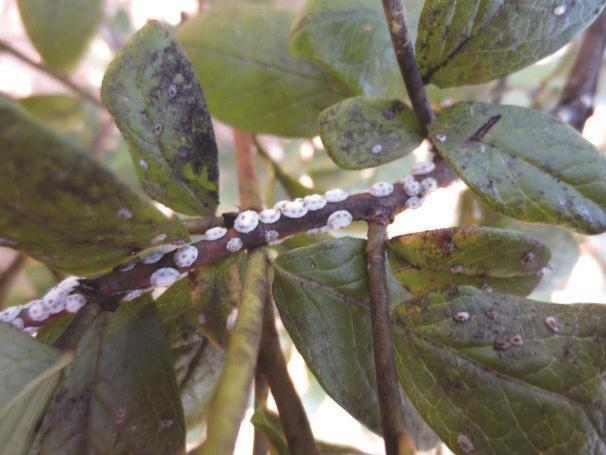
Based on 3 years of production observation, blueberry scale insects in the Shandong Peninsula occur 1 generation per year, overwintering as fertilized female adults on branches. From early July, eggs begin to hatch in large numbers, and newly hatched nymphs begin to densely cover blueberry leaves, damaging the leaves. When the occurrence is severe, there can be as many as 40-50 scale insects per leaf, and the leaf surface is often densely covered with black mold. As the scale insects grow, they slowly move to the branches for sessile life. By mid-August, scale insects mainly move to the branches for fixed damage (Figure 2).
Figure 2 Occurrence patterns of blueberry scale insects
3 Control measures
(1) Reasonable planting, scientific shaping and pruning, reasonable fertilization, maintaining ventilation and light transmission, and making blueberries grow robustly can reduce the degree of damage by scale insects.
(2) In winter and spring, combined with pruning, cut off infested branches to reduce the overwintering population base, and promptly destroy the cut infested branches.
(3) For a small number of scale insects on blueberry branches, they can be brushed off with an iron brush or scraped off with a bamboo piece.
(4) Chemical control. Seize the appropriate control period, which in the Shandong Peninsula is generally from mid-July to early August. During this period, scale insects are at the peak nymph stage, attached to blueberry leaves to feed and cause damage. If scale insects have become sessile on blueberry branches, they have already formed a waxy protective layer at this time, which will greatly reduce the control effect of pesticides. You can use 95% mineral oil emulsifiable concentrate at 200 times dilution, 22.4% spirotetramat at 2,000 times dilution, and emamectin benzoate + dinotefuran at 1,500 times dilution for spray control during the appropriate period.