Detailed Cultivation Techniques for the Extra-Early Ripening Peach 'Xingnonghong 2'
Cultivation Techniques for the Extra-Early Ripening Peach 'Xingnonghong 2'
1 Breeding History
In March 2009, Neihuang County Xingnong Fruit Tree Cultivation Co., Ltd. planted a batch of 'Xingnonghong' peach trees in the warm greenhouses of the Premium Demonstration Orchard of the Neihuang County Fruit Tree Association. In 2010, it was discovered that in Greenhouse No. 77, the fruit borne on one branch growing in the southwest direction of a single plant had mutated. Its ripening period was about 15 days earlier than that of 'Xingnonghong', maturing on April 15. Observations after the fruit ripened showed that it was slightly smaller than 'Xingnonghong' and had the same coloration as 'Xingnonghong'. When weighed, the average single fruit mass was 150 g and the largest fruit was 280 g (Figure 1). In the summer of 2000, scions were taken from this tree (the mother plant is still preserved in its original location) and top-grafted onto 20 open-field-planted 'Xingnonghong' peach trees in the orchard, and 200 nursery stock were grafted and propagated. In the summer of 2011, another 10 mu of nursery stock were grafted and propagated in the same orchard. In 2013 and 2015, open-field demonstration and extension were carried out successively at Xinyuan Landscape Co., Ltd. in Xihua County, Henan Province and Xingwangzhuang Village, Yangshao Township, Qingfeng County, Puyang City, Henan Province, with areas of 75 mu and 90 mu respectively. Under open-field cultivation, it flowers at the end of March and the beginning of April, and the fruit ripens on May 25, about 15 days earlier than 'Xingnonghong'. Generally, under open-field cultivation, the yield per mu in the following year is more than 450 kg. The fruit size is consistent with that under greenhouse cultivation, with an average single fruit mass of 150 g and the largest fruit mass of 280 g, and the genetic traits are stable. This cultivar is an extra-early ripening cultivar, and its productivity is even better than that of 'Xingnonghong'. This cultivar passed the examination and approval of the Henan Provincial Forest Tree Cultivar Approval Committee in March 2017.
2 Main Traits
2.1 Botanical Characteristics
The crown is semi-spreading. The trunk branches low, and the bark is grayish-brown with a slight luster. Perennial branches are gray and smooth on the surface; 1-year-old branches are purplish-red on the sunny side and light green on the shady side, glossy, hairless, with inconspicuous lenticels. Leaves are alternate, clustered on short branches, lanceolate, with a broad cuneate base, finely serrate margins, hairless on both sides, acute apex, 12-16 cm long and 3-4.5 cm wide, with a petiole 1-2 cm long, usually bearing one to several glands. Flowers are usually solitary, opening before the leaves, 2.5-3.5 cm in diameter, with a short pedicel, 5 sepals fused at the base into a short calyx tube, hairless, pedicel 7-12 mm long with glandular dots, 5 petals, obovate, pink, numerous stamens, ovary 1-locular, style slender, stigma small and capitate.
2.2 Fruit Economic Traits
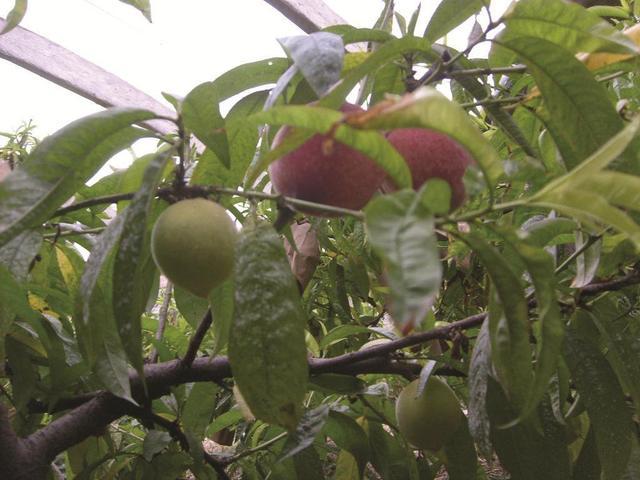
The fruit ripens on May 25, more than 15 days earlier than 'Xingnonghong'. After ripening, the skin is uniformly deep red (Figure 2); bagged fruit is pink, and the appearance is showy. The fruit is round or nearly round, semi-clingstone. According to expert measurements, the average single fruit mass of 'Xingnonghong 2' peach is 168.7 g, the maximum single fruit mass is 248.1 g, the average longitudinal diameter is 72.58 mm, and the transverse diameter is 68.06 mm (Figure 3). The fruit apex is flat or slightly concave, the suture line is obvious, and the two halves are symmetrical; the stalk is short and moderately thick, and the stalk cavity is relatively deep and broad; the fruit surface is fully red, the flesh is white, and when fully ripe there is red pigmentation near the skin; the flesh is fine and crisp, non-melting, with moderate juice and aroma, and the soluble solids content is 9.3%. Semi-clingstone. After ripening, the fruit can remain on the tree for 15-20 days without dropping. The fruit firmness is 8.28 kg/sq cm, and it can be stored at room temperature for 14-15 days.
Figure 1 'Xingnonghong' peach bud sport - 'Xingnonghong 2'
Figure 2 Fruiting of 'Xingnonghong 2'
Figure 3 Ripe fruit of 'Xingnonghong 2'
2.3 Growth and Fruiting Habits
The 'Xingnonghong 2' peach tree is vigorous, with moderately thick branches, strong uprightness, and obvious apical dominance, and strong bud-break and branching ability. After short pruning of 1-year-old branches, the bud-break rate is 86.89%, with an average of 3-5 long branches produced, and new shoots 85-110 cm long. Young trees grow vigorously and have strong natural canopy-expansion ability. Long, medium, and short fruiting branches can all bear fruit. Young trees mainly bear fruit on medium and long fruiting branches, while mature large trees mainly bear fruit on medium and short fruiting branches. It is self-fruitful, flowers easily, has a large amount of pollen, a high fruit-setting rate, light physiological fruit drop, and no pre-harvest fruit drop. Young trees bear fruit early and have strong productivity. A 5-year-old top-grafted 'Xingnonghong 2' peach tree yields 14 kg per plant; with a plant-row spacing of 2 m x 3 m, this is equivalent to a yield of 1,554 kg per mu.
2.4 Phenological Period
In Neihuang, Xihua, and Puyang, 'Xingnonghong 2' peach buds in mid-March, begins flowering on March 28, reaches full bloom on April 4-10 (Figure 4) [Jishan Huayao], and ends flowering on April 12-15. The flowering period is about 7 days earlier than that of ordinary peaches. The fruit begins to color in early May and ripens around May 25 (under solar greenhouse cultivation it ripens around April 15). The fruit development period is 50 days, and leaf fall begins in mid-October.
2.5 Adaptability and Stress Resistance
Multi-site trials show that areas with an annual average temperature of about 13.2°C and rainfall of 500-600 mm are suitable growing areas for 'Xingnonghong 2' peach, where it shows cold resistance, high yield, and disease resistance. 'Xingnonghong 2' peach prefers sandy loam with deep soil, rich organic matter, and good drainage. It can grow normally under neutral soil conditions in plains, hills, and mountainous areas, but grows poorly on poorly drained, wet clay soil.
3 Key Points of Cultivation Techniques
3.1 Site Selection and Orchard Establishment
Choose medium loam to low-clay soil with deep soil layers, good drainage, and a groundwater level no higher than 80 cm during the rainy season to establish the orchard. If establishing the orchard on sandy or clay soil, soil improvement should be carried out before planting, and organic fertilizer should be applied. Because this cultivar is drought-resistant, tolerant of poor soil, relatively salt-alkali tolerant, and fairly cold-resistant, it can be cultivated in plains, hills, and mountainous areas of North China. Generally, the density for open-field cultivation can be (2-3) m x 4 m, and for protected cultivation 1.0 m x 1.5 m.
3.2 Management in the Year of Planting
The density of open-field cultivation is relatively low, so low-growing crops such as peanuts and soybeans can be intercropped in the year of planting. Greenhouse cultivation has a higher density; in order to promote rapid tree formation and early returns, intercropping is generally not carried out. When new shoots grow to about 15 cm, topdressing begins, applying 20-25 kg of urea per mu, and thereafter topdressing once every 15-20 days for 4-5 consecutive applications. After June, when new shoots grow to 40-50 cm, pinching is used to promote branching; for upright-growing branches, branch bending is used to change growth polarity and promote early flower bud formation. After mid-July, when new shoots grow to 70-80 cm, 200-fold paclobutrazol is used to control growth and promote lignification; if growth is too vigorous, spray again after an interval of 15 days.
Figure 4 Flowering of 'Xingnonghong 2' peach
Figure 5 Ripe fruit of 'Xingnonghong 2' peach
Figure 6 Boxed and packaged 'Xingnonghong 2' peaches
3.3 Fertilizer and Water Management
According to the growth characteristics of this cultivar, fertilization is needed 3 times a year: base fertilizer in autumn, applying 3-4 cubic meters of chicken manure per mu; the first topdressing during the fruit expansion period, applying 50 kg of ternary compound fertilizer per mu; the second topdressing during the pit-hardening period, applying 50 kg of high-nitrogen and high-potassium compound fertilizer per mu. Generally, watering is done 5 times a year: after fertilization during the fruit expansion period and the pit-hardening period, water twice each, with an interval of 15 days; after leaf fall in autumn and before the soil freezes, apply the winter freezing water.
3.4 Strict Fruit Thinning and Reasonable Crop Load
'Xingnonghong 2' peach has a high fruit-setting rate, especially after entering full fruiting stage. Strict fruit thinning and reasonable crop load are necessary to achieve the proper fruit size and excellent quality. Fruit thinning should be carried out at the end of April and the beginning of May when large and small fruits can be clearly distinguished. Remove deformed fruit, diseased and insect-damaged fruit, and excess fruit. Leave 1 fruit on short fruiting branches, 2-3 fruits on medium fruiting branches, and 4-5 fruits on long fruiting branches. The yield per mu should be controlled at about 2,500 kg.
3.5 Timely Harvesting
'Xingnonghong 2' peach is a firm-fleshed peach cultivar and does not soften easily, so in production it can be harvested after the fruit is fully ripe. Generally speaking, harvesting when the fruit is crisp and sweet is best (Figures 5 and 6).
3.6 Pest and Disease Control
The main pests and diseases include aphids, red spider mites, peach fruit borers, and gray mold. Control methods: before bud break, use 3-5 degrees Baume lime sulfur mixture to control gray mold, red spider mites, and other pests and diseases; before and after flowering, use imidacloprid to control aphids; during the growing season, use abamectin or abamectin-pyridaben to control red spider mites, and use procymidone or chlorothalonil to control gray mold.