Dioscorea elephantipes is a well-known representative species among succulents
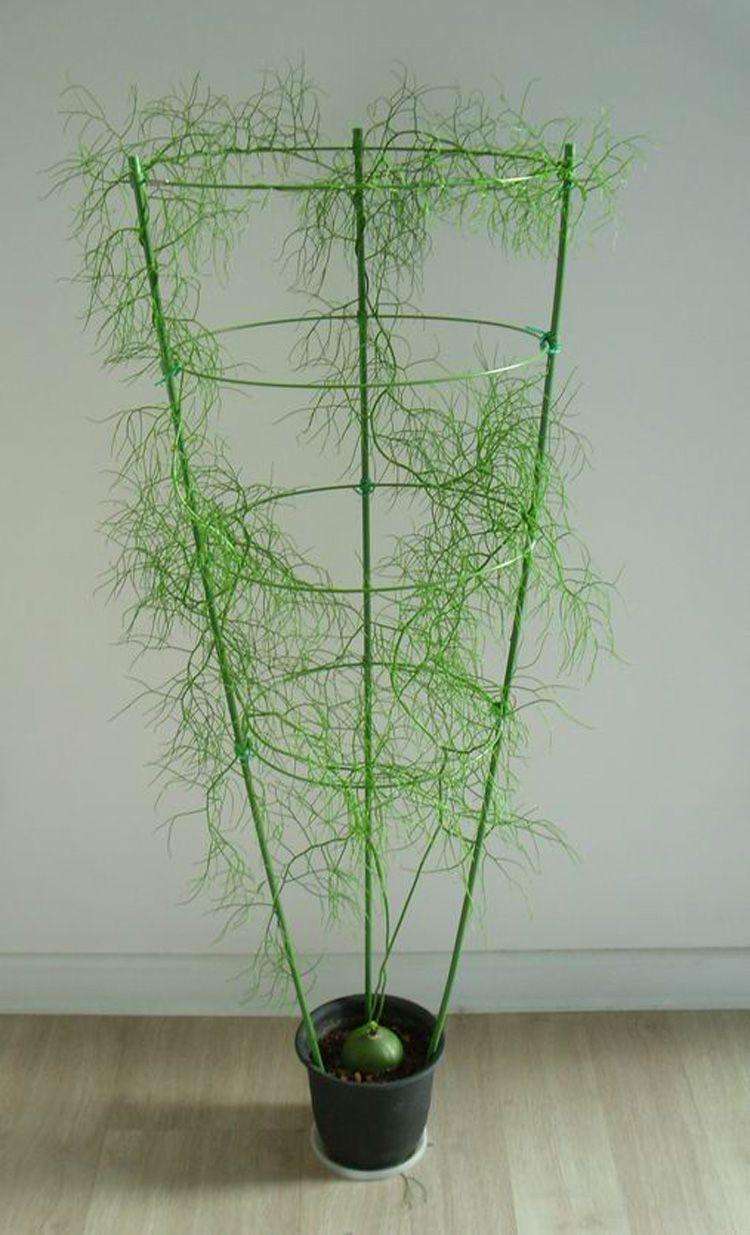
Dioscorea elephantipes originates from the arid regions of southern Africa, and the plant has a large fleshy caudex. The maximum diameter can reach 20-30 cm, and the surface is light green and glossy. It prefers cool conditions, and its cold tolerance and heat tolerance are both somewhat poor. It likes bright light and avoids direct sunlight; Dioscorea sylvatica is summer-dormant, while Dioscorea elephantipes is winter-dormant.
Dioscorea elephantipes
Morphological characteristics:
Dioscorea elephantipes is a perennial fleshy herb. It has a large pale green fleshy caudex, 20-30 cm in diameter.
The top of the caudex is clustered with slender green asparagus-like branches that twine and climb, and the branches bear small green linear leaves; the leaves and branches fall off in the dry season. The flowers are greenish-white, only 0.8 cm large.
The genus Dioscorea contains only 2-3 species, native to South Africa and Tanzania. It has a large fleshy bulb, most of which is exposed above the ground, with a smooth greenish-white surface.
The top of the bulb is clustered with slender green branches, and the leaves degenerate into linear forms and often fall early. The flowers are very small, yellow or greenish-white. A perennial herbaceous succulent native to South Africa and Tanzania, it is characterized by a large green bulb about 5-8 cm in diameter, from the top of which fine vines grow, twining and climbing to heights, resembling messy hair. The leaves degenerate into needle-like scales. The flowering stems branch well, are green, and can grow to 2-3 m, bearing small greenish-white flowers from the tips, about 0.5 cm in diameter, with 6 petals, and 6 visible stamens and 1 white pistil standing in the center; there is another variety whose traits are completely similar to Dioscorea sylvatica, except that its green bulb is about 10-15 cm large, and it is called Dioscorea elephantipes.
Dioscorea elephantipes
Main value:
This species has a peculiar plant shape and is a famous representative species among succulents, as well as one of the most popular representative species of caudiciform succulents internationally at present. It does not demand much light and is very suitable for home cultivation.
The caudex contains medicinal components for treating heart disease.
Dioscorea sylvatica has a peculiar plant shape and is a fairly famous representative species among succulents. Its unusual appearance and robust growth habit, especially its low light requirements, make it quite suitable for growing in a bright indoor spot, and it will bring you a feeling different from ordinary flowers.
Dioscorea elephantipes
Care points:
After flowering, the vines will gradually wither, and at this point it begins to slowly enter dormancy. Gradually reduce watering, and during dormancy do not water at all. The plant can be kept as it is in the pot (when planting, 2/3 of the bulb needs to be exposed above the surface), placed in a cool place. When the growing season arrives and the leaves have grown, begin watering, and some organic fertilizer can be applied appropriately. Water from beside the bulb, and try not to let water accumulate in the center of the bulb to prevent rot; during high summer temperatures, pay attention to ventilation and light, and provide shade if necessary; during low winter temperatures, pay attention to cold protection, and it can be placed indoors to avoid frost damage. When the flower stems appear, be careful not to break them. If the flower stems are cut off, the vines will gradually dry up, and the bulb will split into two and become smaller, but if you want to propagate by dividing the bulb, it is actually feasible; however, for the bulb to swell, it will take several years.
Dioscorea sylvatica can be propagated by seeds. The seeds are somewhat small and do not need to be covered with soil. They can be sown directly in a 3.5-inch pot mixed with Dabutie organic potting soil, keeping it moist. They germinate in about 10-14 days. During the growth period, Hakonechloa horticultural plant special formula can be applied as a top dressing. After about 12-18 months (with the bulb about 1-2 cm large), they can be repotted. After that, pay attention to cultivation and management, giving appropriate light, water, and fertilizer, so that the bulb enlarges year by year.