Which plants have "Du" in their names? Lifting the mysterious veil on plants with the surname Du
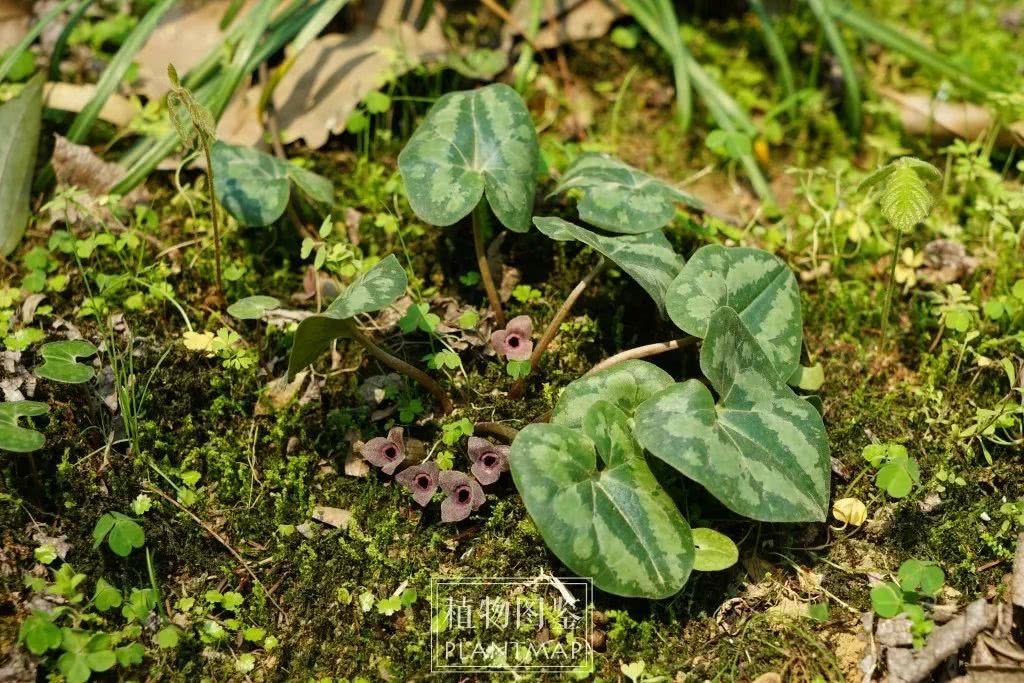
In June, the flowering period of Asarum forbesii is basically over. Its flowers are not particularly attractive, and passersby who do not know it can hardly spot them. In June, the leaves of Asarum forbesii grow quite large, with striking luster and captivating patterns.
[ Asarum forbesii ] Aristolochiaceae >> Asarum
Asarum forbesii is a plant in the Aristolochiaceae family, genus Asarum. Its name "Du Heng" makes it stand out among the many "XX Asarum" species in the genus.
The name "Du Heng" once appeared in the Chu Ci - Nine Songs - Lady of the Xiang: "Angelica roofs the lotus house, wreathed about with Du Heng." It is also recorded in the Classic of Mountains and Seas: "On the Mountain of the Heavenly Emperor there is a plant. Its shape is like a mallow, its scent is like miwu, and it is named Du Heng. It can make horses run; eating it cures goiter."
The Chu Ci writes of fragrant herbs, and the Classic of Mountains and Seas writes of immortal grasses, showing the extraordinary nature of "Du Heng." But Asarum forbesii is neither the most peculiar nor the most beautiful species in the genus Asarum. Why then does it have such a distinctive name?
According to the research of Taiwanese scholar Pan Fujun in "Illustrated Guide to Plants of the Chu Ci," the ancient Du Heng is today's Asarum forbesii. However, according to the research of some mainland Chinese scholars, the Du Heng in the Chu Ci may refer to Pollia japonica.[1] What a muddle. Moreover, who can prove that the ancient Du Heng did not refer to other plants in the genus Asarum? According to research by Cai Shaoqing and others, some traditional Chinese medicine works of the Song Dynasty mistakenly included illustrations of the plant Asarum forbesii as illustrations of Asarum.[2] Perhaps the reason Asarum forbesii has such a unique name is simply that it was lucky...
I do not know why Asarum forbesii has such an outstanding name, nor why it grows such delicate patterns. When the leaves are young, the markings on the leaves look like random ink stains. As the leaves grow, the markings become more regular, spreading along the central axis of the leaf, almost symmetrical.
What use are these patterns? We know that humans have cultivated many variegated plants to satisfy ornamental needs, such as golden-edged Euonymus japonicus and variegated Hosta. But why does wild Asarum forbesii grow this way? Probably no one knows.
Behind the beautiful leaves, Asarum forbesii is actually a low-key wild grass. It grows in the wild, beneath forest trees, among rotting leaves, and is relatively hard to find. I have seen wild Asarum forbesii at Feilai Peak, Lishui, and other places. It has been introduced and cultivated at the Hangzhou Botanical Garden and Xixi Wetland.
Its flowering is also very low-key. Unlike most plants that flaunt their blooms, Asarum forbesii discreetly conceals its flowers, almost down to the soil.
If you visit during the flowering period in March or April, you can see the flowers by lifting up the leaves. The flowers of Asarum forbesii look very much like a salted peanut with its shell removed that has opened into three parts, slightly larger than a peanut kernel, with a dark hole in the center, waiting for pollinating animals to enter.
Overall, Asarum forbesii is a plant rich in mystery. I do not know who "Du Heng" really is, do not know why it grows this way, do not know what is hidden in the opening of its flower, do not know what species pollinates it...
And I do not know whether you will still remember its name next time you see Asarum forbesii in the wild.
[1] Chen Xiuyuan, Hua Qing, Zhang Huiquan. Herbal textual research on Pollia japonica [J]. Journal of Chinese Medicinal Materials, 1988, 4: 44-45.
[2] Cai Shaoqing, Wang Xuan. Herbal textual research on the traditional Chinese medicine Asarum [J]. Journal of Beijing Medical University, 1997, 29(3): 233-235.
Author: Jiang Mouren
Images: Jiang Mouren
This work is licensed under the (CC BY-NC-ND 4.0) license agreement
Please retain the above statement when reproducing