A Journey Through Suzhou's Gardens, Searching for an Ancient Heritage
The moon sets, crows caw, frost fills the sky; riverside maples and fishing fires companion my troubled sleep. Outside the city of Gusu lies Cold Mountain Temple; at midnight, the sound of bells reaches the traveler's boat.
"A Night Mooring by Maple Bridge" - Tang Dynasty, Zhang Ji
Text and photos by Yunzi
In childhood, "Outside the city of Gusu lies Cold Mountain Temple; at midnight, the sound of bells reaches the traveler's boat" was deeply imprinted on my mind. As I grew older, owing to my work, I became even more enchanted by the classical gardens of Suzhou and Suzhou bonsai, which enjoy the reputation of "Jiangnan gardens are the finest under heaven, and Suzhou gardens are the finest in Jiangnan." For this reason, Suzhou has always been a place I longed to visit. Friends around me came and went, but I always had too many reasons that prevented me from going, until today when I finally made a dream-fulfilling journey.
Wandering Through a Painting - The Humble Administrator's Garden's Unique Bamboo-Blind Flower Windows
Cold Mountain Temple in Gusu, like the Tengwang Pavilion in Nanchang, the Yellow Crane Tower in Wuhan, the Yueyang Tower in Hunan, and the Grand View Tower in Kunming, is famous throughout the world because of a single poem, a piece of prose, or a pair of couplets. This is a miracle of traditional Chinese culture. The classical gardens of Suzhou, with a history of more than a thousand years, are even more a model of Eastern civilization's garden-making art. They integrate Chinese classical literature, painting, calligraphy, couplets, and other arts into one, emphasizing cultural connotation, artistic depth, and spatial aesthetic awareness. They are the perfect combination of Chinese literati, painters, and skilled craftsmen. From the magnificent and splendid northern imperial gardens to the small and exquisite Jiangnan gardens, all embody the dreams and pursuits of their creators. The application of the "synesthesia" technique in gardens is the crowning achievement of Chinese classical gardens. This is something that Western traditional gardens and even Japanese gardens cannot match. Among them, the Canglang Pavilion, Lion Grove Garden, Humble Administrator's Garden, and Lingering Garden respectively represent the artistic styles of the Song, Yuan, Ming, and Qing dynasties, and are known as Suzhou's "Four Great Famous Gardens."
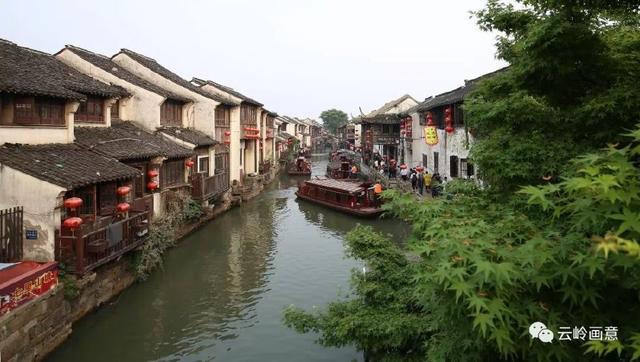
Were it not for the tourists by the water in modern clothing, one might truly suspect they had traveled back in time.
Stepping into these classical gardens that have been passed down for a thousand years, one feels as if transported beyond the world and into a dream. The clamor, roar, and restlessness of the modern city have by now retreated to some unknown place. Strolling along the winding corridors, turning sideways through flower windows and pavilions, with small bridges and flowing water, silk and bamboo music in the ears, and distant green hills - a touch of freehand brushwork, a hint of Zen. This perhaps is the essence of Chinese classical gardens.
But all of this, for modern people surrounded by reinforced concrete, seems to have become an unattainable luxury. Fortunately, the Lion Grove Garden is still here, the Humble Administrator's Garden is still here, the Lingering Garden is still here...
The "Kingdom of Rockeries" - Lion Grove Garden
Influenced by the philosophy of "unity of heaven and humanity," stones in garden landscapes are no longer merely scenic embellishments or decorations; they are endowed with profound meaning and spiritual vitality, carrying the sentiments and spiritual pursuits of literati and poets over thousands of years.
The Lion Grove Garden features the pavilions, terraces, towers, chambers, halls, rooms, verandas, and corridors typical of Suzhou classical gardens, and is even more famous throughout the world for its rockery groups built from Taihu stones, earning it the title "Kingdom of Rockeries."
More than 60 rockery groups are full of charm and ingenuity, delicate and elegant, with winding and deep paths, and peaks that turn with every step. "People say I live in the city, yet I doubt I am among ten thousand mountains" - this is the true feeling of the Lion Grove Garden.
The inscription "Lion Grove" in the Qianlong Emperor's handwriting, rubbed from the ruins of the Old Summer Palace in Beijing
The term "Pointing to the Cypress" originates from the Zen Buddhist allusion "Zhaozhou Points to the Cypress." The "Yifeng and Zhibai Pavilion" also takes its meaning from the Song Dynasty poet Zhu Xi's line "In front, Mount Lu is arranged; one peak stands alone in beauty" and the Ming Dynasty poet Gao Qi's "When asked in the world, one should not answer; smiling, point to the cypress before the courtyard," revealing the literati's affection for mountains, forests, and springs, and highlighting the scenery-viewing characteristics.
Known as the foremost among the peaks of the Lion Grove Garden (photo by Chen Jianxing)
The "Mother of All Gardens Under Heaven" - The Humble Administrator's Garden
The Humble Administrator's Garden is the representative of Jiangnan gardens and the largest classical landscape garden among Suzhou's gardens. It was named "Humble Administrator's Garden" because of the phrase "Building rooms and planting trees... to provide for morning and evening meals... this too is the governance of a humble man." Over more than 500 years, the Humble Administrator's Garden changed owners repeatedly, was once divided into three parts with different names, serving variously as a private garden, an official residence, or a dwelling, until the 1950s when it was finally reunited in its entirety and restored to its original name "Humble Administrator's Garden."
The Humble Administrator's Garden, a classical garden in the style of the Grand View Garden, is known as the "Mother of All Gardens Under Heaven" for its mountain islands, bamboo groves, pine ridges, and winding waters.
The Humble Administrator's Garden Bonsai Garden
As is well known, Suzhou bonsai and Suzhou gardens are inseparable. The long-standing Wu culture and the prolonged influence of Suzhou classical garden-making techniques gave birth to the unique structural forms and artistic style of Suzhou bonsai, which is one of the five major schools of Chinese bonsai art.
The Humble Administrator's Garden Bonsai Garden was first established in 1954. With a long history and numerous fine works, it is one of the earliest specialized bonsai gardens in the country. Like a pearl set in a crown, it adds infinite charm to the Humble Administrator's Garden while also attracting countless dream-seekers to visit.
"One of China's Four Great Famous Gardens" - The Lingering Garden
As one of China's Four Great Famous Gardens, the Lingering Garden is known for its exquisite architectural layout and numerous rare stones. Within a single garden, one can appreciate different scenes of mountains and waters, pastoral fields, mountain forests, and courtyards, combining residence, ancestral hall, family shrine, and garden in one, offering "the pleasure of enjoying mountain forests without leaving the city walls." The "Three Treasures of the Lingering Garden" are even more renowned far and wide.
The Cloud-Capped Peak, One of the Three Treasures of the Lingering Garden
The Cloud-Capped Peak in the Lingering Garden is the finest of Taihu stones, embodying all the qualities of Taihu stones - "lean, wrinkled, porous, and transparent." It is named for its towering top and four spreading sides like a crown, with both form and spirit perfectly united. It is said to be a relic from Emperor Huizong of Song's "Flower and Stone Convoy" and is one of the Three Treasures of the Lingering Garden.
Cloud-Capped Peak
Auspicious Cloud Peak, One of the Famous Three Sister Peaks of the Lingering Garden
Cave Cloud Peak, One of the Famous Three Sister Peaks of the Lingering Garden
The Five Peaks Immortal Hall, One of the Three Treasures of the Lingering Garden
The name "Five Peaks" comes from Li Bai's poem: "Southeast of Mount Lu, the Five Old Men Peaks; on a clear day, they are carved out as golden lotuses." The Five Peaks Immortal Hall uses extremely luxurious building materials - all beams and columns are made of nanmu, and the interior also entirely uses mahogany and ginkgo gauze partition screens.
During the War of Resistance Against Japan, the Five Peaks Immortal Hall became a Japanese military horse stable, and the military horses gnawed the fine nanmu columns beyond recognition. After the victory of the War of Resistance, when repairing the garden, they had to cover the nanmu columns with cement and then paint over them.
The "Sky Clears After Rain" Scene, One of the Three Treasures of the Lingering Garden
Preserved in the Five Peaks Immortal Hall is a natural marble picture screen known as one of the "Three Treasures of the Lingering Garden" - the "Sky Clears After Rain" scene. A marble screen stands by the wall, its surface showing mountains encircling, waterfalls cascading, clouds and mist swirling, and streams flowing gently. At the upper center, a white circular spot resembles exactly a sun or a bright moon.
The "Sky Clears After Rain" marble originated from Cangshan in Dali, Yunnan. It has a diameter of about 1 m and a thickness of only 15 mm. Given the transportation conditions of the time, one truly wonders how such a large marble picture screen was transported to Suzhou from Yunnan, over a thousand li away!
The Lingering Garden Bonsai Garden
The northern part of the Lingering Garden also features a bonsai garden. Strolling through it, one cannot help but think of the planner of the bonsai garden, one of the main representatives of Suzhou bonsai and a master of Chinese bonsai art - Mr. Zhu Zi'an.
In the autumn of 1970, Mr. Zhu Zi'an, then approaching 70, was transferred to the Lingering Garden to take charge of the management and care of the bonsai. In those difficult times, Mr. Zhu Zi'an was not intimidated by the enormous difficulties but used the simple conditions at hand to leave a precious legacy for the Lingering Garden and for posterity. Today's Lingering Garden Bonsai Garden, with more than 500 potted tree-stump bonsai and large landscape bonsai, complements the Humble Administrator's Garden Bonsai Garden beautifully. It has become another specialized bonsai garden representing the level of Suzhou bonsai after the Humble Administrator's Garden.
Cold Mountain Temple Outside the City of Gusu
IV. Cold Mountain Temple
As for Cold Mountain Temple, "I fear being asked about Cold Mountain Temple; the riverside maples rustle in the desolate autumn." Walking out of the temple gate, though somewhat disappointed, I still carried a touch of lingering attachment. In any case, Zhang Ji used the most poetic language to construct a scene of serene seclusion and blended emotion and scenery, adding timeless charm to every bridge and stream, every temple and city of Gusu, attracting dream-seekers from ancient times to the present.
Not far from Cold Mountain Temple is Maple Bridge. Strolling onto the bridge and touching the stone railings, one might say I felt the passage of a thousand years, and my heart could not help but feel much lighter...