When gardenia flowers bloom, what did it first make its name for?
I still remember that year, a song by He Jiong spread across campuses, letting gardenia carry the feelings of so many young men and women in the prime of their youthgraduation seasonfeelings, and even today, when that familiar melody plays, it stirs up the innocent memories of many people.
Gardenia blooms
Gardenia blooms movie original soundtrack
He Jiong
00:00/04:11
In the blink of an eye, fourteen years have passed, and the young men and women who graduated listening to "Gardenia Blooms" have become uncles and aunties. And you may not know,in the Song Dynasty, gardenia also had an unspeakable meaning。
Stirred up youthful memories by the plain and elegant gardenia? That reveals your age. Image: Lazaregagnidze / wiki commons
The cultivation history of gardenia
Gardenia (Gardenia jasminoides) is ashrubplant of the genus Gardenia in the family Rubiaceae, and this genus is mainly distributed in the tropics.The "Garden" in the genus namedoes not mean it is suitable for planting in gardens, but commemorates the Scottish scientist Alexander Garden;the specific epithetcomes from the genus Jasminum, to which jasmine belongs. In the 18th century, gardenia was first introduced to Europe, and people thought this child was aswhite and fragrant ⟧21⟧as jasmine flowers, so they gave it this name, and it also has an English name, Cape Jasmine., so it was given this name, and it also has an English name, Cape Jasmine.
The single-flowered gardenia cultivar 'Daisy'. Image: platycryptus / flickr
China is one of the places of origin of gardenia,and in the mountains and wilds of South China, gardenia flowers are extremely common. At this time every year, as long as you find a decent mountain, you can see gardenia flowers giving off a rich, clear fragrance. The hills of South China in early summer are not as colorful as the plateaus of the Southwest, and the large white flowers of gardenia are especially eye-catching amid the lush greenery.
A clump of gardenia in the mountains. Image: Alpsdake / wiki commons
Such conspicuous flowers and fragrance would naturally not be missed by people. Inthe Southern Song Dynastygardenia was already used as bonsai and cut flowers. Many painters of the Five Dynasties, Song, and Yuan periods (such as Xu Xi and Qian Xuan) painted gardenia flowers, and in Emperor Huizong of Song's flower-and-bird scroll there also appears a scene of an azure-winged magpie standing on a gardenia branch.
Today, compared with the primitive single-flowered gardenia in the mountains,the white gardenia-- this double-flowered variety is cultivated more commonly.
Today's important cultivated variety, the double-flowered white gardenia. Image: Kai Yan, Joseph Wong / flickr
In courtyards, the white gardenia sometimes looks very similar to the double-flowered dog's fang flower, but distinguishing the two is not difficult: as a plant in the family Rubiaceae, the white gardeniahas very distinctive stipules, which the dog's fang flower of the family Apocynaceae does not have.
Gardenia has stipules growing within the leaf stalk. Image: Esme / esmelivingcolour.com
However, gardenia first made its name not by such lovely large white flowers, but by its fruit.Gardenia, gardenia, the emphasis is on "zi"。
The gardenia "zi" for dyeing cloth and dyeing food
The berry of gardenia is oval, orange-yellow when mature, with 5-8 slender calyx lobes remaining at the top, extending all the way down and forming on the fruitraised longitudinal ridges。
The fruit of gardenia. Image: Alpsdake / wiki commons
Li Shizhen wrote in Compendium of Materia Medica: "Zhi [zhī], a wine vessel; the zhi fruit resembles it, hence the name; today the popular form adds the wood radical to make zhi."He believed the gardenia fruit resembles the ancient wine cup "zhi", so it was named this way. To be honest, this explanation is rather far-fetched; the shape of the zhi is quite different from the gardenia fruit. If one must compare it to a wine vessel, I think an invertedzun[zūn] fits better; the several long legs of the zun and the persistent calyx are somewhat alike.
Side view of a gardenia flower; note the calyx. Image: Alpsdake / wiki commons
So why is the gardenia fruit so eye-catching? Because since ancient times it has been used asa dye。
The Han Dynasty text Han Guan Yi records: "The dye garden produces zhi and qian, used to dye imperial garments," and the Records of the Grand Historian: Biographies of Money-makers also records: "A thousand mu of zhi and qian, a thousand plots of ginger and leeks: such a person is equal to a marquis of a thousand households." "Qian" is madder, which can provide red dye, already discussed in this year's February species calendar; whilegardenia can provide yellow, so gardenia also has the alias "yellow gardenia."
The dyeing effect of gardenia fruit. Image: Sisyphus's Stone
The yellow of gardenia comes fromgardenia yellow pigmentin the fruit, also called crocin. That's right, if you have read the species calendar's introduction to saffron, you will know that this pigment also exists in the styles of flowers in the genus Crocus of the family Iridaceae.
Dried styles of saffron, containing crocin just like gardenia fruit. Image: Rainer Zenz / wiki commons
Crocin is a water-solublecarotenoid, and simply crushing gardenia fruit and boiling it in water yields an orange-yellow dye liquid. After adding a mordant such as alum or sodium carbonate, then soaking cloth or paper in it, the latter can be dyed a bright yellow. You can buy gardenia fruit from a Chinese pharmacy, and if interested, you can easily DIY this process.
Dried gardenia fruit; you can buy some and try dyeing cloth yourself. Image: Maangchi
Besides dyeing clothing, gardenia yellow can also be used asa food coloring. In the Chaoshan region of Guangdong, there is a type of small snack made from glutinous rice and eaten during the Dragon Boat Festival, called gardenia zongzi or gardenia guo; in making it, gardenia dye liquid and edible alkali are added to dye the glutinous rice yellow (in fact, adding only alkaline water can also cook the glutinous rice yellow).
Gardenia zongzi, cut into thin slices and eaten dipped in granulated sugar. Image: Little Five Kitchen
Gardenia in poetry is not necessarily pure
During the Song Dynasty, people made a kind ofgardenia lanternimitating the shape and color of the gardenia fruit, placed at the entrance of taverns,and many of them can be found in Along the River During the Qingming Festival. The Southern Song poet Dong Sigao described it: "Wind and frost make fruit, late on the autumn plain, handed down as a pattern for splendid lanterns," and the contemporary Meng Liang Lu: Wine Shops also describes in detail the scene of gardenia lanterns placed in front of taverns, showing that they were very popular at the time.
A detail of Along the River During the Qingming Festival; the red circles in the image indicate gardenia lanterns.
Let us enlarge the picture a bit more. Doesn't it look very much like the shape of a gardenia fruit?
Somewhat awkwardly, the red gardenia lantern may make people associate it with the modern term "red-light district," and at the time it did indeed carry this implication. However, according to records,only when the gardenia lantern at the entrance of a tavern was covered year-round with a bamboo leaf cover did it have that meaning everyone understood. The Southern Song text Du Cheng Ji Sheng records: "An hermitage tavern means there are prostitutes inside, where one can enjoy pleasure, and a bed is hidden in the back room of the wine chamber. On the red gardenia lantern at the entrance, regardless of sunshine or rain, a bamboo leaf cover must be used as a mark of identification. In other large taverns, prostitutes only sit as companions."
The Southern Song man Lin Yong also wrote,"If you seek the Secretary Du of those years, several gardenia lanterns at the Zhuxi Tower", hinting that Du Mu often frequented pleasure quarters. However, this poem is not rigorous enough; after all, in the Tang Dynasty there was not yet a gardenia lantern with such meaning.
Gardenia: "We are clearly very innocent." Image: omcseeds.com
Today gardenia no longer has this meaning, and its connection with Chinese culture continues on. Its quiet floral fragrance carries people'sfaint youth and pure love. Youth may never return, but gardenia flowers will still bloom on time every year on every mountain in the south.
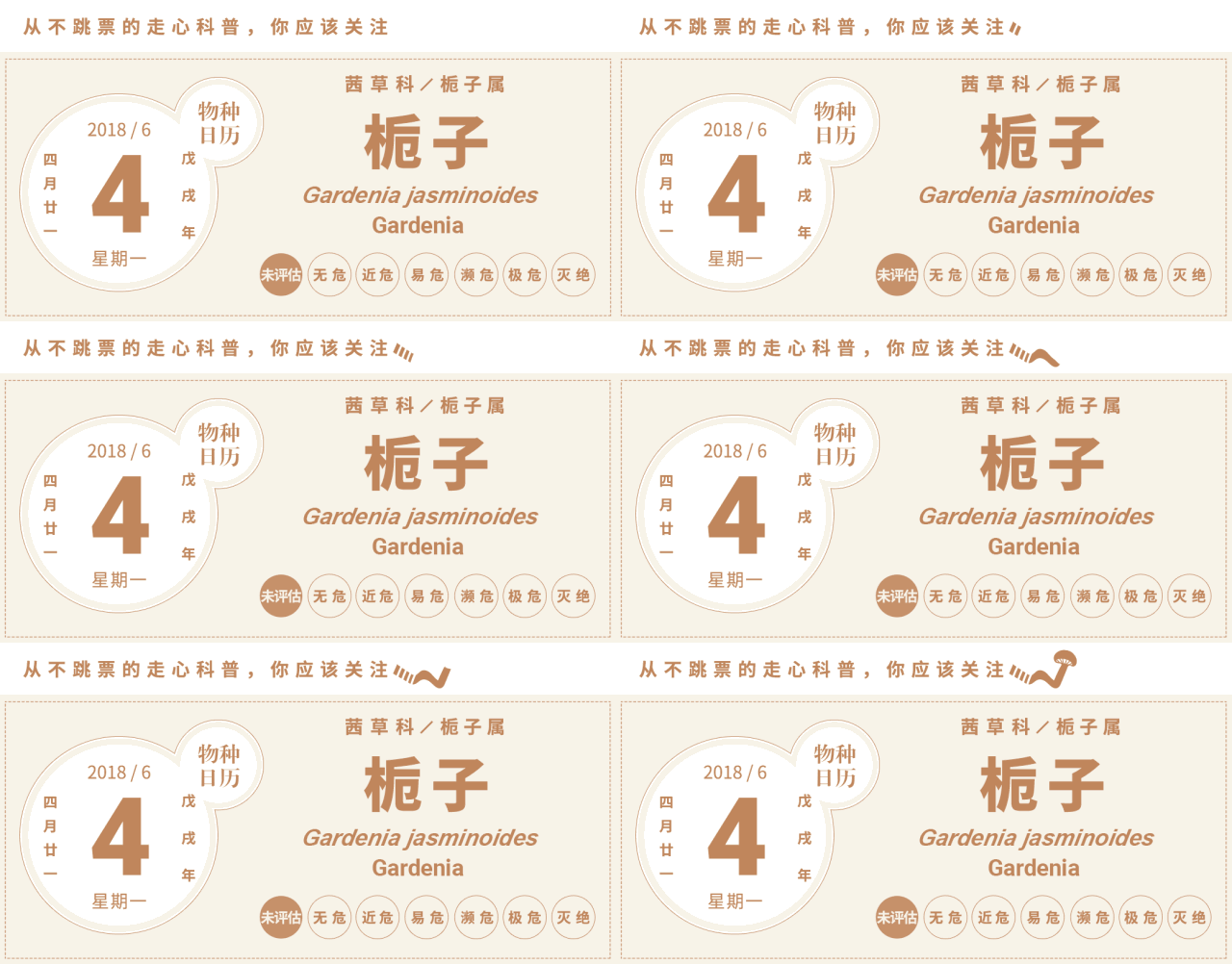
This article is the 155th article of the 4th year of the species calendar, from species calendar author @Hanxiao.
You who love flowers must not miss it
The calendar lady's avatar today
Rubiaceae, Ding Qian