You can grow a vegetable garden even in small urban spaces - check out this gardener's one-meter garden
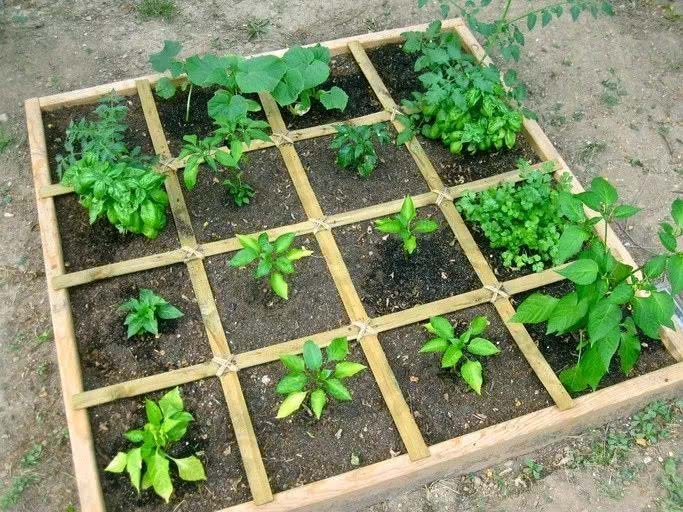
Below we'll show you how to grow a small vegetable garden in a small space. These garden ideas are quite unusual, somewhat like raised beds - small grid-style vegetable gardens built with frames, which people call one-meter gardens.
These small gardens are usually made from bottomless wooden boxes, generally a bit over one meter in length and width. Inside the wooden box there are nine squares, and by putting suitable soil in the squares you can grow all kinds of different vegetables.
The main idea behind the one-meter garden is to adapt to the small spaces of the city - you can grow a small vegetable garden on a terrace, in a yard, or even on a small balcony. The growing medium is a prepared fertile soil mix, which makes it very easy to control weeds, pests and diseases, and caring for the vegetables isn't too difficult either.
This raised-bed idea is especially suited to city dwellers who love growing vegetables but don't have much space. This kind of small garden doesn't demand much ground area, and since you use your own soil mix - you can just buy some potting soil, which saves effort - you can also eat organic vegetables you grew yourself. Using a lighter soil mix, you can grow them even on a balcony.
This garden idea is really just a converted raised bed, only divided into small squares, each about 30-plus cm, though of course the spacing depends on the size of the bed.
This kind of one-meter garden is generally a bit over one meter in length and width, so each square is roughly 30-plus cm long, which is fine for growing vegetables with a short growing period and a less vigorous root system.
The growing medium is best a loose, fertile potting soil with good drainage that isn't too heavy. I suggest using peat moss mixed with compost and perlite - peat moss has some water-retention capacity, compost can supply the soil with plenty of nutrients, and the added perlite keeps the soil draining well.
The granular stone in the picture above is vermiculite
You can also use vermiculite for this kind of one-meter garden. Vermiculite isn't soil but a volcanic rock, used as a top-dressing stone; it can prevent fungal diseases and various pests and also maintain good drainage, though it's fairly expensive, so using too much of it isn't economical.
Vermiculite is slightly yellowish in color and very light in weight - much lighter than ordinary soil. It's actually ore that has been treated at high temperature, containing a great many minerals, such as the common iron oxide, lithium oxide or magnesium oxide. After expanding at over 1,000 degrees of high temperature, its volume becomes fairly large but its weight very light. It can usually be used to replace perlite, and looks somewhat similar to perlite, but it can withstand intense sun exposure, whereas perlite tends to deteriorate after being exposed to the sun.
Vermiculite is often used for sowing and raising seedlings, and also for cuttings propagation. It's called "the soil without soil" and is the most common growing medium; it can prevent mold infection and various fungal diseases. When sowing, simply mixing vermiculite with a suitable amount of peat moss ensures a very good rooting rate.
Next, prepare some compost to make sure the soil has plenty of nutrients. Compost makes up about 1/2 of the potting soil; add 1/4 peat moss and 1/4 vermiculite, and it becomes an excellent potting soil for growing vegetables. Peat moss is very cheap and very loose and airy; it has some water-retention capacity, can prevent the soil from clumping, and holds moisture.
If you use these three media mixed together to grow vegetables, your vegetable yields will be better. If you just grow them in ordinary native soil, it's hard to guarantee the yield. Vegetables grown in these small squares aren't very secretive, grow easily, and the soil is also easy to replace, making everyday care easier too.
The soil in this kind of one-meter garden is all your own mix, so there will be very few weeds, which also reduces the chance of mold developing. The soil drains well, which also prevents root rot.
But this kind of small garden has its drawbacks too: making this raised bed requires wooden boards, meaning you have to cut some wood yourself, or use concrete blocks or bricks instead.
This kind of raised bed has to be divided into many small squares, and each square can only hold one vegetable, such as the common tomato, corn, cauliflower and some melons. Taller, larger vegetables aren't really suitable; growing small vegetables like lettuce, cilantro and basil is very suitable.
The depth of this kind of raised bed is also limited, so vegetables with deeper roots aren't very suitable either. Many people make this kind of raised bed with a perforated bottom, and you can also increase the depth of the bed.
To grow vegetables well, you must have a suitable environment. Besides ensuring plenty of sunlight and good ventilation, you also need to pay attention to regular watering - summer especially is the peak growing season, when you need to water morning and evening to avoid the soil becoming too dry, otherwise it will affect vegetable growth. During the growing period, give a liquid feed once every one or two weeks.