Techniques for Making a Malus micromalus Bonsai, with Auspicious Meaning and Rich Connotations
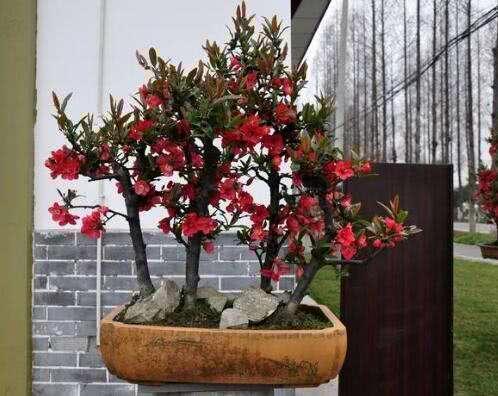
The crabapple is a relatively precious ornamental bonsai. What we are going to discuss today is the finest of the crabapples, Malus micromalus. To understand the Malus micromalus bonsai, you first need to learn how to make and care for it, and then gain a deeper understanding of its culture.
To make a Malus micromalus bonsai, we need to start with pot selection, soil and shaping. Because Malus micromalus grows relatively fast, we should not choose a pot that is too small or too shallow, otherwise its growth will be restricted after a period of time. The color of the pot can be matched to the flower color of the crabapple. As for the soil, Malus micromalus is not very demanding; of course, when conditions allow, providing it with soil that drains better and is looser and more fertile would be ideal. Its shape does not have to be confined to a single form either; multiple forms can be combined.
Having covered its making, let us now talk about the care of Malus micromalus. First, let us discuss the requirements for water and fertilizer management. In fact, its demands for water and fertilizer are not high, but that does not mean it can be ignored; when watering, it still needs to be watered on schedule. However, do not give too much water and cause waterlogging; by summer, the amount of watering can be appropriately increased. As for fertilizing it, a little more can be appropriate, since it rather likes fertilizer, and this helps speed up its growth.
When it comes to placing Malus micromalus, note that it is relatively cold-tolerant but not tolerant of strong sun. So it can be placed in a sunny, ventilated spot, but by summer you need to do a good job of sun protection and move it to a shaded place for shade, so that it does not get sunburned.
Besides its ornamental value as a crabapple tree, Malus micromalus also has edible value and health benefits. Its fruit tastes a bit like hawthorn, and we can usually eat it as candied fruit or a snack to pass the time. In terms of health benefits, it also has the effects of clearing heat and disinfecting, and strengthening the stomach and aiding digestion.
Finally, let us talk about the culture surrounding Malus micromalus. The crabapple has always been a famous flower praised and chanted by literati and refined scholars, and its flower language represents secret love. Malus micromalus is one of the four varieties of crabapple. The other three are the Chaenomeles crabapple, the hall crabapple, and the twisted-stalk crabapple. Where does the charm of Malus micromalus lie? Su Dongpo was captivated by it, Bing Xin used it to express life, Premier Zhou's wife used it to remember Premier Zhou, and Liang Qiushi recorded it in his diary. It has also become the city flower of Baoji.
That is all for our introduction to Malus micromalus today. As for its making and care, some friends can refer to this themselves when tending to Malus micromalus. Its value and culture help us better understand Malus micromalus. If you have your own views on Malus micromalus, you are also welcome to share them with us.