Fertilize succulents with this kind of fertilizer, and they will grow more and more vigorously with new shoots sprouting nonstop
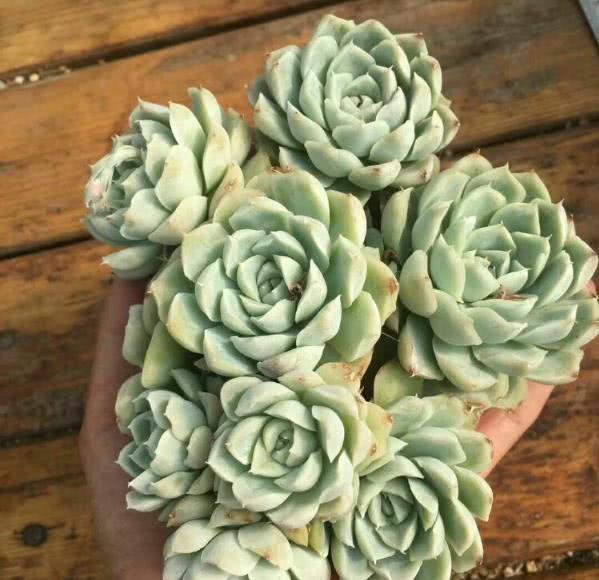
Succulents originally grow in places where the soil is very poor, all small stones, sand and the like, containing almost no fertility. For ordinary home growing, the more particular growers use akadama and kanuma. The more budget-minded use large coal cinders, clivia soil, and garden soil mixed with perlite. The trace elements in these are enough for their growth. If they are growing well and the pot size is suitable, generally repotting about once a year and changing the soil is enough. If you really want to fertilize, then it must be a slow-release fertilizer.
When growing succulents under home conditions, you need to bury some slow-acting flower fertilizer or organic fertilizer at the bottom of the pot, plus regular repotting and soil changing, so that no additional fertilizer supplement is needed. If it never occurs to you to give them a base fertilizer, and you are too lazy to change the soil, then are you still not going to give them an extra fertilizer supplement? Normally, use a little controlled-release granular fertilizer too, because I also know that most Sedum succulents do not need much fertilizer.
If you want your succulents to grow fast and grow big, first you also have to confirm that this variety grows fast and grows big; then you can consider fertilizing. You can consider some organic fertilizers, such as worm castings, cow manure, etc., and inorganic fertilizers leaning toward phosphorus and potassium, such as monopotassium phosphate, especially around the flowering period. To just meet basic needs, you can also use some slow-release fertilizer. Also pay attention to the fertilizing season; generally spring and autumn are suitable, and now that the Start of Summer has already passed, it is not suitable, and fertilizer should be given less rather than more.
Succulents at the seedling stage can be given a little urea or a general nitrogen-phosphorus-potassium compound fertilizer, that kind of nitrogen fertilizer, in order to increase the growth rate. But mature succulents should use nitrogen fertilizer cautiously, because nitrogen fertilizer will promote leggy growth in plants. Phosphorus fertilizer is very important and should be placed first among the macronutrients. When fertilizing, if it is a nutrient solution, the amount should also be small; if spraying water, do not spray it on the leaves, just pour it directly onto the soil. Moreover, when using fertilizer, try to make it fine and mix it into the succulent's potting soil, and do not damage the roots.
The phosphorus element mainly relates to flowers and fruits. So appropriately supplementing phosphorus fertilizer can promote flower bud differentiation and fruit development in plants. If the succulents are going to bloom, you can appropriately increase the phosphorus element to promote the opening of succulent flowers. The potassium element mainly relates to root and stem tissues, so appropriately supplementing potassium fertilizer can make plant stems thick and strong, the root system well developed, increase lodging resistance, and increase the ability to resist external invasion. If you want succulents to take root more firmly, you can appropriately supplement the potassium element.
It is best to choose the succulent's growth period and flowering period to do this. Choose a sunny morning or evening and do it together with watering, once every ten days, to provide nutrients for succulents that are growing or flowering. As for the amount of fertilizer, many succulent lovers cannot control it well, so how much fertilizer is appropriate? Here is one point: when fertilizing, it is better to give less than more, and better to give dilute than concentrated. Less and more dilute is fine, and you can fertilize several more times. But be sure not to apply too much at once, as it easily causes fertilizer burn.
This is a gathering place for succulent lovers, sharing succulent care tips; you are welcome to follow and exchange ideas.