From a distance, Obregonia denegrii looks like a cluster of worms, with a very peculiar form.
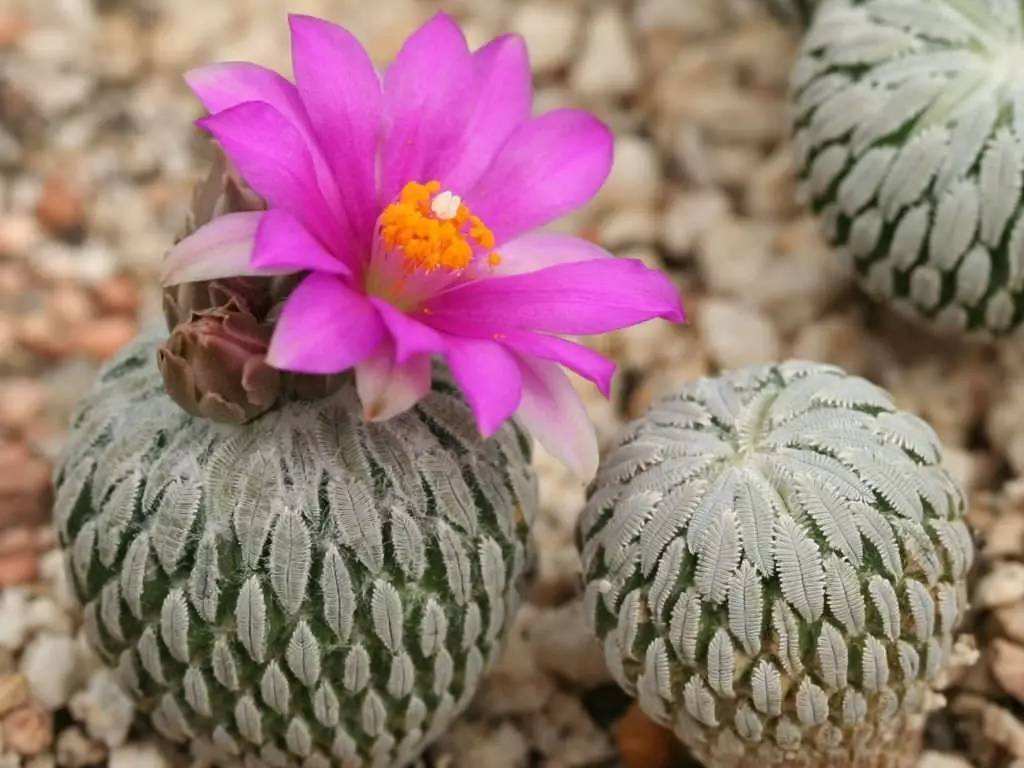
Obregonia denegrii is a very small spherical species, growing in a club-shaped or spherical form. The tubercle is 3cm~~6cm, and the height is 4cm~~10cm. The body is relatively hard, produced when young, and mature old plants often grow in clusters. On the axe-shaped protruding tubercles on the body are fine small white spines, arranged in a comb-like pattern. Small purplish-red flowers are born at the top of the body, with a flower diameter of 3cm, opening from late spring to early autumn.
Obregonia denegrii
Morphological characteristics:
Obregonia denegrii usually grows beneath thickets. Its CITES protection level is 1. Its appearance is dark green, spherical or club-shaped. The growing point of mature plants has clustered white hairs, and old plants tend to produce offsets and form multi-headed clusters. Seed-grown plants have tuberous roots. It has no traditional spines, but rather comb-like arranged spines. The tubercles protrude into narrow, elongated club shapes, and the areoles of mature plants grow a few white hairs at the front. The flower color is pink to peach-red, and the flowering season is usually spring to autumn. However, it needs a period of continuous strong light before it may bloom.
Obregonia denegrii
Propagation methods:
Obregonia denegrii is relatively easy to cultivate, but it grows slowly, so grafting can be used to increase its growth rate. Obregonia denegrii likes well-drained, sunny environments (it needs sufficient light, and watering should be controlled to keep the plant compact and not overly stretched). It is native to beneath thickets, so it fears exposure to the sun and is also suitably shade-tolerant. In summer, shade, ventilate, and dissipate heat. In winter, place it indoors, control water, and improve its cold resistance. Obregonia denegrii seedlings grow relatively slowly and are also rather slender; after growing up, the top body continuously expands, so mature plants often appear club-shaped.
It can be propagated by sowing, and the sowing temperature must be above 30°C. From sowing to growing up takes 5-7 years, and watering must be done very carefully. It can also be propagated by cuttings of side shoots, and before cuttings, make sure the wound has completely healed.
Obregonia denegrii