Many varieties of Conophytum bilobum, let us introduce you to this succulent plant
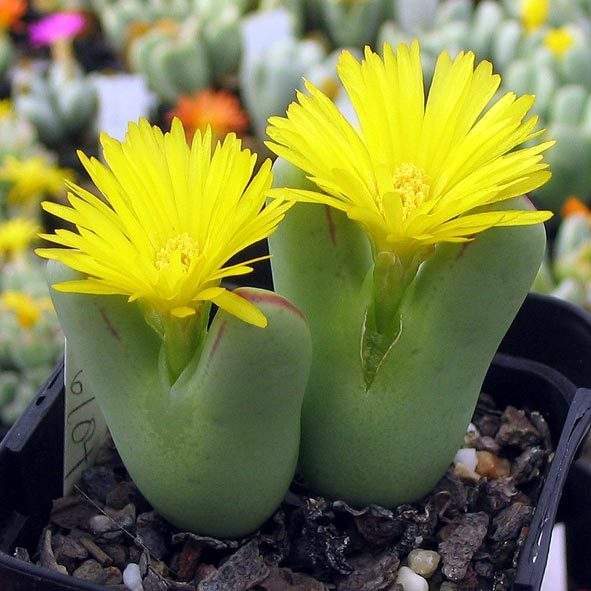
Conophytum bilobum is a succulent plant of the genus Conophytum in the family Aizoaceae, native to South Africa and Namibia. In Latin, bilobum means "two-lobed ears," which fits the morphology of Conophytum bilobum very well. Conophytum bilobum is very fleshy, with flat heart-shaped opposite leaves 3-4.5 cm long and 2-2.5 cm wide, with a saddle-shaped fissure at the top, the fissure 0.7-0.9 cm deep, stemless or briefly stemmed, the tips of the two leaves bluntly rounded, the leaves light green to gray-green, the tips slightly red, the surface may feel finely granular to the touch or may be very smooth, and old plants often form dense clumps. Flowers mostly appear in autumn, emerging from the fissure, mostly yellow (other varieties also come in other colors), up to 3 cm in diameter.
Conophytum bilobum
Cultivation key points for Conophytum bilobum:
Conophytum bilobum is very easy to grow, with a growing season from winter to early summer. During the growth period it should hardly be given water, otherwise the epidermis will split and cause unsightly scars. In summer it enters dormancy; when the plant begins to shrivel, remember to give an appropriate amount of water. Generally, even in summer, as long as an appropriate amount of water is given, Conophytum bilobum will keep growing. Generally speaking, in summer it needs ventilation and coolness with appropriately reduced water, and the light should be soft, but in winter it needs full light. The optimal growth temperature is 18-24°C, and the minimum temperature is -2°C. Conophytum bilobum grows slowly and can stay in the same pot for a long time without needing frequent repotting.
Conophytum bilobum
Propagation methods for Conophytum bilobum:
It can be propagated by division and by sowing.
Division: the part divided from the mother plant must have one or more leaves together with a small amount of roots, but do not divide clumping plants when they are not overly crowded; clumping plants are easy to cultivate, and they multiply faster by division than single plants.
For sowing, raising seedlings requires extreme patience, and the transplanting time should be controlled from late September to early October. After transplanting into moist soil, place the pot in a seedling box to maintain humidity; for a period of time only light misting is allowed and not watering, and water only after obvious growth is seen, otherwise the survival rate of transplanted seedlings will not be high.
Conophytum bilobum
Tips for Conophytum bilobum:
This species and all species of the genus Conophytum are called "living pebbles," with peculiar forms, small and elegant, and large and beautiful flowers. Conophytum bilobum is one of the succulents most prone to morphological variation; under different geographical conditions it may develop some different morphological characteristics, and some have already been named as different names, making it a rather diverse species.