Aglaia odorata has a long lifespan; century-old trees can still bloom.
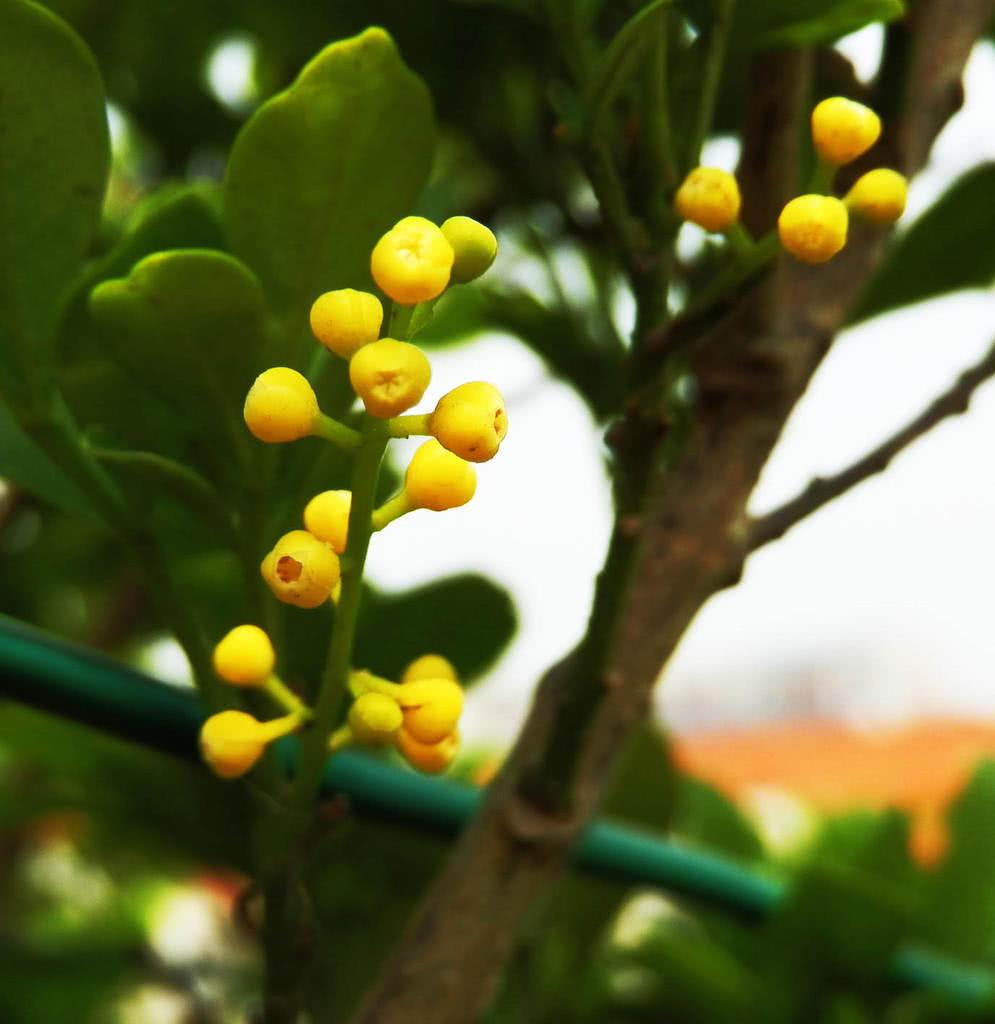
Aglaia odorata, also known as four-season Aglaia or small-flowered Aglaia, belongs to the Meliaceae family and the genus Aglaia. It is an evergreen shrub or small tree, native to subtropical Yunnan, Fujian and other places, and distributed in Guangxi, Sichuan, Guizhou and Yunnan.
Aglaia odorata has dense branches and leaves, with lush green and glossy foliage. It blooms multiple times within a year, most profusely in summer and autumn. When in bloom, it gives off a delicate fragrance that spreads all around, with a scent resembling that of orchids. The tips of the small branches often bear star-shaped rust-colored scales; the pinnately compound leaves are alternate, and the flowers are yellow, extremely fragrant, and about 2 mm in diameter. The bisexual pedicels are slightly short and thick, the calyx is 5-lobed, and there are 5 petals, oblong in shape; the berry is nearly spherical, 10-12 mm long, and the flowering period is between summer and autumn. Aglaia odorata adapts to warm and humid climate conditions, and mature plants need ample sunlight. In southern courtyards, Aglaia odorata is also an excellent landscape tree.
Aglaia odorata
Growing environment:
It prefers a warm, humid environment with ample sunlight, is not cold-tolerant, and is slightly shade-tolerant. It adapts to a fairly wide range of soils, but grows best in deep, loose, fertile, slightly acidic sandy soil. The winter temperature should not be lower than 10°C. It often grows in open forests or shrub forests in low-altitude mountainous areas.
Aglaia odorata likes warmth, sunshine and plenty of fertilizer. The optimum growing temperature is 20°C-25°C. Under normal circumstances, with ample sunlight and relatively high temperatures (around 30°C), the flowers it produces will have a strong fragrance. If it is placed in a shady spot in summer and given a large amount of nitrogen fertilizer at the same time, it may fail to bloom or produce few flowers with a faint scent. Therefore, during its growth and development period, Aglaia odorata needs to be kept outdoors in a sunny spot for care, and attention should be paid to applying an appropriate amount of liquid fertilizer containing more phosphorus. It is best to apply thoroughly decomposed alum fertilizer water made by soaking crushed bone meal, fish bones, chicken bones, etc., and regularly supplement with chemical fertilizers containing more phosphorus or fermented rice washing water, all of which help bud formation, allowing it to bloom more, with golden-yellow flowers and a delicate fragrance.
Aglaia odorata grows slowly and has a relatively long lifespan; century-old trees can still bloom.
Aglaia odorata
Main value:
Aglaia odorata is a flowering plant that people love, and when it blooms, its fragrance is captivating. Potted Aglaia odorata can be displayed in living rooms, studies and porches, fresh and elegant, soothing to body and mind. In southern courtyards, Aglaia odorata is also an excellent landscape tree.
Distribution range:
Native to southern Asia, it is widely cultivated in tropical regions around the world. It is distributed in Fujian, Guangdong, Guangxi, Sichuan and Yunnan, and is mostly grown in pots in the north. It is distributed in various countries of Southeast Asia. It is often cultivated in provinces such as Fujian, Sichuan, Guizhou and Yunnan.
Aglaia odorata
Diseases and control:
1. Aphids: spray the plants with cigarette butt or chili water. Spraying with 800-fold diluted Mieyaling solution also works. If there are few, they can be removed manually with a small brush. For other control methods, refer to roses.
2. Beetles: spray with 1500-fold diluted Jiesha solution. If there are few, they can be removed manually with a brush. For other control methods, refer to large-flowered clivia.
3. Red spider mites: use 10% fenbutatin oxide pyridaben emulsifiable concentrate (such as Guoguang Hongsha) at 1000-fold dilution, or mix 10% fenbutatin oxide pyridaben emulsifiable concentrate (such as Guoguang Hongsha) at 1000-fold dilution + 5.7% emamectin benzoate emulsifiable concentrate (such as Guoguang Leke) at 3000-fold dilution and spray for control. It is recommended to use it twice in a row, with an interval of 7-10 days.
4. Sooty mold: this disease is prone to occur under high temperature and high humidity with poor ventilation, so please pay attention to controlling temperature, humidity and ventilation when growing it.