What does the Malabar nut look like? Its flowers resemble a duck's bill
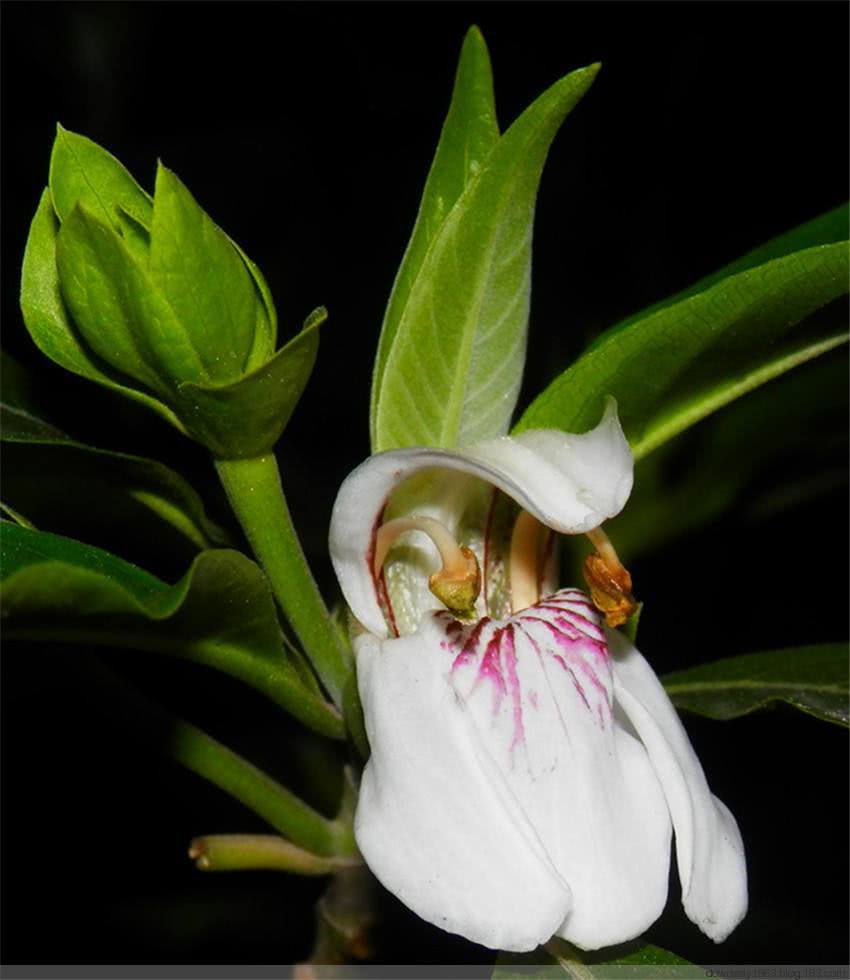
Malabar nut (Justicia adhatoda) is a species in the genus Justicia of the family Acanthaceae. It is a shrub, 2-3 m tall, with swollen stem nodes, hairy young branches, opposite leaves, oblong-lanceolate or oblong-elliptic, pointed at the tip, entire margins, terminal or axillary spikes, ovate bracts, labiate corolla, white with purple lines, flowering in spring and summer.
Malabar nut
Morphological characteristics:
Large shrub, up to 1-3 m tall; branches cylindrical, gray, with lenticels, young branches densely covered with grayish-white fine pubescence. Leaves papery, oblong-lanceolate to lanceolate, or ovate or elliptic-ovate, 15-20 cm long, 4.5-7.5 cm wide, apex acuminate, sometimes slightly caudate, base broadly cuneate, entire, nearly glabrous above, fine pubescence on the underside; midrib grooved above, lateral veins about 12 per side; petiole 1.5-2 cm long. Stems and leaves give off a peculiar odor when crushed. Spikes ovate or slightly elongated; peduncle 5-10 cm long; bracts ovate or broadly ovate, 1-3 cm long, 8-15 mm wide, fine pubescence; bracteoles lanceolate, slightly shorter than bracts, calyx lobes 5, oblong-lanceolate, about 8 mm long; corolla white, with purple stripes or pink, 2.5-3 cm long, pubescent, corolla tube ovate, about 6 mm long; anther cells elliptic, basal spherical appendages usually inconspicuous. Capsule nearly woody, about 0.5 cm long, upper part with 4 seeds, lower part solid and short-stalked.
Malabar nut
Growing environment:
It prefers warmth, has low cold tolerance and dislikes frost.
Distribution range:
Native to tropical Asia, it is naturally distributed in Hainan, China and Yunnan, Guangdong, and southern Guangxi, and is widely cultivated throughout the country.
Malabar nut
Medicinal value:
The whole plant is used as medicine. It can be harvested year-round. It is mostly used fresh or washed and dried in the sun. Nature, flavor and meridians: bitter, pungent, warm. Functions and indications: dispel wind and invigorate blood, disperse stasis and relieve pain, set bones. Used for fractures, sprains, rheumatic joint pain, and low back pain. Knit tendons and set bones, dispel wind and relieve pain, eliminate phlegm.
Cultivation techniques:
Propagation of Malabar nut includes two methods: seed sowing and cutting. The sowing method is the same as for general flowers. Cutting method: use young stems as cuttings; cuttings can be taken in two periods, and the cutting method is the same as for general woody flowers.