The bracts of the shrimp plant overlap in strings, resembling a lobster
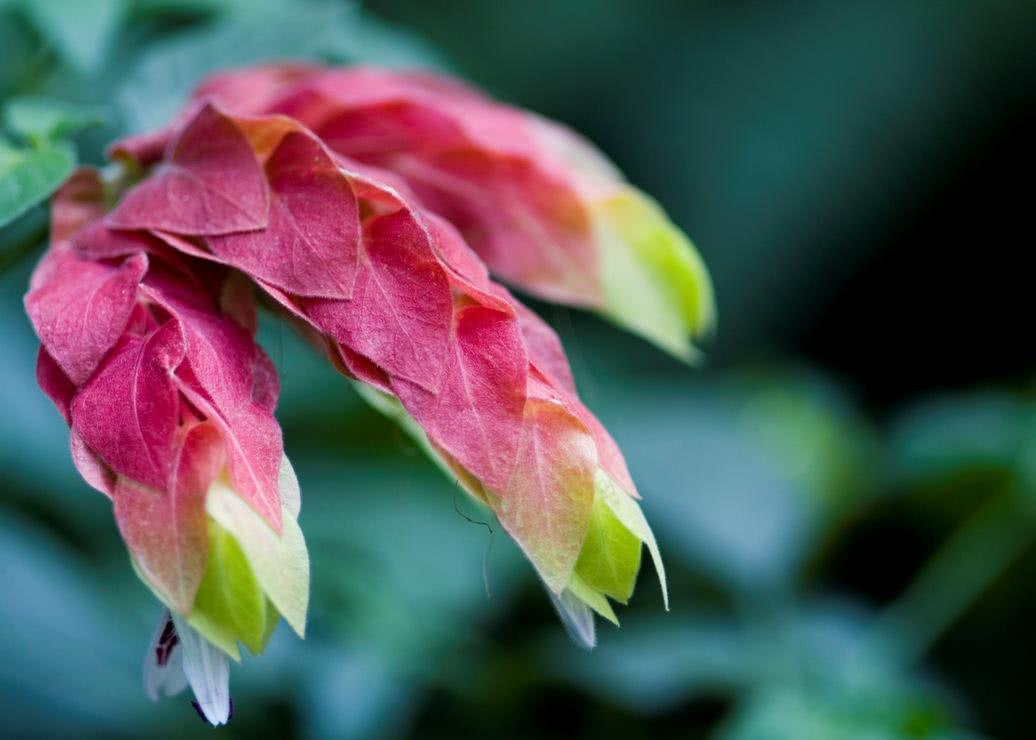
Shrimp plant is a perennial herbaceous or evergreen subshrub in the Acanthaceae family, genus Justicia (Chamberlain's shrimp plant). The plant grows 1-2 m tall, with slender, much-branched stems, and the whole plant is covered with hairs. The leaves are ovate or elliptic, with entire margins. The terminal, drooping spike inflorescence is 6-9 cm long, with persistent bracts in brown, red, yellow-green or yellow, and white, two-lipped flowers resembling a shrimp, with the upper lip entire or slightly 2-lobed, the lower lip 3-lobed, and 3 rows of purple spots at the base. Capsule.
The shrimp plant is native to Mexico and is cultivated in many parts of the world. It prefers warmth and humidity, likes light and is also fairly shade-tolerant, and is not cold-hardy. Propagation is mainly by cuttings. Its bracts overlap in drooping strings, and the inflorescence is about 10 cm long, resembling a lobster or a fox tail, which is very interesting. It blooms year-round, is suitable for pot cultivation, and can be placed on a high indoor shelf for viewing, or used for flowerbed arrangements.
Shrimp plant
Morphological characteristics:
A much-branched herb, 20-50 cm tall; stems cylindrical, covered with short stiff hairs. Leaves ovate, 2.5-6 cm long, apex shortly acuminate, base gradually narrowed into a slender petiole, margin entire, both surfaces covered with short stiff hairs. Spike inflorescence dense, slightly curved and drooping, 6-9 cm long; bracts brick red, 1.2-1.8 cm long, covered with short soft hairs; calyx white, about 1/4 the length of the corolla tube; corolla white, with red spots on the throat protrusion, 3.2 cm long, extending beyond the bracts, corolla limb deeply cleft to the middle, covered with short soft hairs. Capsule not seen.
Shrimp plant
Origin and habitat:
It is very common in gardens and flower nurseries in southern China, growing well whether potted or planted in the open ground, such as cultivated in Haikou People's Park, Hainan. In central regions, however, it must overwinter in a greenhouse. Native to Mexico, and naturalized in Florida, USA.
Growth habits:
It likes moisture, is fairly drought-tolerant, and prefers loose, fertile, well-drained neutral and slightly acidic soil. Full sun or partial sun; it prefers a warm, humid environment and is cultivated in greenhouses. The minimum temperature needs to be: 5-10°C, suitable growing temperature: 18-28°C; it likes sunlight and is also fairly shade-tolerant, avoids scorching sun, and likes moisture. It blooms continuously year-round. Fruiting period year-round. Habits: It prefers a warm, humid environment and is cultivated in greenhouses. The minimum temperature needs to be 5-10°C. It likes sunlight and is also fairly shade-tolerant, avoids scorching sun, and likes moisture. It blooms continuously year-round.
Shrimp plant
Main value:
It blooms year-round, with persistent bracts overlapping in strings, resembling a lobster, very peculiar and interesting; it is suitable for pot cultivation and can be placed on a high indoor shelf for year-round viewing, or used for flowerbed arrangements or made into bonsai. Potted plants decorate windowsills, studies and balconies, and can also be planted along roadsides and walls in courtyards for viewing. In gardens, it is often planted in masses along roadsides and in flowerbeds for viewing.