After planting, this Atractylodes macrocephala grows relatively fast and yields a relatively high output.
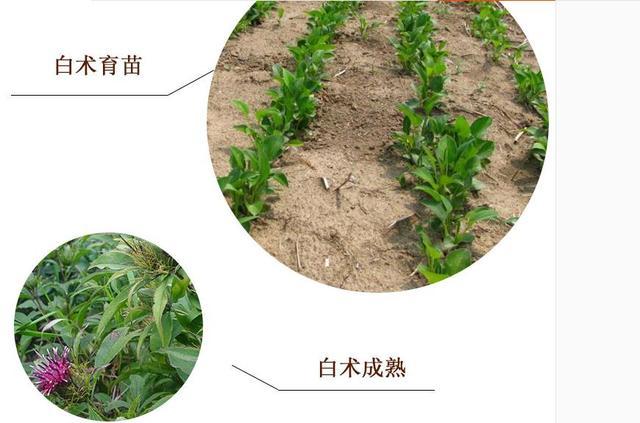
This Atractylodes macrocephala grows relatively fast after planting and has a relatively high yield (Guangzhuan).
Atractylodes macrocephala: a perennial herb of the genus Atractylodes in the family Asteraceae, reaching up to 60 cm in height, with a nodular rhizome. The stem is erect, entirely smooth and hairless. The leaves are alternate, and the leaf blades are pinnately parted, with the lateral lobes oblanceolate, elliptic or oblong-elliptic, and the terminal lobe larger than the lateral lobes; all the leaves are thin in texture, papery, green on both sides, and hairless. The capitulum is solitary at the apex of the stem and branches, and the bracts are green and spiny-pinnately parted. The involucre is broadly bell-shaped, with a purplish-red apex. The achene is obconical. It flowers and fruits from August to October. It is distributed in Jiangsu, Zhejiang, Fujian, Jiangxi, Anhui, Sichuan, Hubei and Hunan in China, and this species is cultivated. This species also has numerous commercial names, such as, based on the shape of the rhizome of the crude drug, "hexingshu", "jinxianshu", or "baizhutui"; named according to the place of origin, such as "huizhu"; and named according to the season when the rhizome emerges from the soil, such as "dongzhu". The quality of Yuzhu (Yuqian, Zhejiang) is considered the best. Its medicinal function is as a spleen-activating drug; its nature and flavor are bitter, warm, pungent and strong, and it has the effects of drying dampness, resolving turbidity and relieving pain.
It is used in various other industries and daily necessities, such as cosmetics, flavoring agents, veterinary drugs, and so on. Since China's accession to the WTO, the export volume of Atractylodes macrocephala has increased year by year. According to reports, the cumulative export volume over 9 consecutive years reached 23,760 tons. The market demand is huge and shows an increasing trend, and the planting area must be maintained at around several hundred thousand mu to meet the market demand.
(1) Seed selection: select new seeds that are plump and free from pests and diseases, and soak them in warm water at 30°C.
(2) Soil: select sandy loam soil with deep soil layers, medium fertility, good drainage and cool ventilation as the land for planting Atractylodes macrocephala.
(3) Fertile land: select cultivated farmland with deep soil layers, a groundwater level below 1 m and good drainage and irrigation; plow deeply to 40 cm. Spread farmyard manure evenly over the land to be planted; after applying the farmyard manure, plow the land deeply once, then apply farmyard manure again; after spreading the manure evenly, plow the land deeply once more, and then harrow the land level.
(4) Bed making: make beds 1 m wide and 4 m long, and at both ends of the bedsset up drainage ditches.;
(5) Base fertilizer: apply base fertilizer in the prepared beds, with an application amount of 150 kg per mu. The specific method is: place the farmyard manure at a water source and use the water flow to carry it into the beds for irrigation and fertilization.
(6) Thinning of seedlings: select seedlings of Atractylodes macrocephala raised in the current year with plump apical buds, uniform size, well-developed root clusters and round, large tails. Try to maintain a row spacing of 20 cm and a plant spacing of 15 cm, and water the Atractylodes macrocephala seedlings after transplanting is completed.
(7) Weed removal: pull out weeds, hoe shallowly to 7 cm, break up and loosen the soil finely, and spray twiceuniconazole.。
(8) Pest and disease control: use antagonistic bacteria for control. The antagonistic bacteria are made by mixing Trichoderma reesei and Bacillus subtilis at a weight ratio of 1:1.5, applied at 10 kg per mu.
(9) Bud control: during early June, spray a preparation for controlling bud growth to inhibit the emergence of buds as much as possible.
(10) Mulching with grass: in the high-temperature season of July, a layer of leaves, wheat bran, etc. can be spread on the ground surface as mulch to regulate ground temperature and allow Atractylodes macrocephala to pass the summer safely.
(11) Harvesting and processing: in the year Atractylodes macrocephala is planted, the suitable harvest time is when the stems and leaves begin to wither. At harvest, dig out the rhizome, cut off the stems, and transport it back for processing. When drying, use a strong fire at the beginning, with the temperature controlled at 95°C; when water vapor appears, lower the temperature to 65°C, turn it over once every 2.5 hours; when the fibrous roots are dry, take it out and pile it up to "sweat" for 8 days, then dry it until completely dry, and rub off the remaining stems and fibrous roots. [Jishan Huayao]