The optimal timing for spraying against the persimmon mealybug is during the emergence period of overwintering nymphs and the late peak hatching stage of each generation's eggs.
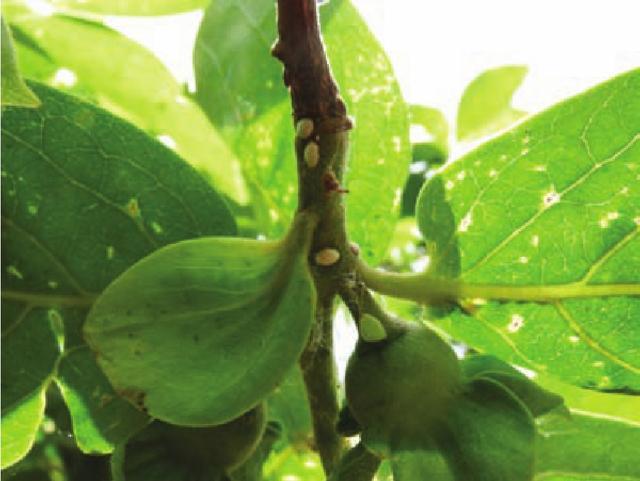
The control technique for the persimmon mealybug is to apply pesticide during the emergence period of overwintering nymphs and the late peak hatching stage of each generation's eggs.
The persimmon mealybug [Asiacornoccus kaki (Kuwana)], also known as persimmon cottony scale, persimmon felt scale, persimmon felted scale, persimmon mealybug, and persimmon louse, belongs to the order Homoptera, family Eriococcidae. It is a common persimmon tree pest that is difficult to eradicate and causes serious damage. In China, it is distributed in Henan, Hebei, Shandong, Shaanxi, Anhui, Guangxi and other provinces and autonomous regions. In the Puyang area, it is found in Nanle, Qingfeng, Fanxian, Taiqian and other counties and districts. Both its nymphs and adults damage persimmon fruits, tender branches and leaves. In severe cases, it causes flower and fruit drop, weakens tree vigor, and seriously affects the growth, flowering, fruit setting and fruiting of persimmon trees. In recent years, through systematic observation, research and exploration of the persimmon mealybug, combined with the production practices of persimmon growers, we have basically clarified its occurrence patterns in this area and summarized a set of effective control measures for fruit growers' reference.
1 Morphological characteristics
The female adult (Figure 1) is about 1.5-2.5 mm long and about 1-2 mm wide, flat and oval, dark purple or red; body segments are distinct, with conical spines distributed on the dorsal surface. The spines are short, stout, and slightly blunt at the tip, appearing roughly equilateral triangular from the side; the ventral surface is smooth with body hairs of varying lengths; the antennae are short, with 3-4 segments, the 3rd-4th segments being slender and cylindrical, of the same shape and length, sometimes fused into 1 segment, bearing about 10 bristles of varying thickness and length; the abdominal margin has white, curved, fine hair-like waxy secretions, and when fully mature, it is enclosed in a white, rice-grain-like felted wax sac. The male adult is smaller, about 1-1.2 mm long and about 0.5 mm wide, purplish-red; antennae have 9 segments, each with 2-3 bristles; wings are dull white and semi-transparent; the abdominal tip has a pair of white wax filaments equal in length to the body, with a short genital spine; the scale cover is oval, with the same texture as the female adult. The egg is oval, about 0.3-0.4 mm long, purplish-red, with white wax powder or wax filaments attached to the surface, concentrated behind and below the female adult's wax cover. The egg sac is pure white or dull white felted material, straw-sandal-shaped, with the front raised, the head end oval, and the abdominal end sunken to form a pincer shape. The surface has relatively stout wax hairs protruding from the egg sac. The overwintering nymph is flat, oval or egg-shaped, purplish-red or carmine red, about 0.5 mm long, with short spine-like protrusions all over the body, resembling a hedgehog. The pupa is about 1 mm long, carmine red; the shell is about 1 mm long and about 0.5 mm wide, oval, flat on top and bottom, with a transverse crack at the peripheral edge of the end that divides the shell into upper and lower layers, the entire shell being composed of dull white flocculent wax.
Figure 1 Persimmon mealybug (female adult)
Figure 2 Persimmon mealybug (first-generation nymph hatching)
2 Occurrence pattern and habits
In the Puyang area, the persimmon mealybug has 4 generations per year, overwintering as 1st-2nd instar nymphs of the last generation in hidden places such as bark crevices of branches more than 2 years old, bud scales, dried persimmon calyxes, and coarse bark crevices of the trunk. After persimmon trees sprout (March 28 to April 6) and unfold leaves the following year, overwintering nymphs begin to activity, crawling onto tender buds, petioles, leaves, and tender shoots to settle and suck sap. After tender shoots are damaged, black spots appear, growth becomes weak, sprouting becomes difficult, and they may even dry up; after petioles are damaged, they turn black and deformed and drop early; young leaves damaged become shrunken and deformed and drop early. In mid-May, a complete white felted scale cover forms on the insect's back, and it differentiates into male and female sexes. In mid-to-late May, adults mate. The female adult's scale cover is the egg sac. After mating, the egg sac changes from pure white to dull white, and egg-laying begins. Eggs are laid behind the mother body under the scale cover. Each female lays 50-160 eggs, with a maximum of about 340 eggs. Those parasitizing fruits lay the most eggs, followed by those on leaves, and the fewest on branches and trunks. As large numbers of eggs are produced, the mother body contracts toward the front of the scale cover. When the posterior margin of the egg sac slightly lifts and opens, it is the peak egg-laying period; when the posterior margin opens wide and slightly reveals red, it is the peak hatching period; when red dots appear on the egg sac, it turns outward in a shedding manner, thread-like materials connect the edges, and small red dots appear on fruits, it is the late hatching period (Figure 2) and nymph settling period. At a temperature of 17-18°C, the egg stage lasts about 21 days; at 31-32°C, about 12 days. After hatching, nymphs disperse to leaves, tender branches, the lower surface of fruits, and the crevices where the persimmon calyx joins the fruit to cause damage (Figure 3). Damaged fruits turn from green to yellow, eventually expanding into black spots, and change from hard to soft (Figure 4) and drop. According to monitoring data in recent years, the peak hatching periods of the 1st-4th generation nymphs of the persimmon mealybug are in early June, early July, early August, and early September, respectively. When the average winter temperature is slightly higher, hatching occurs earlier; otherwise, it is delayed. The generations occur irregularly and overlap. There is 1 generation per month, and each generation generally takes 15-20 days, while the winter generation lasts 180-190 days. The overwintering generation mainly damages persimmon leaves and 1-2 year old small branches. The 1st generation, 2nd generation (Figure 5), and 3rd generation (Figure 6) [Jishan Huayao] each damage persimmon leaves and fruits, with the 2nd-3rd generations causing the most serious damage to persimmon fruits. Around mid-October, the 1st-2nd instar nymphs of the 4th generation (overwintering generation) begin to overwinter.
Figure 3 Persimmon mealybug (first-generation nymphs on fruit)
Figure 4 Persimmon mealybug (fruit damage symptoms)
Figure 5 Persimmon mealybug (second-generation damage)
Figure 6 Persimmon mealybug (third-generation damage)
3 Reasons for difficulty in eradication
In persimmon production, fruit growers report that pesticide control of this pest is ineffective and eradication is difficult. The main reason is that they do not understand the local occurrence and hatching patterns of the persimmon mealybug and fail to grasp the optimal control timing. During the emergence period of overwintering nymphs and the late peak hatching stage of each generation's eggs, the insects are small and easily overlooked. However, once they grow and form a scale cover, or climb onto fruits and bore into the crevices where the persimmon calyx joins the fruit, the effect of pesticide spraying is greatly reduced. Therefore, grasping the emergence period of overwintering nymphs and the late peak hatching stage of each generation's eggs for pesticide application is the key measure for chemical control during the growing season.
4 Integrated control techniques
4.1 Strengthen quarantine
The persimmon mealybug often settles and parasitizes, and its body is tiny. It mainly spreads over long distances by being carried on host branches, scions, fruits, and even trunks. Therefore, forest pest control and quarantine agencies should strengthen quarantine inspection and re-inspection during the procurement and transport of seedlings, scions and fruits, and handle any findings promptly to prevent spread and proliferation.
4.2 Manual control
In conjunction with orchard management, from persimmon leaf fall to before sprouting, prune diseased and pest-infested branches and persimmon calyxes from the trees, scrape off overwintering nymphs and old coarse cracked bark on branches and trunks, promptly clean them out of the orchard, and burn them in a centralized manner to reduce overwintering pest sources.
4.3 Chemical control
First, before persimmon trees sprout in early spring (March 28 to April 6), spray the tree body with 3-5 degrees Baumé lime sulfur mixture to eliminate overwintering nymphs; second, after persimmon trees unfold leaves (early April) and before flowering (May 1-12), when overwintering nymphs emerge from overwintering sites and have not yet formed waxy shells, spray 3% high-permeability fenoxycarb emulsifiable concentrate at 3,000 times dilution or 10% imidacloprid wettable powder at 2,000 times dilution to eliminate overwintering nymphs; third, at the peak emergence of each generation's nymph hatching, spray as appropriate 1.8% abamectin emulsifiable concentrate at 2,000 times dilution or 25% buprofezin wettable powder at 1,000 times dilution to control the pest damage.
4.4 Biological control
During the occurrence period of natural enemies, try to avoid or minimize the use of broad-spectrum chemical pesticides for control, so as not to kill natural enemies. The predatory natural enemies of the persimmon mealybug found in the Puyang area mainly include two species: the black-margined ladybird beetle and the Chinese green lacewing.