Key Technical Points for Stable Production and Renewal of Old Apple Orchards
Techniques for Stable Production and Renewal of Old Apple Orchards
1 Benefits of Using New Techniques for Renovating Old Apple Orchards
1.1 Shortens the time needed to re-establish an orchard
Generally, building an orchard with nursery stock takes at least 4-5 years to reach fruiting, while with the new renovation technique, orchards generally begin fruiting in 3 years, saving at least 1-2 years.
1.2 Solves the problem of replant soil
Digging out an old orchard and replanting to establish a new one generally takes 5-6 years, while the new renovation technique can be completed in the same year, saving at least 4-5 years. It also solves the difficult problem of replant soil.
1.3 Overcomes the problem of land shortage
The new technique for renovating old orchards is carried out in the original orchard whenever the fruit grower wants to make changes, with no need to find new land to establish an orchard, thus solving the problem of land shortage.
1.4 Saves costs and reduces investment
Buying one dwarfing apple nursery stock for a new orchard generally costs 6-7 yuan, and machine digging of each hole costs 1.0 yuan; whereas renovating one old apple tree requires only 5.5 yuan (2 yuan for the scion, 3 yuan for grafting labor, 0.5 yuan for nylon grass and plastic bags), saving at least 1.5-2.5 yuan.
2 Methods of the New Renovation Technique and Scion Preparation
2.1 Sawing the tree
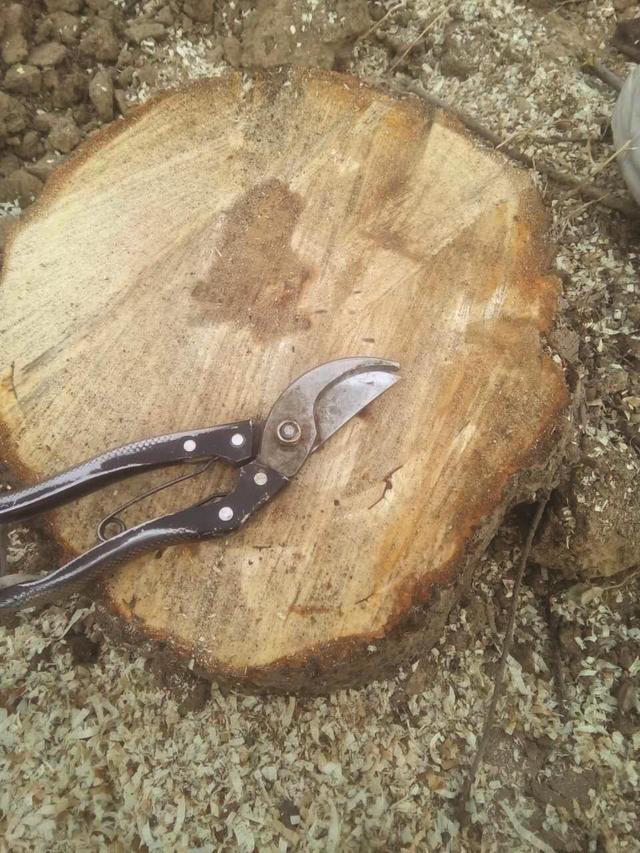
Saw off the old tree at 10-15 cm above the ground (Figure 1). The bark at the saw cut must be smooth and free of canker scars, and the saw surface must be flat with no burrs, otherwise survival will be affected.
2.2 Using the bark grafting method
The cut surface of the scion should be at least 3 cm long, with an arrow-shaped cut on the back (Figure 2).
2.3 Scion preparation
To save scions and reduce costs, the main scion (that is, the central leader scion to be retained) can be selected from the new variety to be grafted, while the remaining scions can be selected from ordinary varieties during winter pruning of the orchard.
Figure 1 Sawing the old tree
Figure 2 Performing bark grafting
2.4 Number of grafts
For trees with an old trunk diameter of more than 10 cm, graft at least 4 graft unions; for trees with an old trunk diameter of less than 10 cm, graft at least 3 graft unions.
2.5 Wrapping after grafting
The saw surface must be tightly wrapped with plastic bags, and each scion must then be tied tightly with nylon rope (Figure 3) [Jishan Huayao]. Do not let water flow into the junction between each scion and the saw surface, otherwise survival will be affected. Finally, cover everything tightly with a large plastic bag and tie it firmly (Figure 4).
Figure 3 Wrapping after grafting
Figure 4 Wrapping the grafted branches tightly and tying them firmly
3 Timing for Renovating Old Apple Orchards
It can be carried out once the bark slips, that is, from late March to late April.
4 Management after Grafting
4.1 Checking survival
After the scions sprout, first tear open the plastic bags to let air in and harden the plants for several days, then remove the plastic bags after 4 p.m.
4.2 Loosening the ties in time
In mid-to-late June, loosen the nylon grass rope in time; do not let the nylon grass constrict the scions.
4.3 Tying support poles
In June, while loosening the ties, tie one bamboo pole to each tree to secure the scions and prevent strong winds from breaking them.
4.4 Fertilizing and irrigating in time
Strengthen soil, fertilizer and water management in the renovated old orchard. After the grafts survive, apply 0.5-1.0 kg of urea per tree, split into 3-4 applications, and irrigate at the same time.
4.5 Pest and disease control
Control aphids, leaf rollers, red spider mites, green mirids, early defoliation disease and other pests and diseases in time to ensure vigorous growth of the scions.
5 Timely Joining
5.1 Joining in July
Entering July, carry out joining in time. Select a good central trunk. Choose one tree with a thick, straight trunk as the central tree and retain it. On each of the remaining scions, select and retain one relatively thin branch, and when the new branch is semi-lignified, use the side grafting method to insert and join it to the central trunk. In this way, a "three supplying one central trunk" form can be formed (Figure 5).
5.2 Joining the next year
Figure 5 Grafting and joining completed
Joining can also be carried out in the following spring. After the bark slips, complete it by side grafting. From the scions grafted the previous year, select one tree with a thick, straight trunk as the central tree and retain it. On each of the remaining scions, select and retain one relatively thin branch and side-graft it onto the central leader, finally forming a "three supplying one central trunk" form (Figure 6).
Figure 6 Joining the next year
6 Precautions
(1) Strive to graft each scion successfully in one attempt, otherwise the bark at the unsuccessful spots is prone to drying and rotting.
(2) Protect the saw surface of the old tree well. After the grafts survive, apply a chemical for preventing canker disease on the saw surface to prevent the saw surface from rotting and turning black. Be careful not to apply it to the scions.
(3) Remove the wrapping material in time (Figure 7). Do not let the wrapping material break the scions or constrict them into a thin gourd shape, which would affect the sturdiness of the tree.
Figure 7 Removing the wrapping material in time