What are the common ornamental species of the genus Aerides?
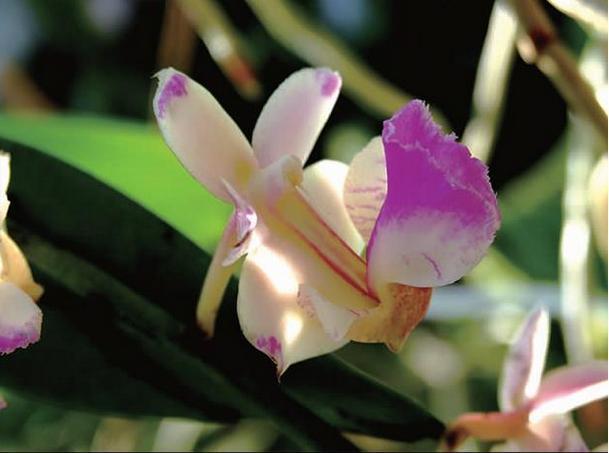
What are the common ornamental species of the genus Aerides?
Plants of this genus have no pseudobulbs. Because the leaves are mostly leathery or nearly cylindrical, they have strong drought tolerance. Their aerial roots are well developed and can obtain part of their water and nutrients from humid air. The optimum growth temperature is 18°C-30°C, and they can overwinter safely above 10°C. They have a somewhat high light requirement and prefer medium or brighter light; 50% shading is sufficient in summer and autumn, while full light is suitable in spring and winter. Because they have no pseudobulbs, they cannot store large amounts of water, so during the growing period the substrate should be kept moist, and the plants should be misted to maintain humidity and prevent water loss from excessively dry air. For cultivation, pot them in an epiphytic substrate, or attach them to tree trunks or tree-fern boards for growing. During the growing period, apply a balanced fertilizer at 1500 times dilution once every half month; when flower buds are differentiating, increase the amount of phosphorus and potassium fertilizer, which helps the plants bloom. They are difficult to divide, and sometimes produce a few keikis, which can be cut off and planted separately; propagation can use tissue-culture sowing.
1. Aerides falcata
An epiphyte native to southeastern Yunnan. It grows on tree trunks in montane evergreen broad-leaved forests. It is also distributed in Southeast Asia. The stem is stout, with several distichous leaves. The leaves are strap-shaped; the raceme is loosely several-flowered; the sepals and petals are pale white with purplish red on the upper part; the lip is 3-lobed. The flowering period is spring to summer. The optimum growth temperature is 20-28°C; it prefers a well-ventilated environment, is easy to cultivate, and likes medium light.
2. Aerides rosea
An epiphytic herb native to Guangxi, Guizhou, Yunnan and other places. It grows on tree trunks in montane forest margins or on sparsely wooded evergreen broad-leaved forest slopes at altitudes of 320-1530 m; it also occurs in Southeast Asia. The stem is stout, and the leaves are fleshy, narrowly oblong or strap-shaped. The inflorescence is axillary, densely many-flowered; the flowers are white with purple spots, spreading; the lip is 3-lobed; the front of the lateral lobes is deep purple; the mid-lobe is densely covered with purplish red spots on the upper surface; the spur is white; the column is white tinged with purplish red. The capsule is nearly ovoid. The flowering period is July, and the fruiting period is from August to May of the following year. The optimum growth temperature is 18°C-28°C; it is easy to cultivate and likes medium light.
3. Aerides odorata
An epiphytic herb with a stout stem, native to Guangdong, Yunnan and other places, growing on tree trunks at altitudes of 200-1200 m; it also occurs in Pakistan, India, Indonesia, Laos, Myanmar, Malaysia, Nepal, the Philippines, Thailand and Vietnam. The leaves are thickly leathery, broadly strap-shaped, with an obtuse apex and unequal 2-lobed tip. The raceme is pendulous, nearly as long as or longer than the leaves, densely many-flowered; the flowers are large, spreading, fragrant, white with pink; the lip is attached at the end of the column foot, 3-lobed; the lateral lobes are upright, relatively large, with rounded-obtuse tips and irregular teeth on the upper margin; the mid-lobe is narrowly oblong; the spur is narrowly horn-shaped. The flowering period is May. The optimum growth temperature is 18-30°C; it is easy to cultivate and is best grown in a slightly shaded place.
4. Aerides mitrata
An epiphytic herb with a short stem, native to Thailand and Myanmar, growing attached to tree trunks in rainforests. The leaves are linear, nearly cylindrical, with inward-rolled margins, leathery, green, entire-margined, and the stem has many aerial roots. The raceme is upright or obliquely spreading, shorter than the leaves, densely many-flowered; the flowers are small, white with pale pink; the lip and column are pink. The flowering period is spring. The optimum growth temperature is 20°C-30°C; it is not cold-tolerant, and can be mounted on a board and hung in a slightly shaded place or attached to tree trunks for cultivation. Because the leaves of this species are nearly club-shaped, it gets its name. When Reichenbach published this species in 1864, it was placed in the genus Aerides. Later, because its semi-club-shaped leaves are completely different from those of other Aerides species, Seidenfaden in 1972 separated Aerides mitrata from Aerides to form its own genus, naming it (Seidenfadenia mitrata); the genus name is Seidenfadenia, and the specific epithet mitrata continues to be used. The specific epithet means mitre-shaped, and the appropriate English name should be "Mitred Seidenfadenia".