A Complete Analysis of the Key Technical Points for Controlling Grape Green Mirid Bugs
Grape Green Mirid Bug Control Techniques
Speaking of the green mirid bug, many farmers get a headache. In earlier years it was only a secondary pest, but as the use of chemical pesticides has been greatly reduced and the agricultural industrial structure has been adjusted, the green mirid bug population has surged, and the damage has worsened year by year (Figure 1). Many grape growers have suffered greatly from it, with serious losses.
Figure 1 Green mirid bugs causing increasingly severe damage year by year
1 Getting to Know the Green Mirid Bug
The green mirid bug belongs to Hemiptera, Miridae, Apolygus. It is widely distributed, has rather diverse feeding habits, and has many host plants (Figure 2). It produces 4 to 5 generations per year, prefers warm and humid environments, and tends to break out in large numbers when the temperature is 20 to 30°C and the relative humidity is 80% to 90%.
Figure 2 Green mirid bugs with diverse feeding habits and many host plants
1.1 Eggs
The egg is 1.2 mm long and 0.26 mm wide, yellow-green, with a relatively narrow neck and a bluntly rounded end. The egg cap is pale yellow, raised at the front and rear ends, with a central depression and no appendages along the edge. When magnified, it looks somewhat like a banana (Figure 3).
Figure 3 Eggs of the green mirid bug (Image source: Laiyang Agricultural College)
1.2 Nymphs
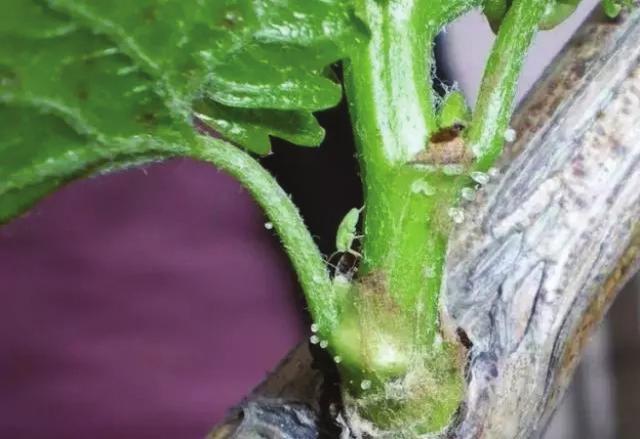
Nymphs go through 5 instars. Newly hatched nymphs are orange-yellow in body color, then gradually turn green. They are quite active and begin piercing and sucking the young tender parts of the grapevine from an early age (Figure 4).
Figure 4 Second-instar nymph of the green mirid bug (Source: Zheng Guofeng)
1.3 Adults
The adult body is oval, elongated, yellow-green or light green, and densely covered with short hairs. The head is triangular, the compound eyes protrude, and the junction between the end of the corium and the cuneus is slightly grayish brown (Figure 5). It has strong flying ability, hides during the day, and is mainly active in the early morning and at dusk when it is not easily noticed.
Green mirid bug egg-laying generally shows a tendency toward tender tissues. Most overwintering eggs are laid within the bud scales of grapevines, while some eggs are laid on dead branches and fallen leaves.
Figure 5 Adult green mirid bug (Source: Yangchun Sanyue)
2 Damage Caused by the Green Mirid Bug
The green mirid bug mainly damages grapevines by nymphs and adults piercing and sucking unopened buds or newly opened young leaves, new shoots, young fruit, and so on.
After young leaves are damaged, pinhead-sized reddish-brown spots initially form. Then, as the leaves grow, irregular holes of varying sizes form around these small spots (Figure 6).
Figure 6 Initial damage symptoms on leaves
In severe cases, many piercing wounds cluster on the leaves, causing the leaves to shrivel, become deformed, and even appear torn (Figure 7). Growth is impeded, photosynthesis is greatly affected, and the plant's own nutrient production is restricted, so it cannot supply enough nutrients for plant growth. Plant growth and flower bud differentiation are affected to varying degrees.
Figure 7 Severely damaged leaves
When young fruit is damaged by adult or nymph green mirid bugs, mottled young fruit appears (Figure 8).
Figure 8 Damage symptoms on young fruit
As the young fruit enlarges, small black spots form at the wound sites on the fruit surface (Figure 9), seriously affecting the appearance of the fruit. It is worth noting that the damage caused by the green mirid bug to young fruit seems to be irreversible, equivalent to "disfigurement"!
Figure 9 Black spots formed on the fruit surface due to green mirid bug damage
3 Summary of Damage Patterns
Figure 10 Damage to tender buds
The green mirid bug generally causes more severe damage from after grape budbreak in early spring to the young fruit stage. Among these, first-generation nymphs feed on and damage grape tender buds (Figure 10); second-generation nymphs damage inflorescences, young fruit, and so on; at the beginning of the third and fourth generations, because tender grape tissues decrease, many green mirid bugs choose to "go out to work"; by the fifth generation they "return home" and lay eggs to overwinter.
Overwintering eggs of the green mirid bug show strong cold resistance throughout the overwintering period and can withstand low winter temperatures. 2016 was a warm winter, so the insect population base was bound to be relatively large, and the occurrence would be even more severe in orchards where orchard cleanup work was not done well. [Jishan Huayao]
The green mirid bug is suited to living in environments with a temperature of around 20°C and relative humidity of around 80%. Therefore, the environment below 1 m under the grape trellis may be more suitable for its feeding and damage; excessive outdoor rainfall and humid greenhouse environments favor its reproduction; lower new shoots are more susceptible to damage than upper new shoots.
Its living habits make it difficult to detect, and the damage symptoms are easily confused. For example, leaf symptoms resemble viral disease and pesticide damage; fruit damage resembles black pox disease.
Grapes of Euro-American hybrids suffer less damage than Vitis vinifera varieties. For example, Red Globe suffers relatively severe damage, while Kyoho has a relatively lower damage rate.
4 Control Strategies
4.1 Agricultural and Physical Control
(1) Before burying vines for winter protection, clear weeds and dead branches inside and outside the vineyard, bury them deeply or burn them in a centralized manner, and eliminate eggs overwintering on weeds and dead branches.
(2) From vine unearthing and trellising to before budbreak, scrape old and loose bark from branches and trunks and burn it in a centralized manner to eliminate pests overwintering in bark crevices. During the grape growing season, yellow sticky boards or insect-killing lamps can be hung in the vineyard to trap and kill green mirid bugs.
4.2 Chemical Control
The green mirid bug generally causes more severe damage from after grape budbreak in early spring to before flowering, and the damage caused at this time has a relatively large impact on the tree body. Therefore, seizing the key control period in early spring is an important measure to reduce green mirid bug damage.
(1) Before budbreak, spray 3 to 5 degrees Baume lime sulfur mixture, including the ground weeds, to eliminate overwintering eggs.
(2) From budbreak to the new shoot leaf expansion stage, choose bifenthrin, cypermethrin, and similar products, or use their compound products for spraying, then spray again after an interval of 7 to 10 days. In orchards with severe damage, spray 3 times consecutively, which can effectively reduce the number of green mirid bugs.
4.3 Biological Control
The green mirid bug has many types of natural enemies, mainly including egg parasitoid wasps, flower bugs, lacewings, nabid bugs, spiders, and so on. While carrying out chemical control, attention should be paid to protecting them, and insecticides with low toxicity to natural enemy organisms should be selected as much as possible.