Efficient Cultivation Model of Corn Intercropped with Konjac Combined with Green Manure
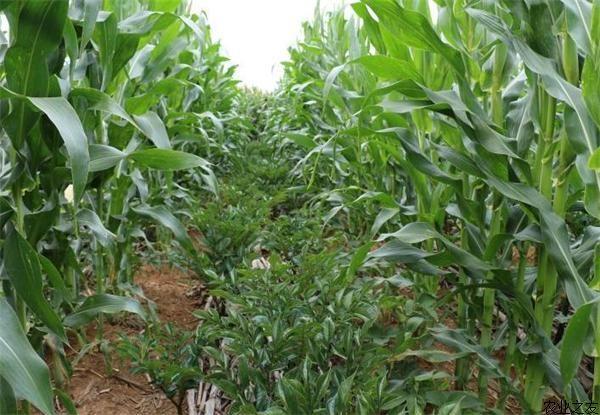
Efficient Cultivation Model of Corn Intercropped with Konjac + Green Manure
1 Research Background Analysis
Wenquan Town is located in the southeast of Changning County, with its southeastern direction bordering Fengqing County of Lincang City, and its northwestern direction bordering Wengdu Town and Tianyuan Town of the same county. The town area of Wenquan Town is approximately 236 sq km, with mountainous areas accounting for about 99% of the total area. Wenquan Town has a cultivated land area of 20,274 mu, of which about 9,000 mu is paddy field and more than 10,000 mu is dry land. The highest altitude of Wenquan Town reaches 2,400 m, and the lowest altitude is around 140 m. The annual average temperature of Wenquan Town is about 14°C, and the annual average rainfall is about 1,300 mm. In order to promote agricultural production in Wenquan Town, with a three-year period from 2016 to 2018, focusing mainly on the combination of improved varieties and improved methods, the assembly and matching of practical technologies, the pairing of crop varieties and integrated technical guidance, the method of corn intercropped with konjac was selected to achieve the goals of cost saving and increased production and income. First, a 300-mu intercropping and relay cropping core demonstration model was promoted, radiating and driving 30,000 mu. After a year of unremitting efforts, 100 households in 4 villager groups of Xinhe Village, namely Sanyi, Sanwai, Xiaoxinzhai and Zhangjiazhai, achieved 100 mu of corn intercropped with konjac. After joint yield measurement by technicians from the Agricultural Comprehensive Service Center, leaders of the Villagers' Committee, members of the villager groups and farmers, the results showed that corn yield was 602 kg per mu, konjac 1,120 kg, equivalent to 224 kg of grain, and the 300 mu of intercropping and relay cropping in Wenquan Town increased grain yield by 110.2 kg per mu.
2 Analysis of the Efficient Cultivation Model of Konjac Intercropped with Corn Plus Green Manure
2.1 Soil Selection
Soil selection is relatively critical. Soil suitable for konjac growth generally needs to be relatively deep, with a relatively loose texture, and the organic matter in the soil should be relatively rich, so as to fully meet the growth needs of the 2 crops. If the soil is relatively hard, has poor drainage performance, and frequently becomes compacted, it is not suitable for konjac growth and can easily cause konjac yield reduction and disease problems; the konjac grown is of relatively poor quality and is also relatively difficult to process. In addition, soil that is too shallow is not conducive to the growth of konjac corms.
The soil pH suitable for konjac growth is about pH 6.5, and slightly acidic soil is the most suitable. Konjac is also planted in neutral or slightly alkaline soil, but if the acidity or alkalinity is too high, then konjac growth will be seriously affected. Therefore, Wenquan County selected areas at an altitude of 1,600 m to 2,000 m for konjac planting. This is because these areas have relatively high terrain, relatively good soil drainage, sufficient organic matter in the soil, good air permeability, and are also slightly acidic soil suitable for konjac growth. When selecting soil, attention should also be paid to avoiding areas where the previous crop was Cruciferae or Solanaceae, and areas with Gramineae crops should be chosen as much as possible for konjac planting, which can also reduce pathogen infection.
2.2 Adopting Cost-Saving and Efficiency-Enhancing Measures
First, the relevant technical concepts and methods of returning straw to the field were promoted to farmers in Wenquan Town. Combined with the actual situation of Wenquan Town, technical models such as direct return of crushed straw to the field were selected, with the aim of improving soil fertility, thereby reducing the amount of chemical fertilizer applied, and thus achieving cost savings and efficiency enhancement. Second, technologies such as soil testing and formula fertilization were promoted to farmers in Wenquan Town, achieving the goal of reducing production costs within the experimental area.
2.3 Variety Selection
In the Wenquan Town demonstration area, the crop varieties mainly selected should follow the main principles of high yield and disease resistance. For corn quality selection, hybrid corn varieties with relatively good lodging resistance and relatively high yield, such as Huidan No. 4, should be selected as the main variety for spring sowing. The main variety selected for autumn sowing was "Jinyinsu." The konjac variety selected was red konjac. Red konjac is a new konjac quality discovered in Yunnan in recent years. This konjac itself has relatively high disease resistance and relatively high yield, and is favorable for processing. The green manure used was a conventional variety.
2.4 Reasonable Close Planting to Ensure Increased Yield
For corn intercropped with konjac, the corn density should preferably be maintained at 3,600-4,000 plants per mu. Within a 160 cm bed width, sow 2 rows of corn and 2 rows of konjac, opening furrows for sowing. According to the slope direction of the plot, draw lines and open furrows from top to bottom, with a furrow depth of 5-10 cm, and the width determined according to the size of the seed konjac. Open another furrow in parallel at intervals of 20-25 cm, and sow in the opened furrows; when sowing, the plant spacing should be properly controlled according to the size of the seed konjac. Generally, keep a space of 2.5-3.0 seed konjac between 2 seed konjac. When sowing, sow simultaneously in the two parallel furrows, using 420 kg of seed per mu and planting 2,803 plants.
While planting reasonably, a fertilization plan must also be arranged reasonably. The base fertilizer is about 1,500-2,000 kg of farmyard organic fertilizer per mu. Ordinary calcium superphosphate is about 30 kg, and potassium sulfate fertilizer is about 9 kg. At the same time, apply 40 kg of compound fertilizer specially for corn per mu as a top dressing. When applying the base fertilizer, a fertilization ditch can be dug between the planting furrows, the base fertilizer and compost can be mixed, and then applied in the ditch. Another method is, after opening the planting furrows, first apply compost at the bottom of the furrow, then apply the base fertilizer, and cover with about 3 cm of soil. It should be noted that nitrogen-containing compound fertilizer must not be applied; nitrogen fertilizer is not conducive to crop growth. Second, konjac planting must not come into direct contact with fertilizer, and chicken manure must not be used as farmyard manure.
2.5 Pest and Disease Control
First is the control of diseases. The main disease of konjac is soft rot. The main measure is prevention-oriented, using a combination of agricultural control and chemical control. When konjac grows to a certain stage, unified disease prevention treatment should be carried out: use broad-spectrum, low-toxicity pesticides with relatively low residues as preventive fungicides. The prepared fungicides are specifically as follows: use 70% dexon 1 million units and 72% agricultural streptomycin spray. The pesticide application frequency is once every 7-10 days, with continuous spraying 3-5 times, which can achieve an effective preventive effect. Once a crop infected with disease is found, pull it out immediately, spread lime on the soil where the crop grew, and tread it firmly to prevent pathogens from flowing away in the rain and infecting other crops. The control measures for insect pests are as follows: for aphids and leafhoppers, 40% dimethoate emulsion 1,000-1,500 times liquid can be used. For the control of moths, 50% decis 2,000-3,000 times liquid can be used for spraying.
2.6 Timely Harvesting and Safe Storage
Timely harvesting of konjac is also very important, directly related to the storage of seed konjac for the next year and the quality of konjac in the current season. When the leaves of konjac slow down in growth, become yellow and lodging, and the corms of konjac no longer grow, konjac can be harvested. Harvesting should be carried out more than 10 days after the start of konjac leaf lodging, choosing sunny days for digging, and keeping the corms intact. After harvesting, konjac can be directly sold or processed into konjac products. After the seed konjac is dug out, it should be dried in a ventilated place for one day, and the storage temperature should be maintained at 15-20°C [Jishan Huayao].
3 Effectiveness Analysis
Through the efficient cultivation model of konjac intercropped with corn plus green manure, a total of 300 mu of intercropping and relay cropping model was completed, with the area completing 100% of the plan. Farmer training in the model area reached 300 person-times, completing 100% of the plan. The income increase rate of farmers in the project area exceeded 10%, and costs were reduced by 5.2%, stabilizing the balance of total grain output value. Among the 15 households surveyed for farmer satisfaction in the project area, 14 households expressed satisfaction, with a satisfaction rate of 93%. According to yield measurement by technicians from the agricultural center, for corn intercropped with konjac, the konjac yield equivalent to grain was 224 kg. The average grain yield per mu of the 300 mu of intercropping and relay cropping was 110.2 kg, completing 367% of the plan. This konjac intercropped with corn cultivation model, with comprehensive measures such as selecting one tall and one short crop in technical variety selection, reasonable fertilization, and effective pest and disease control, drove the radiation of 30,000 mu of economic crops in winter agricultural development throughout the town.