Houseplants are easy to care for and beautiful, and they can also purify the air and remove formaldehyde
Most energy-efficient home designs in the United States restrict the rate of air exchange between indoors and outdoors, making it easier for harmful chemicals to accumulate inside. This is especially true since modern people spend most of their time indoors (at home, in the office), and some have even developed“Sick Building Syndrome”this condition in which substances inside a building make people within the building feel unwell.
Scientists at NASA once conducted research and found that many common household plants can very quickly and effectively purify harmful substances in enclosed spaces, making indoor air fresh and improving the living environment. Plants are also an indoor decorative touch that never goes out of style. Growing some green plants at home is both attractive and eco-friendly.
Below, Rain from TheNaturePlanet does some homework on those easy-to-grow indoor green plants that can also purify the air, along with planting tips, as a reference for friends who want to start growing them.
Indoor green plants that can purify the air
1. Peace Lily
(Image from Phil-Amy Florist, copyright belongs to the original author)
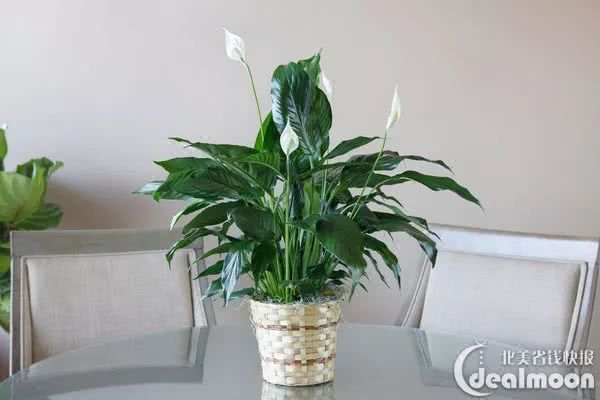
The peace lily is a perennial tropical plant, named for its pure white flowers that symbolize the flag of peace. Paired with broad, glossy dark green leaves, it is very elegant and is one of the ornamental plants many people love to grow. The peace lily is very effective at removing alcohol, acetone, trichloroethylene, benzene and formaldehyde, and because its transpiration rate is relatively high, it can also humidify and moisten indoor air.
The peace lily is very well suited to indoor growing; it can survive even without sunlight or if its owner often forgets to water it. Of course, the most suitable growing environment is a room temperature between 60-75F, and at night it is best kept above 50F. Peace lilies like indirect light (for example, 6-8 ft away from a window); direct light easily turns the leaves yellow or even causes them to wither. When you see its leaves drooping, you know it is time to water it.
But note that the peace lily contains oxalic acid, which is toxic if eaten, irritating the mouth and stomach and possibly irritating the skin as well. If there are children or pets at home, it is better to place it somewhere they cannot reach.
2. Areca Palm
(Image from The Tree Center, copyright belongs to the original author)
The areca palm is evergreen year-round with dense foliage. Grown indoors, it can reach 6-8 ft tall. If you want to add a touch of tropical flair to your home, or want some larger indoor plant decor, the areca palm is a favorite choice for many people. Some people who pay attention to feng shui also believe the areca palm can ward off negative energy and bring good luck. It is also non-toxic, making it even more suitable for families with pets or children.
According to Dr. Wolverton's experimental results, the areca palm can remove more toluene and xylene than other plants, and it releases a large amount of moisture, making it a very effective natural humidifier.
The areca palm likes bright, indirect light, but it can also adapt to fully shaded environments. The ideal room temperature is 65-80F, but it is not cold-tolerant, and at night it is best kept above 50F. Although it likes moist environments, too much water in the soil easily causes its roots to rot, so you should choose soil with good drainage. It is best to wait until the top two inches of soil are dry before watering. In spring and summer, you can fertilize at half the amount recommended for regular fertilizer.
The areca palm does not grow quickly and likes its roots to fill the pot, so it usually only needs to be moved into a pot 2-4 inches larger every two to three years.
3. English Ivy
(Image from Today, copyright belongs to the original author)
When people think of English ivy, they may mostly picture the ivy covering building exterior walls. In fact, this evergreen climbing plant is also great grown indoors. It can be hung as decoration, or you can guide it to climb up along furniture to create a look. It can also effectively purify many common harmful substances in the air, such as benzene, formaldehyde, trichloroethylene, toluene and xylene.
English ivy needs plenty of indirect light. It likes cool, moist environments, with a temperature of around 60F being most suitable. As long as the soil drains well, keep the soil moist. During the spring and summer growing season, regular fertilizing or using a slow-release fertilizer is better.
English ivy stems and vines root easily and are usually propagated by cuttings. Cutting off a section to give as a gift is also nice. However, English ivy is somewhat toxic, so be careful if you have children and pets at home.
4. Snake Plant
(Image from Pinterest, copyright belongs to the original author)
The snake plant has upright, thick, fleshy leaves, named for the horizontal tiger-skin-like patterns on the leaf body. Its sword-shaped leaves give it a bold, upright appearance, and it is often regarded as a good luck plant, believed to protect the home and ward off evil. Popular varieties include Mother-in-Law's Tongue and the golden-edged snake plant, which has golden yellow margins along the leaf edges.
The snake plant can absorb harmful substances such as benzene, trichloroethylene and formaldehyde, and it is extremely adaptable. Even if its owner ignores it for several weeks, it can still grow tenaciously, making it very suitable for people who do not have much time or patience. However, the snake plant itself is slightly toxic, and eating it may cause symptoms such as nausea, vomiting or diarrhea, so be careful if you have children and pets at home.
The snake plant is a succulent, so the potting soil you choose must drain well; otherwise, a large amount of water accumulating in the soil can easily cause root rot. Using a breathable clay pot is better than a plastic pot. It does not need frequent watering, and too little water is better than too much. In winter, watering once a month is fine. When watering, pour from the edge of the pot and do not wet the leaves.
The snake plant likes a warm, bright environment. Room temperature should be kept above 50F, and long periods of indirect light are best, for example placing it within 3-6 ft of a sunny window. But it can also adapt to dark places, just growing more slowly with less vivid color. In spring and summer, you can feed it a little general-purpose fertilizer (1/4 of the recommended amount). With fertilizer too, less is better than more, and do not fertilize in winter.
5. Boston Fern
(Image from Miracle-Gro, copyright belongs to the original author)
The Boston fern is a perennial evergreen fern herbaceous plant. Its verdant, feather-like fronds droop once they reach a certain length. It can not only be placed on a desk, but is also especially suitable for hanging to decorate the environment in midair. In Dr. Wolverton's experiments, the Boston fern's ability to remove formaldehyde was the fastest and most effective among all the plants tested, and it is non-toxic and safe for people and animals.
The Boston fern likes cool, moist environments and dislikes direct sunlight. As long as there is indirect light, a standard room temperature of 55-75F is suitable. However, most homes may be relatively dry. Placing the pot on a tray filled with water and pebbles, or misting it daily with clean water from a spray bottle, can solve this problem. If you see its leaf tips turning yellow, that usually indicates insufficient moisture.
6. Rubber Plant
(Image from Leon & George, copyright belongs to the original author)
The fiddle leaf fig and the weeping fig are very popular large indoor green plants right now. In fact, the rubber plant belongs to the same genus, but it is even easier to grow and care for than the two mentioned above, and experiments have proven that the rubber plant can effectively remove formaldehyde from the air. If you want to grow a large plant, you might consider it.
The rubber plant likes a warm, moist, brightly lit environment, with a suitable temperature of 60-80F. When light is insufficient, the leaves droop and their color is not as healthy and glossy. The rubber plant needs to absorb a lot of water. Normally, and especially during the growing season, keep the soil moist but not waterlogged. If there is too much water, the leaves turn yellow. In summer when temperatures are high, wiping the leaves with a damp cloth is also better. The rubber plant grows relatively quickly and needs regular fertilizing during the growing season.
The latex in the rubber plant's leaves is slightly toxic and can irritate the skin, mouth and eyes. If you have children or pets at home, it is best to be careful, and it is also best to wear gloves for protection when pruning the branches and leaves.
7. Spider Plant
(Image from 24 SPACES, copyright belongs to the original author)
The spider plant is known as the "air flower" and is especially suitable for growing in a hanging pot as a decorative touch. Besides looking good, it can also effectively purify harmful substances in the air such as formaldehyde, xylene and toluene, and it is itself non-toxic.
The spider plant is a highly adaptable plant and suitable for beginners. As long as you give it well-draining potting soil and bright, indirect light, it will mostly grow very well. The suitable temperature is 55-80F. It likes moist environments, so it is also very suitable for placing by the window in a steamy bathroom as decoration. The spider plant's roots must not sit in too much water.
So each time you water, you should water thoroughly, but wait until the top half of the soil has dried out before watering again. Fading green color in the leaves is a sign of insufficient water. Note that if your tap water is fluoridated, it is best to use purified water, otherwise the leaf tips will turn yellow. The spider plant grows quickly but does not need frequent repotting; you can wait until the roots have clearly grown out before repotting.
8. Chinese Evergreen
(Image from Pinterest, copyright belongs to the original author)
Chinese evergreen can remove benzene and formaldehyde from the air, and the longer it is grown, the better its air-purifying ability becomes. Chinese evergreen is also one of the easiest potted plants to grow. It does not have high light requirements (medium to low indirect light is enough), and watering and fertilizing do not need to be too frequent. However, it is somewhat toxic, so it is best kept away from pets and children.
Although it is hard to kill, if you want it to grow well you still need to pay some attention. Chinese evergreen likes warm, humid environments. A room temperature of 60-72F is the most suitable, and it should not go below 50F. It is better to wait until the surface soil is dry before watering. Too much water will cause its stems to rot, and when there is too little or too much water, the leaves will turn yellow. It also does not need much fertilizer; applying general-purpose fertilizer once or twice a year is enough.
9. Dracaena
(Image from Garden Design Ideas, copyright belongs to the original author)
Dracaena, also called the Brazilian iron plant, can effectively remove many harmful substances from the air, such as benzene, formaldehyde and trichloroethylene, and it is also very easy to grow. Dracaena has a unique tree shape and can be arranged in many different ways as decoration. Common popular varieties include Red-edge Dracaena, Cornstalk Dracaena, Janet Craig and Warneckei, among others.
The most suitable growing temperature for dracaena is 65-78F, but it should not go below 55F. It does not need much light; indirect light or a semi-shaded spot is best. Keep the soil slightly moist; you should wait until the surface soil is dry before watering. Use well-draining soil, otherwise the roots will rot. When there is too much water, the leaves droop and turn yellow. Dracaena is sensitive to fluoride, so if your tap water is fluoridated, filter it before use. Fertilize only once or twice in spring and summer.
Dracaena is also slightly toxic, so be careful if you have pets and children at home.
Tips for growing plants indoors
1. Use suitable pots and potting soil
(Image from mustangrobotics.club, copyright belongs to the original author)
Potted plant containers usually need drainage holes at the bottom to ensure excess water can flow away. For plants prone to root rot from too much water, if a tray under the pot catches water, be sure to pour off the excess water after watering. For plants that do not need much water, choose breathable terracotta pots, while plants that need to retain more moisture are better in plastic pots. If you feel plastic pots are not elegant enough, you can place another decorative pot around them.
The soil used for potting is called Potting Mix/Potting Soil,and its composition is very different from the Garden Soil/Top Soil used for outdoor planting. Potting mix is also commonly called soilless mix. It is mostly made by mixing peat moss, pine bark, coconut coir, perlite and vermiculite, among other things. It is lighter in weight and drains better than ordinary outdoor potting soil, making it more suitable for relatively enclosed containers like flower pots.
If you put outdoor potting soil into a flower pot, it is more harmful to plants prone to root rot from too much water, and over time this kind of soil also more easily settles and clumps, which is not good for plant growth.
2. Suitable fertilizer
The amount of fertilizer used for potted plants is also very important. Insufficient nutrients lead to slow growth, but too much fertilizer can also harm plants. Usually, fertilize only during the plant's rapid growth season, and do not fertilize when newly repotted or in winter.
(Image from Barton's Greenhouse and Nursery, copyright belongs to the original author)
Fertilizers all list the N-P-K (nitrogen-phosphorus-potassium) ratio. Nitrogen mainly promotes green leaf growth, phosphorus mainly promotes root, stem, flower and fruit growth, and potassium promotes overall health. Generally speaking, a balanced 10-10-10 general-purpose fertilizer is suitable for the vast majority of indoor plants.
For potted plants, it is usually best to use water-soluble fertilizer. This kind of fertilizer is easy to dilute, and you can fertilize according to need, since large pots and small pots require different amounts.
There are liquid potting fertilizers that are very easy to use. There are also foam fertilizers specially designed for succulents. Some slow-release fertilizer sticks that can be inserted directly into the soil are also popular with many people, because after fertilizing once you do not need to bother for several months, making them very convenient to use.
(Image from Home Depot, copyright belongs to the original author)
● Miracle-Gro's slow-release potting fertilizer sticks have an NPK ratio of 6-12-6. This ratio is more suitable for plants that need to flower and fruit, and it can continuously and effectively supply nutrients for 2 months.
●Jobe's slow-release potting fertilizer sticks are very cost-effective, 50 sticks for 2 dollars, and each stick remains effective for 2 months. The NPK ratio of this potting fertilizer is 13-4-5, which is more suitable for the growth of foliage plants or leafy vegetables.
3. Suitable environment
Every plant has its own suitable growing environment requirements. Some plants are highly adaptable, while others need careful care. However, even the hardiest plants have conditions they cannot withstand. Take succulents, which many people say cannot be killed; if you keep watering them nonstop, you can still drown them.
(Image from Casa Flora, copyright belongs to the original author)
So when choosing plants in a store, it is best to first carefully read the back of the label, which will indicate some plant characteristics and key growing points, such as how tall it can grow, how much sunlight it needs, temperature requirements, watering and fertilizing frequency, how to care for it, and so on. It is important to know clearly whether you can provide these conditions.
The suitable growing temperature for the vast majority of plants that can be used as houseplants falls within the room temperature range comfortable for people. Many are not cold-tolerant, so be careful not to place plants by a drafty window when the weather is cold, to avoid freezing them.
5. Water
(Image from Business Insider, copyright belongs to the original author)
Plant roots also need to breathe. If too much water accumulates in the pot, it can easily "drown" the roots. Each plant has different water requirements. For example, succulents like very dry sandy soil, so after watering once, wait until the soil is completely dry before watering a second time. Others, such as the Fiber-optic plant and umbrella plant, like very moist soil and generally cannot be overwatered. But most plants' water requirements are neither too dry nor too wet.
So for most ordinary potted plants, the simplest watering method is to wait until the surface soil is dry before watering again. This way the lower layer is still moist, ensuring it will not be too dry, but it also will not sit in water all the time.
In addition, for ordinary potted plants, you can also use some automatic watering tools that slowly release water into the soil through a thin tube.
Also, some plants like humid air, but the air humidity in most homes is not quite enough, so pay attention to this, especially do not place plants in particularly dry spots like heating vents.
In some areas, tap water is hard, or fluoride is added. The fluoride or salts in the water can easily harm plants, so if the water quality is not good enough, it is best to use purified water or filtered water for growing plants. Before watering, let the water sit for a while and bring it to room temperature before using it, which is also better.
6. Pests
Many plants also attract small insects. Using insecticidal soap spray can safely and effectively remove many pests such as aphids, mealybugs, mites, leafhoppers, psyllids, scale insects, thrips and whiteflies, solving the problem. Insecticidal soap is also an insect-control method recognized in organic growing, and it can be used on vegetables and fruits too.
For example, Miracle-Gro has this ready-to-use spray
Friends who want to save a bit of money can also buy the concentrate and dilute it with water themselves. A 16oz concentrate can make 6 gallons.
Final words
Do you grow any plants at home that are both ornamental and air-freshening? What kinds do you all like to grow? Friends who love growing plants are welcome to share their own growing experiences.
If you want to find some solid material related to air-purifying plants, you might also want to read Dr. Wolverton's great work.
This article was originally written by Rain, editor of TheNaturePlanet. It may not be reproduced without permission, otherwise legal action will be pursued. Some images come from the internet and from fans who shared their purchases; copyright belongs to the original authors.
THE END
Author: Rain / Editor: Sophia