Introduction and Cultivation Techniques of Purple Yam 'Suyu No. 2' in De'an County, Jiangxi Province
Introduction and Cultivation Techniques of Purple Yam 'Suyu No. 2' in De'an County, Jiangxi Province
'Suyu No. 2' is a new mid-to-late maturing, high-quality, short-tuber purple yam variety jointly developed by the Xuzhou Institute of Agricultural Sciences and the Institute of Industrial Crops, Jiangsu Academy of Agricultural Sciences, through radiation breeding of "Zhejiang Taihu Purple Yam", and was bred in 2013. In December 2015, it passed the appraisal of the Jiangsu Provincial Crop Variety Appraisal Committee (appraisal number: Sujianyu 201502). In 2017, the De'an County Agricultural Technology Extension Center introduced this variety and successfully trial-planted it at the Yaoxiang Ecological Agriculture Family Farm in Baota Township. This variety has strong adaptability, requires little labor for cultivation, and yields an economic benefit of 10,000 yuan per mu.
1 Characteristics and Traits
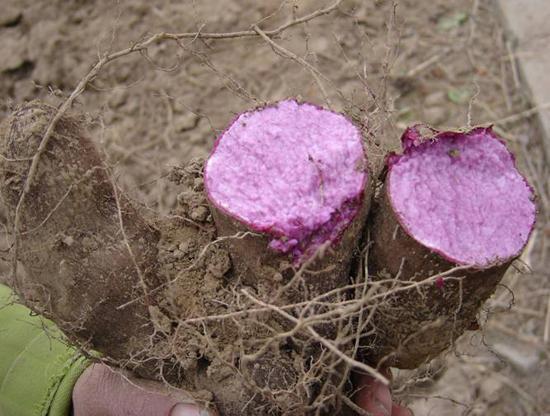
'Suyu No. 2' has a relatively late growth period, requiring 170 d from emergence to maturity. It emerges 29 d after sowing, with full emergence at 50 d, and the seedlings are vigorous. Its tubers are long spindle-shaped, with densely grown fibrous roots on the surface and a brown skin; the flesh is purple, vivid in color, and smooth in texture. The tuber diameter is 4-6 cm, and the length is 15-20 cm. Each plant has two to three tubers, with an average tuber weight per plant of 0.75 kg. This variety has wide adaptability and strong resistance, is slightly susceptible to yam anthracnose, and has strong tolerance to waterlogging and waterlogging damage.
2 Economic Benefits
A unified harvest and yield measurement was conducted on October 30, with an actual average of 2,491 plants/667 sq m, an average tuber weight per plant of 0.75 kg, and an average fresh tuber yield of 1,868.3 kg/667 sq m. At a selling price of 10 yuan/kg, the output value was 18,683 yuan/667 sq m; after deducting the cost of 5,500 yuan/667 sq m, the net income was 13,000 yuan/667 sq m, showing significant economic benefits.
3 Cultivation Techniques
3.1 Fine land preparation. Select fields with convenient drainage and irrigation, fertile soil, and deep soil layers, preferably sandy loam or loam with good permeability. Deep plow and sun-bleach the soil, then prepare the land and make beds. The bed surface should be 50 cm wide, the bed height 30 cm, and the ditch width 30 cm. The bed surface should be leveled and finely prepared.
3.2 Seed tuber treatment. Before sowing, select disease-free and undamaged seed tubers, remove the soil from the surface, cut them into tuber pieces about 5 cm long and 40-50 g in weight, mix with lime or burnt soil ash, and sow after the cut surfaces are dried. When cutting, disinfect the cutting tools with 75% alcohol to prevent virus (bacterial) infection.
3.3 Sowing at the appropriate time. Sow around Qingming, using a single-plant single-row planting method. The plant spacing is 30 cm, the row spacing is 80 cm, and the density is 2,700-2,800 plants/667 sq m. In the middle of the prepared bed surface, open a sowing ditch 20 cm deep, first apply compound fertilizer into the ditch, cover with 2 cm of crushed soil, then place the seed pieces, and cover with fine soil, ensuring uniform seed spacing and soil covering. The seed rate is about 130 kg/667 sq m.
3.4 Black film mulching. After sowing, cover the bed surface with black plastic film 100 cm wide. When covering the film, stretch it tight and press the edges firmly, and suppress it with soil clods every 2 m on the film to prevent strong winds from destroying the film. When seedlings emerge, promptly break the film to expose the seedlings to prevent the leaves from contacting the plastic film and being scorched. Compared with white plastic film, black film mulching provides better warming and moisture retention and has better weed prevention and removal effects [Jishan Huayao].
3.5 Trellising and vine guiding. After emergence, promptly set up trellises to guide the vines to grow upward. Generally, thin bamboo poles are used to set up a herringbone trellis, with a trellis height of 1.6-2.0 m being suitable. The supports should be inserted firmly and tied tightly to prevent being blown down by wind. Yam stems and vines generally can naturally extend onto the trellis. To avoid tangling with each other, the stems and vines can also be guided along the trellis evenly.
3.6 Scientific fertilization
3.6.1 Apply sufficient base fertilizer. Apply base fertilizer in combination with plowing and sowing. Before plowing, evenly spread 100 kg/667 sq m of decomposed rapeseed cake on the soil surface, then plow 30 cm deep so that the soil and fertilizer are fully mixed; at sowing, bury 45% potassium sulfate compound fertilizer in the sowing ditch at a rate of 100 kg/667 sq m (method as in sowing at the appropriate time).
3.6.2 Timely topdressing. When the stems and vines have fully covered the trellis, apply 25-35 kg/667 sq m of high-concentration compound fertilizer and 10 kg/667 sq m of urea. In the late growth stage, spray a 0.3% potassium dihydrogen phosphate solution and urea two to three times to preserve leaves and prevent aging.
3.7 Irrigation and drainage. From April to June, during continuous rainy and heavy rain weather, promptly drain standing water from the production field to prevent waterlogging damage. From July to August, if there is continuous hot and dry weather for more than 7 d, promptly use sprinkler irrigation or run water through the field to keep the soil moist.
3.8 Disease and pest control. Yam is mainly harmed by yam anthracnose, brown spot disease, bacterial wilt, viral disease, and pests such as white grubs and cutworms. Focus on controlling anthracnose. In the early stage of the disease, spray 75 g/667 sq m of 25% prochloraz emulsifiable concentrate mixed with 50 kg/667 sq m of water. If the disease is severe, spray once more after 7-10 d. To control viral disease, mainly select virus-free seed tubers. At sowing or the seedling stage, use 5% carbaryl granules for seed dressing or mix with fine sand and broadcast to control underground pests.
3.9 Timely harvest. At the end of October, the plants stop growing and the underground tubers are fully mature. Choose clear, fine weather to begin harvesting, and all harvesting should be completed before frost. During harvesting, take care to avoid damaging the tuber skin as much as possible and do not break the tubers.