Propagation Methods and Cultivation & Care Tips for Euonymus schensianus
Euonymus schensianus Propagation and Cultivation Care
Photo captions
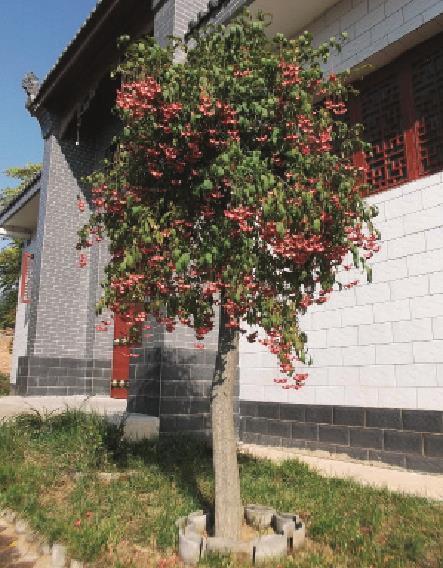
1. Euonymus schensianus planted in front of a resident's door in Lantian County, Shaanxi Province
2. Fruit of Euonymus schensianus in late autumn, bright red in color, shaped like butterflies
3. Potted Euonymus schensianus
Once a tree in imperial courtyards, colorful butterflies fly amid ten thousand greens.
The charm of Tang poetry and Han rhythm remains today, planted in the homes of ordinary people.
As winter arrives in Shanghai, the sky is high and the clouds vast, clear and dry; the citrus have turned yellow, the sweet persimmons red, and the riot of colors sets off the beauty and tranquility of Shanghai. A Euonymus schensianus planted at the Shanghai Academy of Landscape Architecture Science and Planning has reached a height of 2m and has been grown in the ground for several years. This year it not only survived the summer heat but also bore numerous butterfly-like fruits. Under the coloring of winter, the fruits gradually turned red, bringing the joy of harvest. This is the first time the plant has turned red since it was introduced to Shanghai. At the same time, on the vast plains of northern Shaanxi, in the Qinling area known for its biodiversity, the fruits of Euonymus schensianus are already brilliantly red. Viewed from afar, they look like rolling flames. Against the magnificent backdrop of blue sky and white clouds, when the autumn wind blows, golden threads hang all over the tree, with butterfly-shaped fruits dancing gracefully, like colorful butterflies fluttering amid ten thousand greens, highly distinctive and endearing.
Morphological Characteristics
Euonymus schensianus Maxim is a plant of the genus Euonymus in the family Celastraceae, also known as golden-thread hanging butterfly, money tree, and auspicious tree. It is currently widely cultivated in Shaanxi, Gansu, Hubei, Sichuan and other provinces. It is a climbing shrub, reaching several meters in height, with branches slightly grayish-red; flowers in fours, yellow-green; capsules square or oblate, about 1cm in diameter, with 4 wings growing large, occasionally 5 wings; the fruit stalk is long, the longest fruit stalk among existing Celastraceae plants. Each year it sprouts in March, blooms in April, sets fruit in May, the fruit is green from June to August, golden yellow in September, and after ripening from October to November turns bright crimson red, with an ornamental period lasting as long as half a year. Especially after Frost's Descent, when the forest is dyed in layers of color, walking into a grove of "money trees" under the sunlight, a beautiful and colorful scene makes one relaxed and joyful, lingering without wanting to leave.
Propagation Techniques
Euonymus schensianus can be propagated by seeding. Collect the fruits after they ripen in autumn; after drying, the pericarp splits open, then collect the seeds and dry them. In January of the following year, soak the seeds in 30°C warm water for 24h, store in moist sand in a dark place, and from mid-March germinate at 20-25°C under light; once the radicle appears, they can be sown. Generally drilled sowing is used, with row spacing of 35cm, plant spacing of 3-5cm, soil covering depth of 2-3cm, and sowing rate of 15kg/m2.
For selected superior individual plants, grafting propagation can be used. The rootstock is generally Euonymus bungeanus; grafting can be done in mid-to-late March when the rootstock begins to sprout, using cleft grafting and cut grafting methods. Euonymus schensianus bonsai cultivated by high-trunk grafting has very high ornamental value. Some nursery bases, through years of exploration to select superior rootstocks and improve grafting techniques, have now successfully cultivated large quantities of high-quality premium nursery stock.
Several research institutions have also conducted extensive research on the in vitro culture of Euonymus schensianus, using young stems, leaves and other tissues as explants to induce callus, and further differentiate adventitious buds, later inducing rooting, initially establishing a regeneration system, but large-scale production has not yet been achieved and is still being explored.
Cultivation and Care
Euonymus schensianus is cold-tolerant, drought-tolerant, salt-alkali tolerant, and highly adaptable, unaffected by soil pH in different regions. Its maintenance and management are simple and extensive, but the soil needs to be kept moist and loose regularly, with topdressing 2-3 times per year. The main pests and diseases are geometer moths and aphids.
Historical Legends
In the past, when people in Xi'an spoke of the golden-thread hanging butterfly, they would mention two places: the 'Zhang Millionaire' family in Chezhanggou in the eastern suburbs, and the Shuilu Nunnery, an ancient Tang Dynasty temple in Lantian County. From the late Qing Dynasty to the Republic of China period, in the Zhang family's tall, antique and elegant courtyard house with carved brickwork, a Euonymus schensianus was planted, said to have been transplanted by the Zhang family's ancestors from the Forbidden City in Beijing. This old tree, having weathered a hundred years of wind and rain, still grows vigorously with lush branches and leaves, bearing abundant fruit every late autumn. In front of the main hall of the Shuilu Nunnery in Lantian County, two Euonymus schensianus trees are enclosed by steel bar protective railings; under such heavy protection, one can also feel its preciousness.
Landscaping Applications
Because Euonymus schensianus possesses beauty of form, seasonal beauty, dynamic beauty and artistic beauty, it has relatively high aesthetic value and can meet the aesthetic needs of modern gardens for plants. Applied in natural-style gardens, mixed-style gardens and formal-style gardens, it can display its special value, and can be widely used for beautifying courtyards, potted plants, upscale residential communities, villas, plazas and parks. The specific garden application methods are diverse: it can be planted in combination with buildings, as a solitary specimen, as bonsai (small trees or old stumps), in rows, as courtyard trees, and can also be used as an unusual-shaped flower material for flower arranging. It is a resource-conserving garden tree species and a good regional garden plant landscaping material [Jishan Huayao].
Relevant seedling and landscaping companies, through unremitting efforts in experimental improvement and promotional outreach, have seen nursery stock of various specifications take root, sprout, bloom and bear fruit across the country in Beijing, Shanghai, Shandong, Henan, Hebei, Anhui, Inner Mongolia, Zhejiang and other places. Euonymus schensianus has now become one of the most closely watched and favored varieties in the nursery industry, highly recognized and appreciated by a broad range of customers. This rare flower and tree, originally from imperial gardens, has now gradually entered thousands of households, silently dedicating its modest contribution to Beautiful China!