Cultivation Techniques for Flower Induction and Fruit Retention in the Classic Black King Kong Wax Apple
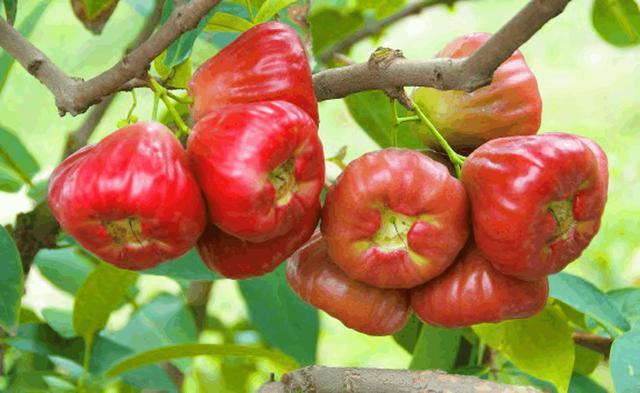
Cultivation Techniques for Flower Induction and Fruit Retention in the Classic "Black King Kong" Wax Apple
Wax apple is an evergreentropical arbor fruit treeof the genus Syzygium in the family Myrtaceae. It has strong adaptability, can adapt to various soil types, grows fast, and is highly productive and stable in yield. At present, it is planted in Hainan, Guangdong, Yunnan, Guangxi, Taiwan, Fujian and Sichuan provinces and regions of China, but is planted more extensively in Taiwan and Hainan. The wax apple not only has brightly colored fruit with a fresh and refreshing taste, giving it high edible and commercial value; its trunk is also much branched, with a naturally rounded crown, opposite simple leaves, leathery foliage, fragrant and beautiful flowers, bell-shaped and brightly colored fruit, and abundant and long-lasting fruiting, giving it high ornamental value.
Black King Kong (also written as Black Jin Gang) wax apple is a new wax apple variety selected and improved in Taiwan, China on the basis of Black Pearl. Under normal management conditions, Black King Kong wax apple begins to bear fruit 2 years after planting, enters full production after 6 years, with an average yield of more than 40 kg per tree; Black King Kong wax apple fruit is relatively large, with an average single fruit weight of about 150 g. The fruit is long bell-shaped, dark red to purple-black in color, with a rich flavor and little spongy tissue. The soluble solids content is higher than 15%, making it deeply loved by consumers. In recent years, the market price of off-season fruit has exceeded 30 yuan/kg, with good economic benefits. Producers are highly motivated to plant it, and it has become an emerging high-efficiency agricultural industry.
Wax apple is a moisture-loving fruit tree. Except for the flower bud differentiation period, which requires relative drought, the orchard soil field water capacity should be maintained at about 70% during other periods. At the same time, wax apple is intolerant of waterlogging. During the fruit development period, if there is continuous rain, drainage should be carried out promptly to avoid large-scale fruit cracking and fruit drop. In terms of management, special attention should be paid to the following points:
Shoot Control
3~4 days before pruning, spray the tree with 40% ethephon aqueous solution at 6000 times dilution or paclobutrazol at 200~500 times dilution for shoot control, to inhibit shoot sprouting and growth.
Tree Pruning
After spraying the Black King Kong wax apple tree with ethephon or paclobutrazol, light, moderate or heavy pruning can be selected according to tree growth and development conditions and production period, so as to reduce branch volume and maintain tree ventilation and light penetration. Light pruning is mostly carried out after fruit harvest from May to July. The technical operation is: remove water shoots, back branches, overly dense branches, diseased and pest-infested branches and weak branches, cut off basal branches and root suckers, retain scaffold branches, and maintain the original tree shape. Moderate pruning is mostly carried out from March to May. The technical operation is: on the basis of light pruning, remove terminal branches of the tree, retract scaffold branch tips, select and retain large branches and strong branches with uniform spatial distribution. For fruiting branches, according to the vigor of the branch, short-cut and retain branch stubs of about 2~5 cm, and remove about 50% of shoots and leaves to promote tree renewal. Heavy pruning is generally carried out once every 3~5 years. For perennial plants with tall crowns, severely reduced productivity, severe disease and pest damage, or weakened trees, crown renewal is carried out, mostly from January to March. The technical operation is: shorten the main branches and remove about 70% of shoots and leaves, which is conducive to reshaping a round-headed tree shape.
Flower Induction Time and Methods
Flower induction from the end of June to the end of November can control the market time from October to April of the following year. The specific operations are:
(1) Trunk girdling or strangulation: 30~35 days after pruning, when the last shoot is more than 70% mature (leaves turning from red to yellow), make 1 closed girdling ring on the trunk about 30 cm above the ground, deep to the xylem, with a cut width of 1~2 cm (varying according to tree age and tree vigor); or 2~3 weeks before flower induction, use wire to strangle the trunk.
(2) Drenching the root and stem with paclobutrazol: on the next day after girdling, drench the soil at the base of the tree root and stem with 15% paclobutrazol wettable powder at 200 times dilution. Control the dosage at 2~4 kg/plant according to tree age and tree vigor.
(3) Covering the crown with netting: after pesticide application,
cover the crown with a shading net with 90% shading rate for 25~45 days. Among these, for flower induction from April to August, the shading days should be controlled at more than 35 days; for flower induction after mid-September, the shading days can be shortened to 25~30 days.
(4) Chemical flower induction: immediately after removing the net, spray 48% chlorpyrifos emulsifiable concentrate at 500 times dilution + 1.8% sodium nitrophenolate aqueous solution at 1200 times dilution + 0.5% urea. Spray continuously 2 times, with an interval of 2~3 days, and carry out before 7 a.m. or after 18 p.m., preferably on cloudy or partly cloudy days. When spraying, spray evenly on both the front and back sides of the leaves.
Flower and Fruit Management
(1) Flower thinning: principles for selecting and retaining flower branches: select and retain oblique, lateral or drooping fruiting branches; back fruiting branches, thin and weak fruiting branches, and diseased and pest-infested fruiting branches should be removed. The spacing between fruiting branches should be controlled at 15~20 cm. For the first thinning, remove 2/3 of the flowers, retain 1 inflorescence per fruiting branch, and keep 5~10 flowers per inflorescence.
(2) Fruit thinning: from after flower drop until the fruit is the size of a finger, manually wipe off withered stamens and pistils, and thin out small fruits, weak fruits, deformed fruits, and diseased and pest-infested fruits. Per fruiting branch, according to the robustness of the fruiting branch, retain 3~6 small fruits, with a maximum of no more than 8.
(3) Bagging: after fruit thinning, spray the whole tree and young fruits with 50% prochloraz manganese salt wettable powder at 1000~1500 times dilution or 64% oxadixyl mancozeb wettable powder at 600~800 times dilution or 70% thiophanate-methyl wettable powder at 800 times dilution, mixed with 20% fenpropathrin emulsifiable concentrate at 2000~2500 times dilution or 10% imidacloprid emulsifiable concentrate at 5000 times dilution or 1% abamectin emulsifiable concentrate at 5000 times dilution, then bag the fruit clusters with sterilized special fruit bags.
From flowering to harvest, shoots should be properly controlled, and flowers and shoot tips should be removed in a timely manner, to avoid vegetative growth consuming tree nutrients and affecting flower and fruit quality.
(4) Fruit retention: from after flower drop until 1 week before harvest, begin spraying 80% 2,4-D sodium salt water-soluble powder at 50,000~100,000 times dilution + 0.1% monopotassium phosphate or multi-element foliar fertilizer, to improve fruit set rate and prevent fruit drop, once a week. After bagging, focus spraying on the leaves around the fruit clusters [Jishan Huayao].
(5) Harvesting: depending on the season, the fruit begins to turn red after 30~50 days of bagging. Observe fruit maturity and coloring through the "sky window" of the fruit bag. Harvest when about 90% mature. When harvesting, use pruning shears to cut from the base of the fruiting branch together with the fruit bag, place into baskets and transport uniformly to the packing house. Handle gently during harvesting and transport.
Fruit Grading and Packaging
(1) Grading: carefully open the fruit bag, take out the fruit cluster, place it on the fruit conveyor sorting machine, screen out rotten fruit, diseased fruit, cracked fruit, and deformed fruit, then grade according to conditions. The requirements for commercial fruit appearance quality are: regular fruit shape, uniform coloring, bright fruit color, fruit traits consistent with variety characteristics, and no cracks, disease and pest spots, or mechanical damage on the fruit surface. Grade by single fruit weight: premium fruit single fruit weight >110 g; first-grade fruit single fruit weight 90~110 g; second-grade fruit single fruit weight 75~90 g; substandard fruit single fruit weight<75 克。(2)包装:果实经分选、分级后用聚乙烯保鲜膜实行单果包膜,粘贴标签后再套上泡沫网袋,按等级装箱、运输。