Why do succulent plant leaves spread out and also get sunburned?
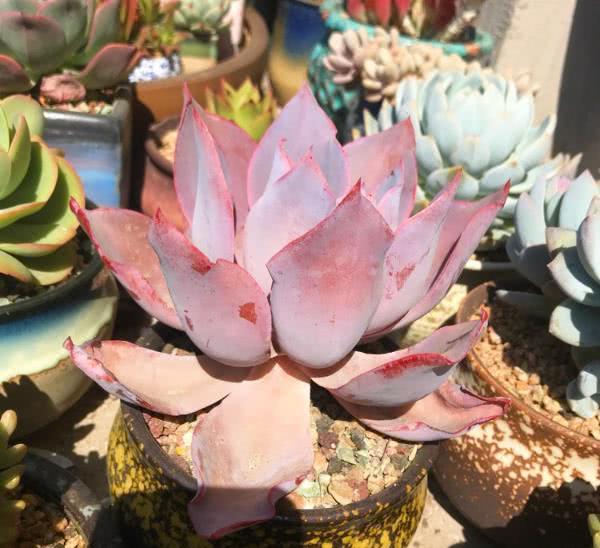
When succulent plant leaves spread out, this situation is mostly caused by too much water and too little light. When this happens, you need to increase light and reduce watering. When increasing light, it must be done gradually; you cannot just put them outside to sun directly, as they will easily get sunburned. Leggy growth is the advanced version of spreading out. If spreading out is not dealt with in time, the succulents will become leggy. Leggy succulents will not return to their original appearance. We can behead them and repot the cut-off heads.
Some flower friends have said that after a winter, some northern flower friends who had no choice but to move their succulents indoors may be pleasantly surprised to find that the succulents have grown taller, turned paler, and become looser. Actually, leggy growth like this can still be saved; as long as you increase light, they can usually become beautiful again. Early detection is the best solution for preventing leggy growth in succulents. When the leaf centers begin to turn white, that is a sign of insufficient light. If it continues to develop, they may become leggy.
Succulents are very prone to sunburn if exposed to harsh sun, and in severe cases they will turn to mush and develop black rot. So if a succulent is sunburned, we should put it in a cool, ventilated place. If it has turned to mush, pull off the leaves. If only a few leaves are left and leaf propagation is possible, then do leaf propagation. Leggy succulents are caused by too little light, but if light is suddenly increased too strongly, they are very likely to get sunburned.
Why do succulents get sunburned? Besides the reasons mentioned earlier, such as being too weak to tolerate strong supplementation and the effect of water droplets, it really is because it is too hot. Not all succulents are as heat-resistant and sun-resistant as the Cactaceae. Many Crassulaceae succulents originate from highlands and mountains where it is not so hot. When watering, if water accidentally gets on the leaves or accumulates between the leaves, and the soil is moist, the former may only cause sunburn spots, while the latter may cause turning to mush or even black rot.
Can sunburned succulents recover? If they have been sunburned to the point of turning to mush and black rot, it is already good if a little bit of life remains. If sunburn spots appear, the spots generally remain permanently, but sometimes over time the traces of the sunburn spots will fade. The Echeveria 'Purpusorum' of Uncle Lianmeng that was sunburned once miraculously did this: in summer it developed scars from sunburn, but by spring it was again like creamy white jade.
Pennywort, Hydrocotyle vulgaris, is relatively unlikely to get sunburned. Plants like pennywort have a special ability in sunlight that succulents cannot match: they transpire a large amount of water. Water evaporation can quickly cool down pennywort leaves. Succulents are different. Their nature is to conserve water. Although their leaves also have stomata, the stronger the sunlight, the more tightly the stomata close, for fear that water will be lost through the stomata.
This is a gathering place for succulent plant enthusiasts, sharing succulent care tips. You are welcome to follow and exchange ideas.