Goose Intestine Greens were once a lifesaving food for the poor, and now they are a rare commodity at 40 yuan per jin.
Friendly reminder
Hemu Report aims to share and popularize information about various plants and their uses, for reference only. If medicinal use is needed, it is recommended to consult a professional physician to avoid problems!
Friends living in rural areas are probably no strangers to wild vegetables, especially older farmers and rural children born around the 1970s and 1980s. Basically, they have eaten quite a few wild vegetables and are very fond of them. The author remembers that when he was little, he still lived in a rural mountainous area, and his family was not well off. Often they could not eat or dress well, so he often followed his mother to the wild or into the mountains to dig up all kinds of wild vegetables to fill their stomachs. Therefore, the author is very fond of wild vegetables and wild grasses, and it can be said that these wild vegetables and wild grasses were the lifesaving food of the poor at that time.
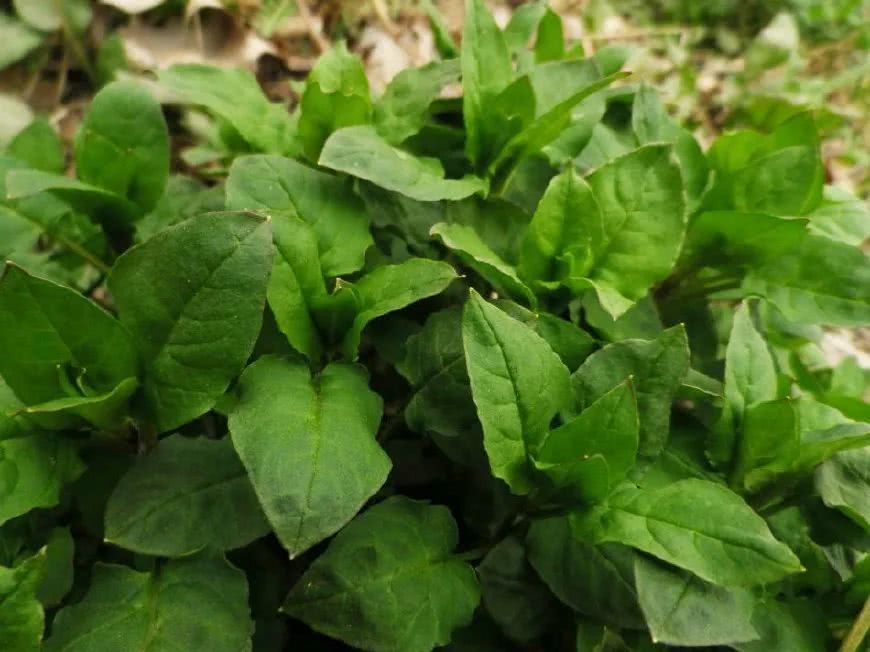
In the afternoon, in the vegetable garden of a farmer friend in the village, the author saw a rare kind of "vegetable." The reason this vegetable is said to be rare is that it was once a wild vegetable, and it was once a lifesaving food for the poor people in rural areas. The author ate it when he was little. Here in the author's hometown, farmer friends call this wild vegetable "Jiaopi Cai" (Foot Skin Greens). Although the name of this wild vegetable is very plain, it is indeed deeply loved by many farmer friends, and many friends have probably eaten it too.
The scientific name of Jiaopi Cai is goose intestine greens (Stellaria aquatica), and in some places it is also called chicken intestine greens, black kelp, small kelp, wild kelp, foot cabbage, goose egg greens, winnowing basket greens, gluten greens, earth kelp, shredded kelp, and so on. Goose intestine greens are also distributed very widely in China, almost throughout every province and city in the country. Its adaptability is also very strong, growing on mountains from 300 m to 2,700 m in altitude, and it likes to grow in wasteland, roadsides, and rather shady and damp grasslands.
So, since goose intestine greens can be eaten as a wild vegetable, what values does it have?
Although the author ate goose intestine greens when he was little, at that time it was to fill his stomach, and he did not know what value it had. Now, after looking up information on goose intestine greens, he discovered that goose intestine greens actually have such high nutritional value.
According to recorded information, goose intestine greens are rich in protein, fat, dietary fiber, phosphorus, carotene, vitamin B2, vitamin C, potassium, calcium, magnesium, sodium, iron, manganese, zinc, and many other nutrients, and eating them regularly is also good for the body in many ways.
In addition, the whole plant of goose intestine greens can also be used as medicine. It tastes sour and is neutral in nature, and has effects such as clearing heat and treating strangury, cooling blood and invigorating blood, reducing swelling and relieving pain, and resolving food stagnation and promoting lactation. It can be used to treat conditions such as infantile malnutrition, toothache, dysentery, swelling and pain of hemorrhoids, difficult urination, urinary tract infection, acute and chronic appendicitis, mastitis, and obstructed milk flow.
It is precisely because goose intestine greens have edible and medicinal value that their value has greatly increased today. According to farmer friends who grow goose intestine greens, if sold as a wild vegetable, it is about 10 yuan per jin, and if dried and sold as a medicinal herb, it is about 40 yuan per jin. Compared with the past, goose intestine greens can now be considered a rare item.
Friends, have you eaten goose intestine greens? You are welcome to leave a message and share.
Text/Hemu Report, images/Internet
If you like Hemu's articles, you are welcome to follow.