Wild fruit: 60 years ago the mountains were full of it, you could pick over a hundred jin at a time; now it's a rare commodity at fifty yuan per jin
Friendly reminder
Hemu Report aims to share and popularize information about various plants and their uses, for reference only. If you need it for medicinal purposes, it is recommended to consult a professional physician to avoid problems!
Our country has numerous mountain ranges, and in the mountains, the most abundant thing is all kinds of mountain delicacies. Throughout the four seasons there are all sorts of different delicious things, including mushrooms, herbs, and wild fruits. In the Lesser Khingan Mountains of Northeast China, there is a kind of wild fruit that once grew in such abundance it was practically overrun. 60 years ago the mountains were full of this wild fruit; you could take a sack into the mountains and pick over a hundred jin at a time. Later, with the development of the Lesser Khingan Mountains, large numbers of trees were cut down, causing this wild fruit to become increasingly scarce. On top of that, this wild fruit can only be picked by hand, so the cost is relatively high, and today it has become a rare commodity with a steep price.
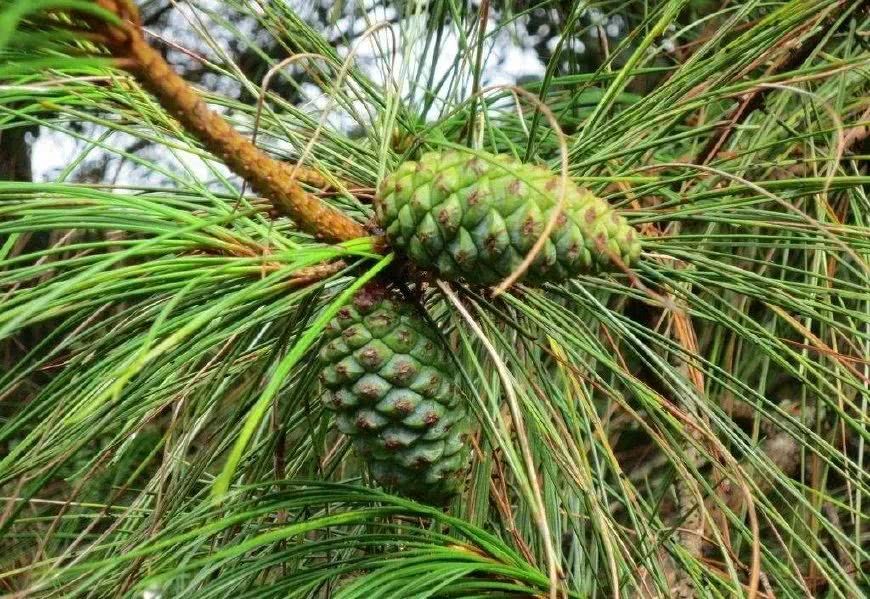
This wild fruit is the pine cone, and the fruit it bears is the pine nut. Not all pine cones can produce pine nuts. Generally speaking, the pine nuts commonly seen on the market are mostly imported Brazilian pine nuts, as well as the pine nuts of Masson pine, Korean pine, and red pine, which are mainly distributed in Northeast China and Yunnan. The pine cones people often see in parks or other places are mostly the fruits of lacebark pine or Chinese pine; their seeds have "wings," and once the cone opens, a gust of wind blows them away, so the pine cones you pick up are completely empty.
This kind of pine tree that does not produce pine nuts is often used for urban landscaping because it grows fast, whereas pine trees that do produce pine nuts grow extremely slowly, so they are not commonly seen in cities.
Take the red pine (wild red pine is a protected plant, and picking its pine cones is not recommended) for example. In the wild, a red pine must go through a 50-year growth cycle before it bears fruit. The process of the fruit ripening is also very long, requiring 2 years to mature. Moreover, pine cones are not easy to obtain; besides having to compete for resources with squirrels, birds, and other animals in the forest, the process of picking pine cones is both arduous and full of danger.
Red pines grow deep in the mountains, and walking from the foot of the mountain to the top takes dozens of li. In order to harvest more pine cones, people choose to set up a simple tent deep in the mountains to spend the night. Pine cones are a fruit that ripens in autumn, and autumn in Northeast China is already very cold, not to mention how cold it is to spend the night in the mountains.
There is a saying among the locals: to tell whether a person often picks pine cones, you only need to observe whether he often looks upward. This is because pine cones all grow on large trees over 20 m tall, and to knock down pine cones you must look upward, then strap on the local tree-climbing tool, the "foot spikes," and climb up, then use a special tool to knock the pine nuts down. Generally at least two people must work together, one climbing the tree to knock them down and the other picking them up below the tree. The wind in the mountains is strong, and climbing up a tree you wobble and tremble; only someone bold and careful can do this work, which is truly dangerous and hard.
The collected pine cones are sent down the mountain for threshing and processing, and out come fresh pine nuts, one by one! After further processing such as sun-drying, oven-drying, and roasting, they become the pine nuts sold on the market. One kilogram of pine nuts costs a hundred yuan, and the price per jin is about 50 yuan, making them a rare commodity indeed.
Every single pine nut is condensed from the sweat and effort of laborers, and is truly hard-earned. Dear readers, have you ever picked pine cones?
Text/Hemu Report, Images/Internet
If you like Hemu's articles, you are welcome to follow