For summer flowers, choose this one that is as cool as water
By the way, the biggest difference between plants and humans is that humans like to live in roofed houses and dislike being exposed to wind and rain. To have a place to shelter from wind and rain, humans can strive for a lifetime, not to mention all the joys and sorrows that arise from it.
Plants are the opposite. They love wind, rain, and sun. Even if they get battered and dusty from sun and rain, they are happy. As soon as they are indoors, they feel uncomfortable all over.
Therefore, there are not many plants that can adapt to indoor conditions for a long time. Besides common varieties such as spider plant and pothos, there is also a beautiful foliage plant called Pilea cadierei.
Pilea cadierei, a plant in the Urticaceae family. Other names: transparent grass, white-transparent grass, aluminum-leaf grass, snow-white grass... It is relatively common in areas south of the Yangtze River.
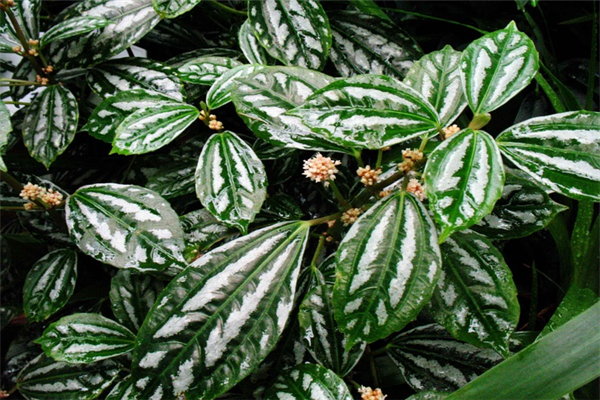
Pilea cadierei is a foliage plant with a small, elegant clump, distinctly green-and-white leaves, and a beautiful, unique pattern.
It also blooms, in June and July, but the flower shape is not attractive and can basically be ignored.
The biggest advantage of Pilea cadierei is that it is shade-tolerant, suitable for being kept indoors for a long time, and has super strong vitality.
As a black thumb, I rarely manage to root cuttings, and even the survival rate of roses is not high. But Pilea cadierei, every cutting I take roots.
The stems of Pilea cadierei are very soft. When they grow to a certain height, if not pruned, they will sprawl. To keep the pot compact and neat, pruning is a must-do task when growing Pilea cadierei.
When Pilea cadierei grows to about one chi tall and the stems begin to lean, it can be pruned.
If it is spring, summer, or autumn, the cut stems can be used for cuttings.
As shown in the picture, the cut stem is relatively long and has eight nodes. In this case, it can be cut into two, making two segments, and each segment can be used for cuttings.
For the upper half that was cut off, there are more leaves. You can cut off the lower leaves and bury the bottom two nodes in the soil.
Why bury the nodes in the soil? Because the nodes easily sprout and root, making the cuttings easy to root.
To test the results, and also because there were quite a few cut stems, I found three pots for cuttings. The medium in each of the three pots was different: one pot was general fine sand, one pot was nutrient soil, and another pot was garden soil that was not very loose.
Then, I placed them on the shady north balcony.
In the first week, because they were covered in wounds all over, the leaves of the cuttings drooped and looked listless.
Half a month later, the remaining leaves straightened up, and tender buds began to sprout from the nodes of the stems.
The test result: no matter which kind of soil was used for cuttings, the easygoing Pilea cadierei could survive. Moreover, in any kind of soil, the growth rate was treated equally, with absolutely no discrimination.
In addition, the young plants I took from cuttings at around ten-plus degrees and at around 30-plus degrees all survived the same. There was only one condition: they had to be placed in a shady spot.
Pilea cadierei likes a warm, humid environment and likes sunlight, but fears strong light. It is a fairly good plant for balcony arrangements and can be placed long-term on coffee tables and flower stands with scattered light.
My experience is: keep it indoors for a week, then take it to a cool, ventilated place for two days, then bring it back indoors. This cycle can be repeated.
Pilea cadierei does not have high fertilizer requirements. Feeding it a little compound fertilizer once a month is enough. It does not matter much if you do not feed it. It is very easygoing.
Pilea cadierei has very few pests and diseases. As long as the maintenance environment is not unsuitable, root rot and yellow leaves will basically not appear. The only pest is the scarab beetle, so it is very convenient to care for.
Recommended!