What to do about yellowing and curling leaves on an areca palm? Master these few tricks and the leaves will be glossy and won't curl
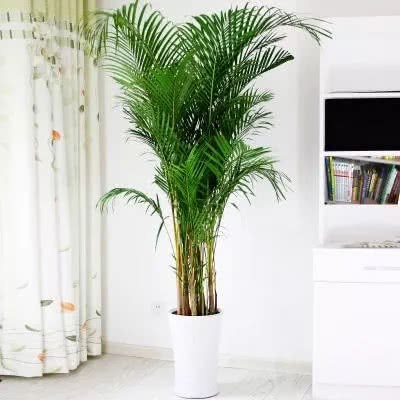
Growing plants is now an indispensable part of our lives. Whether large or small, every household keeps a potted plant or two. Some people like to grow flowering plants, but others happen to prefer foliage plants, feeling that this kind of green plant kept at home not only purifies the air but also gives a full sense of freshness. So today, Huahua recommends a foliage plant that is very well suited to growing at home - the areca palm (Dypsis lutescens)!
The areca palm as a whole is on the larger side. If grown well, it spreads out like a small forest. Just like the one at Huahua's friend's home, so big it had to be tied up with rope, and its leaves are on the whole quite green. Though they aren't as glossy as those of other plants, this actually adds greatly to its ornamental appeal.
The areca palm is a typical tropical plant, so its growing environment must be kept warm and humid. Apart from winter, when low temperatures slow its growth rate somewhat, the temperatures in the other seasons all favor its growth. But in winter we just need to keep it indoors and it will be fine.
As we grow it, we will occasionally find its leaves turning yellow, and some will slowly curl up. When this happens, it is mostly a sunlight problem. You should know that this kind of large green plant cannot withstand long periods of direct sun exposure, yet it also can't be kept where it gets no sunlight at all, so it should be placed somewhere with indirect light.
Then there is the matter of watering. Because its size is on the larger side, its water needs are greater than those of other plants, and now that temperatures are getting higher and higher and water evaporates quickly, the pace of watering naturally has to keep up.
Because when growing this plant we use fairly tall pots, we must check how moist the soil is before watering. We can keep a thin wooden stick on hand, insert it into the soil and then pull it out. If it is too moist, that means it is not yet time to water again. What's more, this also lets air into the soil! But we must be careful when doing this not to damage its roots!
Although we need to ensure its water supply, we must also be careful not to let water accumulate; just water it thoroughly. If this does happen, we should first make a judgment. As long as the roots aren't rotten, we can use the method of withholding water and place it somewhere ventilated to speed up evaporation. But if the roots are rotten, we must take it out, trim the roots and let it dry, to prevent it from continuing to rot in the pot!
Because its plant body is relatively large, it is also rather troublesome to handle, so when it comes to soil we should choose one with strong air permeability, otherwise water cannot seep down. It is also best to repot it with fresh soil regularly, as this will be more conducive to its growth and will greatly reduce the occurrence of water accumulation.
If yellow leaves appear, besides adjusting our care, we can also prune: cut off all those yellowed and curled leaves so they don't affect one another. Moreover, the areca palm itself is a fairly large plant, and regular pruning will do a good job of controlling its shape, or you can simply tie it up with rope, so it won't grow lopsided and sprawling!