A few tricks for growing loofah on the balcony, to make the loofah grow more vigorously
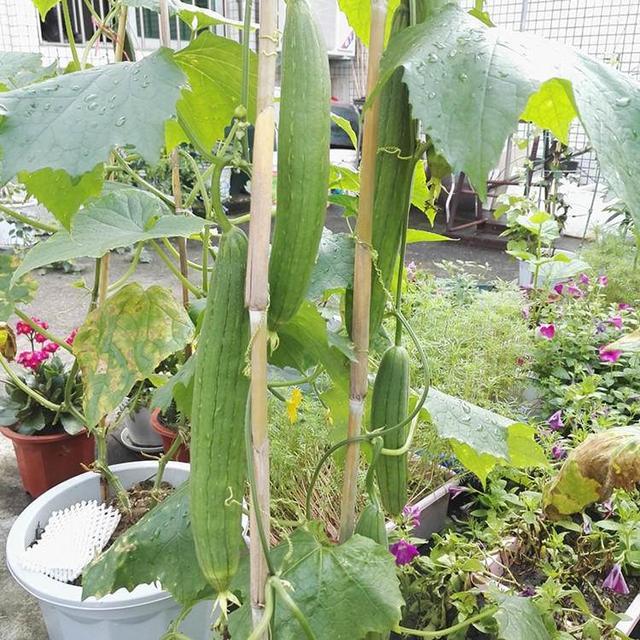
In summer, with plenty of rain, if you are a flower lover who enjoys growing plants, you might as well plant some melons, fruits and vegetables; they are easy to harvest and safe to eat with peace of mind. Especially if you have a small balcony, plant a few loofah plants on it, make good use of a few little tricks, and the fruit set will be what you would call "top-notch".
Because loofah likes warmth and tolerates high temperature and high humidity, flower lovers can generally use spring sowing; those in Central China, East China and North China can sow and raise seedlings between March and April, transplant in May, and harvest in summer and autumn.
In addition, loofah is a short-day plant, growing and developing quickly under high temperature and short daylight, while with summer sowing the temperature is high, the daylight is long, the stems and leaves grow vigorously, the node position where female flowers appear is high, and flowering is late, so choose varieties that are not strict about natural conditions and can still set fruit relatively early under long daylight.
1. Raising seedlings
In early spring, flower lovers can raise seedlings in nutrient pots or nutrient soil blocks. Before sowing, soak the seeds first to promote germination; generally soak them in warm water at 50-55°C, stirring constantly, and after the water temperature drops, change to clean water and soak for 10-24 hours, rinse off the sticky matter, wrap them in a wet towel and place them at 30°C to promote germination; once the white root shows, they can be sown.
Before sowing, water the nutrient pots thoroughly, put 1 sprouted seed in each pot, and cover with about 1 cm of fine soil. The seedbed should preferably be covered with plastic film to keep in moisture, and the nursery temperature should be kept at around 30°C; after the seedlings emerge, ventilate and lower the bed temperature to below 25°C and above 20°C; after the two cotyledons unfold, adjust the bed temperature to 16-18°C. Also give short-day treatment for about 7-10 days, so that female flowers can appear early after planting.
The seedling stage is 20-30 days; 10-15 days before transplanting, gradually increase ventilation, and adjust temperature and humidity according to the growing environment to harden the seedlings, but prevent the young seedlings from being damaged by cold, and the temperature must not be lower than 15°C.
2. Transplanting
Loofah has a long growing period and sets many fruits, so the planting site must be given sufficient base fertilizer; the base fertilizer is best barnyard manure or chicken manure fertilizer with complete nitrogen, phosphorus and potassium and relatively long-lasting fertility. Planting density: determined by the variety planted and the way the trellis is set up. Common loofah is generally grown beside houses or along wall bases, climbing trees or walls in scattered plantings.
3. Fertilizer and water
Common loofah is managed more extensively than ridged loofah. If sufficient base fertilizer was applied at planting, then apply little fertilizer in the early growth stage to prevent excessive vegetative growth, and topdress as soon as the first flowers appear. For topdressing, it is recommended to use an organic liquid fertilizer specially for fruits and vegetables, diluted 500 times with water, and water the roots once every 7 days.
The fruiting period needs sufficient fertilizer and water; in the hot season, water in both the morning and the evening, and keep the soil in the beds fairly moist at all times. The relative soil humidity should be around 80%-90%.
4. Building a trellis and training the vines
Loofah has strong branching ability, and both the main vine and side vines can bear fruit. To make the plant bear more fruit, generally do not remove the side vines; set up a relatively tall shed frame or support in time to train the vines to grow, and if there are too many side vines, you may keep 2-3 vigorous vines, earth up and press down the vines before they go up the trellis, and after the stems and vines are on the trellis, guide them by hand so they are evenly distributed; they will soon cover the balcony, heavy with fruit.