If you are even slightly careless with geranium summer care, they can easily rot and die.
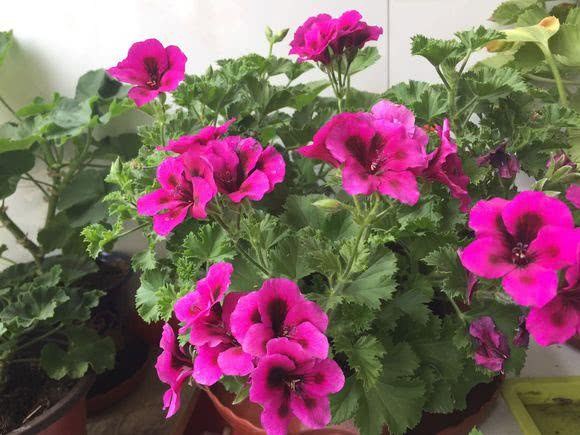
It is only just the start of summer, and this whole week has been scorching hot. I have also seen fellow flower lovers worrying about how geraniums will get through the summer. I get especially nervous every summer too. Although I have several years of experience getting them through summer, I still have to tend them carefully. Below, let's talk about the problems that may come up when geraniums get through the summer:
What are geraniums afraid of when getting through summer?
1. High temperatures
High temperatures can affect the formation of chlorophyll in new geranium shoots. Leaves lacking chlorophyll will turn yellow-white. Here in summer, when the minimum temperature exceeds 28°C, the new shoots of geraniums that cannot tolerate heat will turn albino. When the minimum temperature exceeds 30°C, most zonal geraniums and ivy geraniums will produce white leaves. Regal pelargoniums and angel pelargoniums will gradually develop yellowing and drying of old leaves because water evaporates too quickly.
2. Damp heat
In the Jiangnan region, there are several weeks of "plum rain season." Although there is no strong sun and it is often cloudy and rainy, the temperature is not low, and the air humidity is very high. In such a season, if you do not promptly clear away the dead leaves at the lower part of the geranium, you can basically see white fuzz (mold) starting to grow on the dead leaves in the flowerpot after just one day. At this time, the levels of various pathogens in the soil are very high, and with the slightest carelessness, the geranium will develop black stem. In the early stage of black stem, it often cannot be seen with the naked eye, and the symptoms shown by the geranium are rather similar to lack of water: the leaves wilt and then turn yellow and dry. If you do not pay attention, you will often increase the amount of watering, which further worsens the black stem condition, until in the end the blackened, rotting stem completely breaks off.
3. Too dry
Because of worry about black stem, many flower lovers use water control to grow geraniums in summer, but improper water control can leave the root system short of water, causing old leaves to gradually turn yellow and drop. For mature regal pelargoniums and zonal geraniums whose main stems have become woody, I do not control water, but water every day, watering thoroughly. (Old pots, well-developed root systems, soil filled throughout with roots, so I water boldly and confidently. They still remain lush with branches and leaves in summer. They can even bloom.) Ivy geraniums and angel pelargoniums get a thorough soaking one day and a moderate amount the next. For sub-mature plants that have not yet become woody, water carefully, slowly pouring a ring of water along the flowerpot, and a moderate amount is enough. Try as much as possible not to wet the green main stem.
Main causes of death
1. Black stem
The cancer of geraniums; basically, once discovered, there is already no saving it. The cause is damp heat.
2. Weakening and death due to inability to carry out photosynthesis
If new leaves cannot produce chlorophyll because of high temperatures, and old leaves have also lost all their leaves because of drying out, then the plant will weaken and die because there is no chlorophyll to carry out photosynthesis.
3. Death by drying out
Excessive water control damages the root system, and in the hot weather new roots are not easy to grow, so the plant gradually dies of thirst.
Fellow flower lovers who like geraniums should comprehensively consider what summer-survival measures to take according to their own geraniums' conditions. I hope that after the autumn cool arrives, you can see the geraniums that made it through summer bloom beautiful flowers. (As for the issues of soil and watering methods, I wrote about them in a post before, so here I am being lazy and not writing them.)