A succulent arrangement done in five minutes, teaching you how to create a colorful and varied display
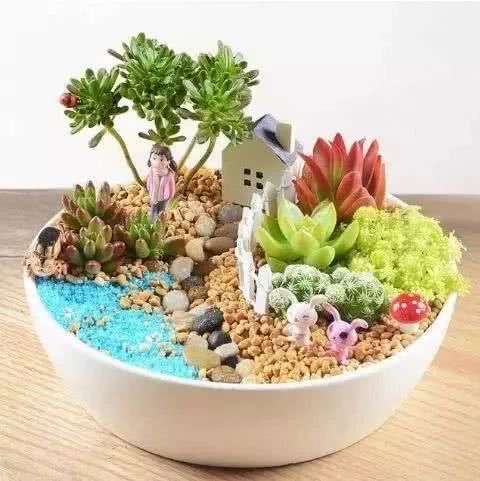
The best viewing period for sedums is autumn and winter, so planting in autumn is recommended, as you can enjoy them for a longer time, followed by winter. Unless you live in a city where it feels like spring all year round, try to avoid spring, because summer will soon arrive with its harsh conditions; in summer, it is best to minimize planting activity.
Step one: Fill the soil.
This is the most basic task and should not be done carelessly. The soil must be pressed firm and filled as level with the rim of the pot as possible. On one hand, after planting, a certain degree of firming is needed to hold the plants in place; on the other hand, it gives the plants more room to grow so they will not be squeezed into a corner. In addition, plants that naturally stretch out beyond the pot give a greater visual sense of beauty.
The last reason is that after long-term watering, the planting medium will be lost to varying degrees and naturally compacted, and the soil surface will gradually sink.
Step two: Prepare the plants
Choose healthy plants free of pests and diseases, and trim the roots. Many people plant and fill soil at the same time in order to preserve as much of the root system as possible, but this is actually completely unnecessary. When temperature and humidity are suitable, sedums root very quickly; they can even root while just sitting in the air. I simply cut off the plant's aged stems together with the root system entirely.
The most effective method is to place the trimmed plants in a cool, ventilated spot and let them dry until slightly wilted. In this way, after potting, the plant's survival instinct will prompt it to root faster and resume growth.
It is worth mentioning that if the plants have been dried, then it is best to use moist soil during the first step of filling the pot; if the plants have not been thoroughly dried, the soil should preferably be kept relatively dry.
Step three: Planting.
Prepare a small-headed tool such as tweezers or a dedicated hole-punching tool to help you insert the plants into the potting soil.
Since the roots have already been thoroughly trimmed, at this point you can easily use a tool to plant the plants firmly into the soil and press firm. For plants that have not retained a longer stem, use a tool to poke a small hole about the thickness of a finger in the soil surface where you plan to plant, which helps retain a certain amount of moisture and space around the plant's roots and to some extent helps with rooting, then simply place the plant on the soil surface.
To keep the arrangement lasting, it is best to reasonably reserve growing space between plants, which also requires some understanding of the plants' characteristics, especially the size of mature plants. But this is not set in stone either; plants are highly adaptable, a small environment cannot produce an oversized plant, and the purpose of control can be achieved through later care. Still, beginners to arrangements should adopt the principle of looser rather than tighter, appropriately leaving more space, and should not blindly pursue getting everything perfect in one go.
It is recommended to plant some small ground-cover plants in the empty spaces in the pot, such as Sedum anglicum, Sedum lineare, and Sedum japonicum, and you can also mix in some small Crassula varieties such as Coral Beads, Bai Miao, Hong Shu Zhu, David, and Egret to add color and texture. There is no need to fill everything at once; during later care, the small plants will spread out and form a more natural and harmonious effect.
Step four: Top dressing
This step is optional. Top dressing has advantages and disadvantages. The disadvantage is that you cannot intuitively gauge the dryness or moisture level of the potting soil; the advantage is that watering is less likely to wash up the soil surface, and it helps isolate moisture that can easily cause rot. There is another reason: for me, since I generally aim for both ornamental value and saving planting space, I usually make full use of the space in the pot; but for many enthusiasts who pursue the creation of artistic conception, they will leave "blank space" within the pot, and those "blank space" areas need top dressing for embellishment. As for the material used for top dressing, enthusiasts need to choose according to different situations.
Step five: Place in a ventilated spot with diffused light
A newly completed arrangement, since new roots have not yet sprouted, is not suitable to be placed directly in sunlight for care. Proceed gradually, and after one week gradually increase light exposure. Water after the potting soil has dried out completely.
Generally speaking, once a good arrangement is completed, because sufficient consideration was already given in the early stages to plant selection and planting space, later care is nothing special. It is the same as growing sedums generally: strengthen observation and detect hidden problems early, and that is enough. Of course, you can adjust the plants in the pot according to your own preferences, whether replacing or pruning them.
When replacing, it may be inconvenient to pull the entire plant out directly with its roots. You can first cut the plant off near the root area, replant it elsewhere, and then dig out the root portion.
It is worth mentioning the repotting that many people care about. Yes, although a good arrangement will not become overcrowded in three months as some people worry, it is still best to repot every one to two years. However, this is not due to the arrangement itself; the growth pattern of sedums is simply that new leaves sprout and old leaves wither.
LOVE. Soilless Farm
Soilless FarmShengguo Ju Mall
Discover the beauty of growing flowers