Want roses to cover your wall? Pruning techniques revealed
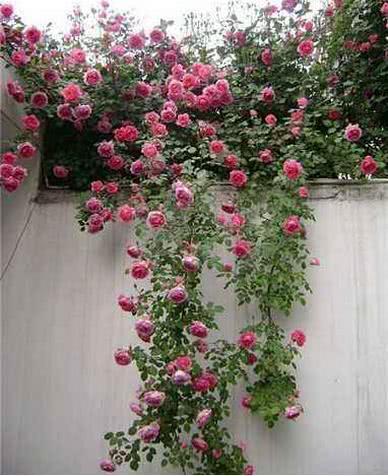
Climbing roses generally grow astonishingly vigorously, with plants reaching several meters tall, numerous branches that can spread over dozens of meters, and many varieties can cover an entire wall within a few years. Gardeners who grow climbing roses are advised to plant them in the ground; the best option is to prepare a planting spot beside a wall, an iron gate or a railing. If conditions are truly limited, choose a relatively large flower pot to reserve enough space for root growth.
To get roses to bloom abundantly, you first need to understand the growth patterns of their branches, leaves and flowers. First, the rose grows main stems, and then each main stem produces many small side branches -- flowering branches. Generally speaking, the tip of each main stem will bloom, but there are only a few main stems, so the flowers produced on the main stems account for only a very small portion of the total bloom count.
Flowering branches are the main force behind blooming. There are many flowering branches and they grow relatively close together, so when the flowering season arrives, the blooms on the flowering branches make up the main part. Therefore, to ensure abundant blooming, first, let the rose grow more new main stems; second, let the main stems produce more flowering branches. As for pruning timing, roses are generally given one major pruning in winter so the plant can conserve its strength and grow quickly when spring arrives the following year; after each bloom, give a minor pruning. Once the flowers fade, the flower stalk serves no purpose other than wasting nutrients.
The general principle of pruning is roughly: prune the main stems only slightly, prune the flowering branches heavily, and prune the flower stalks immediately after blooming. First, heavily prune the flowering branches on the old main stems, keeping only the stems of a few flowering branches. If a new main stem has grown from an old main stem, and the old main stem has already bloomed, you can cut off the old main stem at the point where the new main stem emerged, removing the "old" and keeping the "new."
For newly grown main stems, observe them carefully. If the new main stem has not yet produced flowering branches, simply shorten the tip slightly. If the tip of the new main stem has already produced many flowering branches, you can choose to cut off a large section where the flowering branches have clustered, so as to send more nutrients to the lower main stem, encouraging more flowering branches to grow and thereby increasing the number of blooms.