Why do roses always bloom more in other people's gardens? Have you trained yours?
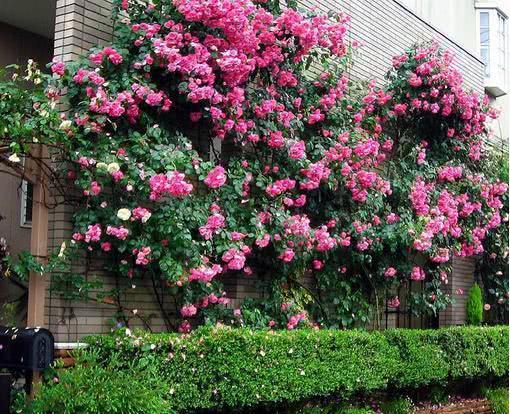
Perhaps many flower lovers who grow climbing roses at home will from time to time have this confusion: why does my rose grow so vigorously, with leaves so dense it looks like a big tree, yet when it comes time to bloom it only opens a few scattered flowers? Is it really true that the moon is rounder abroad, and roses are more beautiful in other people's gardens?
First, I think it is necessary to give all you flower lovers a little lesson on some plant growth knowledge. In botany there is a term called "apical dominance." What does it mean? Think of it this way: the tip has the advantage of being supplied with nutrients first, meaning nutrients are preferentially delivered to the tip. To put it even more plainly, roses are plants that tend to bloom at the tips.
But this trait has another drawback. What is that drawback? It is that most of the nutrients are delivered to the tips, so you can imagine that the other, shorter branches cannot get enough nutrients to bloom. Just think: if only the tips bloom, then the whole rose plant won't produce many flowers!
So what should be done at this point? Perhaps some clever flower lovers have already thought of it: since nutrients tend to flow upward, then just try to keep all the branches at roughly the same height, and wouldn't that solve it?! Exactly right! This is the highest principle for training roses! Keeping all the branches as much as possible on the same horizontal line can weaken apical dominance, thereby allowing all the branches to receive balanced nutrients.
The best time for training is after pruning, as this makes it easier to do, and it is generally during the rose's dormant period in winter. The growth habit of climbing roses is to grow upright and upward, so at this time we should give them appropriate guidance, not letting them grow "straight" but letting them grow "crooked."
At this point, the only way is to "bend" the main stem and train it in a horizontal direction, which can encourage more flowering branches to grow (those small side branches, that is, branches that can bloom, so they are called flowering branches). At this time, if you have a railing or iron gate or something, that is the best training prop! Just let the main stem and branches climb horizontally onto the support, really simple and rough!
If there is no railing or iron gate, you can also make some simple support frames yourself: set up a few vertical wooden strips and then a few horizontal wooden strips, and you can smoothly train the branches. The most common is to build a circular frame and let the branches wind around the circular frame in circles; when it comes time to bloom, it becomes a circular flower cylinder.
The so-called horizontal training is only meant to give everyone a direction. When putting it into practice, you can improve and shape it according to the actual situation. For example, forming a flower garland along a circular arch is very beautiful. Beauty has never been a concrete definition. Between blooming more and blooming beautifully, make the most harmonious adjustment. I believe that you, being clever, will decide for yourself.