How to prevent and control pests in pick-your-own sightseeing orchards without spraying pesticides?
"Zero-pesticide" pest prevention and control technology for pick-your-own sightseeing orchards
The "zero-pesticide" pest prevention and control technology means that, on the basis of carrying out manual and physical pest control during the dormant period of fruit trees, according to the biological characteristics of the pests, during the pest occurrence period, yellow sticky boards, insect-killing lamps, sex pheromone lures and the like are used to trap and kill the pests, keeping them within the allowed range of the control threshold, thereby achieving a comprehensive prevention and control technology that completely replaces chemical pesticide pest control. At present, this set of pest prevention and control technology has been used in multiple sightseeing picking orchards in Xingtai County, Shahe City, Lincheng County, Neiqiu County, Wei County, Longyao County, Linxi County and other counties and cities of Xingtai City, and the good-leaf rate and good-fruit rate of fruit trees in the demonstration areas are all above 90%. In addition, the fruit from several of these sightseeing picking orchards has obtained green fruit and organic fruit certification. The specific technology is summarized as follows:
1 Pest control technology using the biological characteristics of pests during the pest occurrence period
1.1 Control by binding grass around the trunk
Mainly used to control pests that have the habit of moving down the tree to overwinter, such as the walnut fruit moth, leaf miner, tortrix moth, aphids, mites, scale insects, peach fruit borer, pear fruit borer, peach pyralid moth, jujube inchworm, brown marmorated stink bug and other overwintering pests. Starting in late August each year, bind a ring of grass around the trunk at 10 cm from the first tier of main branches. The grass bundle should be tied loose at the top and tight at the bottom, without gaps exposing the bark, and about 3-5 cm thick. In early spring of the following year, untie them and burn them in a centralized manner. This method can control a variety of overwintering mature larvae and also prevent fruit trees from freezing damage.
1.2 Control by barrier method
Mainly used to control pests that have the habit of moving up the tree to cause damage, such as peach fruit borer, pear fruit borer, peach pyralid moth, jujube bud-eating weevil, jujube inchworm, giant mealybug, green plant bug, red spider mite and others. Before the fruit trees sprout, scrape the bark of the trunk, then apply a ring of insect-sticking glue on the trunk at 30 cm above the ground; a width of 3-5 cm is enough to cut off the passage for crawling pests to climb up the tree and cause damage, thereby achieving the purpose of control.
1.3 Control by yellow sticky board trapping
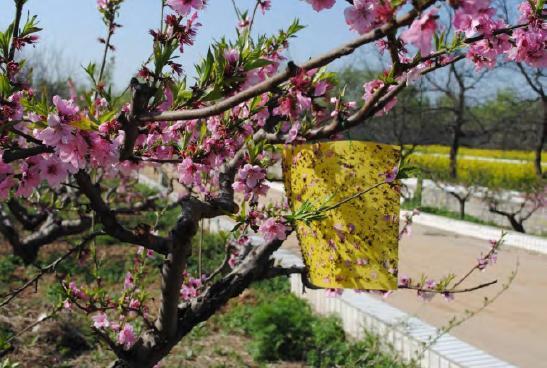
Yellow sticky boards are mainly used to trap and kill some small and micro pests that are attracted to yellow, mainly aphids, planthoppers, leafhoppers, thrips, bugs, flies and mosquitoes and others. The yellow board specification is 20 cm x 25 cm, with about 25 boards used per mu. Hanging begins in early April, at a height of 1-1.5 m above the ground. When hanging, use a plastic rope or wire with one end fixed to the trellis and the other end tied to the reserved hole on the yellow board. Use a zigzag distribution or a distribution parallel to the row direction; yellow boards placed in an east-west orientation have a better trapping effect than those facing north-south. When more than 60% of the area of the yellow board is stuck with insects, the yellow board should be replaced promptly, and it should also be replaced promptly when the sticky glue no longer sticks. Practice has proved that yellow boards can completely replace chemical pesticides in trapping and killing small and micro pests attracted to yellow, truly achieving zero pesticides (Figure 1) [Jishan Huayao].
Figure 1 Yellow sticky boards hung for trapping and killing at the Wei County High-efficiency Agriculture Demonstration Base
1.4 Control by insect-killing lamp trapping
Insect-killing lamps use the phototaxis, wave and other characteristics of pests, applying light, wave, color and scent, together with a high-voltage electric grid, to trap and kill pests. Insect-killing lamps have a good trapping and killing effect on adult pests of Lepidoptera, Coleoptera and others. They mainly trap and kill Lepidoptera pests, accounting for about 85%-90% of the total number of pests trapped and killed. They also trap and kill natural enemy beneficial insects, mainly bees, dragonflies, ladybugs, mantises and others, but the number of beneficial insects killed accounts for only about 0.1% of the total insect count. In areas with convenient power facilities or where power facilities are easy to set up, light-controlled and rain-controlled insect-killing lamps are used, while in areas where it is not convenient to set up power facilities, solar insect-killing lamps are used. Insect-killing lamps should be placed as much as possible in open spaces among the trees where the light source is not blocked, with a distance of 80-100 m between lamps; on average, placing 1 insect-killing lamp per 30 mu is sufficient. The hanging height of the lamp should be just above the fruit trees, and the hanging time starts in mid-April each year and generally ends at the end of September. When in use, turn on the lamp at 7 p.m. each day and turn it off at 5 a.m. the next day, and do not turn on the lamp on thunderstorm days. Brush the high-voltage grid once every 1-2 days, and clean the insect collection bag once every 1-3 days (Figure 2).
Figure 2 Solar insect-killing lamps hung for trapping and killing at the Jinmiao Ecological Orchard in Neiqiu County
1.5 Control by sex pheromone lure trapping
Sex pheromone lure trapping of pests works by artificially synthesizing the chemical components called sex pheromones released by female moths after sexual maturity, attracting male moths of the same species in the field seeking to mate, and trapping and killing them in traps, so that the females lose the opportunity to mate and cannot reproduce offspring effectively, thereby reducing the population of the next generation and achieving the purpose of controlling such pests. Practice has proved that for pests causing relatively serious damage in orchards, such as peach fruit borer, pear fruit borer, peach pyralid moth, green plant bug, leaf miner and others, hanging sex pheromone lure traps is the most effective control method, and sex pheromones have the advantages of low cost, no pollution, good effect and simple operation, and conform to the production regulations for green fruit. When in use, generally place one trap every 15-20 m; in densely planted orchards, the spacing should be somewhat smaller, and the hanging height is preferably 1.5 m above the ground (Figure 3). Under normal circumstances, replace the lure core once every 1-2 months, and during this period promptly inspect and repair the traps to prevent pests from escaping killing. Timely clean out the dead insects in the traps and bury them deeply. The traps can be reused, and discarded lure cores should be buried deeply for disposal. Green plant bug lure cores are hung at the end of April; pear fruit borer lure cores are hung at the end of March in peach orchards or orchards mixed with peach trees, and in pure pear and apple orchards they are hung in early May; peach fruit borer lure cores are hung at the end of May; peach pyralid moth lure cores are hung at the end of April; leaf miner lure cores are hung in early April.
Figure 3 Triangular sex pheromone lure traps in a jujube orchard in Lincheng County
2 Comprehensive manual and physical prevention and control technology during the dormant period of fruit trees
2.1 Prune out insect-infested branches and mummified fruits
Prune out branches, fruits and the like carrying pests and burn them in a centralized manner to prevent aphids, longhorn beetles, scale insects and others, and reduce the overwintering base of the pest population.
2.2 Thoroughly clean the orchard
Many pests of fruit trees, such as cicadas, moths, whiteflies, spider mites and other pests, overwinter in dead branches, fallen leaves and mummified fruits. Therefore, after the fruit trees shed their leaves, promptly clean up the weeds, fallen leaves and fallen fruits in the orchard, and bury them deeply, burn them or compost them at high temperature in a centralized manner, to reduce the overwintering base of pests, which can effectively reduce the number of pests occurring the following year.
2.3 Deeply plow the orchard soil
When deep plowing, turn the soil around the trunk from shallow to deep outward in all directions; at more than 1 m from the trunk, plow about 20 cm deep, turning the topsoil below and the subsoil above. When encountering roots 1 cm in diameter, take care to protect them and never cut them off.
Through deep plowing, the overwintering nests of pests in the soil can be destroyed, and the pests are frozen to death or dried to death, or can also be directly killed by the tillage machinery. Plowing can also turn a large amount of pest- and disease-carrying weeds, fallen leaves and diseased fruits on the soil surface deep into the soil, both increasing the fertilizer source and reducing the source of pests and diseases. [Jishan Huayao]
2.4 Scrape the tree bark
Scraping the bark of fruit trees is an important measure in winter orchard management. It not only helps strengthen the tree vigor and prevent the tree from prematurely aging, but can also eliminate pests overwintering in the cracks of the bark, control or reduce the occurrence and damage of some pests the following year, thereby achieving the effect of "no pesticide applied, better than pesticide applied." After removing the grass bundles from the trunks, begin winter bark scraping of the fruit trees, mainly scraping off the coarse bark and curled bark on the trunk and main branches. The degree of scraping should be such that the light brown bark layer is scraped off, revealing green but not white. When scraping the bark, spread a plastic sheet under the tree to collect the scraped bark and debris, and bury them deeply or burn them in a centralized manner (Figure 4).
Figure 4 Jujube trees in a jujube orchard in Lincheng County after bark scraping during the dormant period
2.5 Whitewash the branches and trunk
Whitewashing the branches and trunk can not only effectively prevent freezing damage and sunscald, but also provide good control of pests and diseases remaining on the branches and trunk. The concentration used should be such that after application to the branches and trunk it neither runs down nor forms lumps. Never brush incompletely slaked quicklime onto the trunk, otherwise the quicklime will absorb water and release heat and burn the trunk. When brushing, it is best to choose a soft brush.