How to grow freesia in pots? Detailed guide to home growing techniques
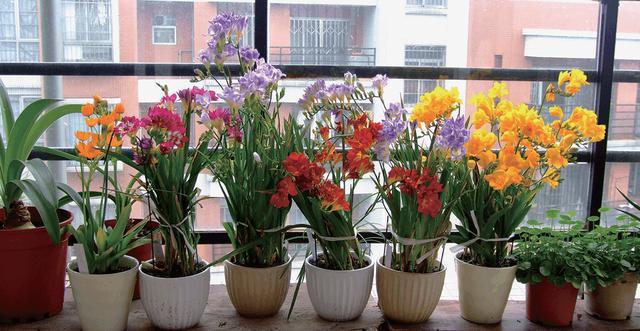
Home potted freesia growing techniques
Freesia, also known as xiaocanglan, xiaochanglan, changlan, and changpulan, is a perennial bulbous plant in the genus Freesia of the family Iridaceae. There are about 20 species of Freesia plants worldwide, mainly distributed in southern Africa. Only 1 species is commonly cultivated in China, namely freesia. The corm of freesia is narrowly ovate or ovate, covered with a membranous tunic bearing a netted pattern and dark red spots. The leaves are sword-shaped or linear, slightly curved, 15-40 cm long and 0.5-1.4 cm wide, yellow-green, with a prominent midrib. The flower stem is erect, with 2-3 curved branches on the upper part; the flowers are sessile, erect, pale yellow or yellow-green, fragrant, 2-3 cm in diameter; the perianth tube is trumpet-shaped, with 6 perianth lobes arranged in 2 whorls. The capsule is nearly ovate. The flowering period is April to May, and the fruiting period is June to September. It is native to southern Africa. In southern China it is mostly grown outdoors, while in northern China it is mostly grown in pots. It is grown for ornament, and the flowers can be used to extract essence. Most freesias cultivated today are cultivars, with a wide range of flower colors including yellow, white, red, pink, lilac, and purple, single or double, and cultivated varieties include 'Mercury', 'River', 'Snow River', 'Santiago', 'Honeymoon', 'Vulcan River', and others.
Freesia is mostly propagated by division of corms. After the flowers fade, the weather gradually enters summer and the aboveground parts slowly die back. At this time the potting soil can be tipped out and the corms picked out and graded by size. Generally, corms 1 cm or larger can flower the following year, while small corms need 1-2 years of cultivation before they can flower. The graded young corms can be placed in envelopes or mesh bags and kept in a ventilated, shady place to spend the summer.
Planting can be done when the weather is cool. In the north it can be done in September to October, and in the south in October to December. For the growing medium, commercially available potting soil can be used, or a mix prepared from peat, leaf mold plus a small amount of base fertilizer and perlite, etc. Avoid heavy clay soil to prevent poor growth. The number of corms to plant can be decided according to the size of the pot; generally a 120 cm flower pot can hold about 10 corms. After planting, cover with soil to a depth 1-2 times the diameter of the corm, and water once thoroughly to keep it moist. About 10 days after planting, they sprout. The freesia flower stems are weak and prone to lodging, so when the plants are 15 cm tall, supports can be set up with wire or thin bamboo stakes.
Freesia likes strong light. Under insufficient light it grows poorly and is prone to lodging. For indoor care, it can be placed on a balcony, windowsill, or other place with ample light. Short-day conditions favor flower bud differentiation and can increase the number of flowers. It does not have high water requirements; the soil only needs to be slightly moist. Prolonged excessive moisture causes leggy stems and leaves and makes lodging likely. It does not have high fertilizer requirements; fertilizing 3 times during the growing period is enough. In the early stage, a general-purpose compound fertilizer of 20-20-20 can be used, and when flower buds are differentiating, 1-2 applications of a 15-20-25 flowering fertilizer can be given. [Jishan Huayao]
About 100 days after planting, it will bloom. After the flowers fade, cut off the flower stalks to prevent nutrient consumption, which helps the corms accumulate and swell. After the flowering period, control watering, and when the aboveground parts dry up in May, lift the corms out. Freesia is an excellent popular flower, widely grown by the public. It is easy to cultivate, richly fragrant, and elegant in flower form. It can be potted for decorating halls, and can also be used as cut flowers in vases to decorate dining tables, desks, and so on.