What are the methods for propagating Cattleya orchids at home?
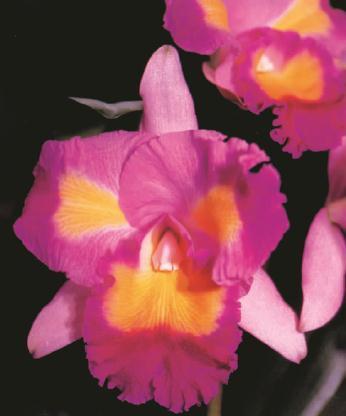
How do you propagate Cattleya orchids at home?
Cattleya is the "queen of orchids", incomparably beautiful, with flowers that can be as large as a human palm. It is easy to grow in southern homes and has strong propagating power.
At home, you can use the simple division method to propagate. However, Cattleya differs slightly from other orchids in division, such as Paphiopedilum and Cymbidium, which only need to be split apart from the base. Cymbidium in particular, like Chinese orchids, has "lan tou" (pseudobulbs) connected to one another.
Cattleya mostly connects the various "lan tou" through creeping stems, and is divided into single-leaf varieties and double-stem varieties. The leaves are all attached to the "lan tou".
New stems grow from adventitious buds differentiated on the "nodes" at the base of the "lan tou". In other words, the "lan tou" are not connected to each other; rather, the creeping stems serve as their "underground bridges". Therefore, when propagating by division, you should cut between the base of two "lan tou".
You can use a new blade or a sterilized sharp knife as the cutting tool. Never tear with your hands or cut with a blunt knife, because this will squeeze the creeping stems and damage the cell tissue at the cut.
If a sharp knife is not sterilized and has previously cut orchid plants with a virus (virus disease), it will transmit the virus through the cut, and it cannot be cured. If the tool is sterilized with fire, it must be cooled before use.
The cut should be disinfected with "Daxian" powder or charcoal powder.
The side of the "old lan tou" can be grouped as three growths (three "lan tou") [Jishan Huayao]; while the side near the new shoot can be grouped as two growths, or one growth plus a newly grown shoot.
If the "old lan tou" is withered and brown, it can be cut off; but if it is still green and firm, even if the leaves above have broken off from the "lan node ring", it can still be retained, because it still has nutrients.
Never propagate with a single growth, or with one "old lan tou" connected to only one semi-aged growth, otherwise the future growth will surely be weak and it will be harder to bloom.
In the south, division should be done during the spring and autumn rainy seasons, and should not be done on stormy days or in too cold a season.
After division, it can be planted in osmunda fiber (tree fern fiber), with charcoal chunks as the bottom layer; in the dry season, lay a layer of wet sphagnum moss on top to retain moisture. The "lan tou" should be exposed above the surface of the medium. The flower pot should preferably be an unglazed clay pot.
Cut between the base of two "lan tou"
Cattleya after division