How to grow Brunfelsia latifolia in pots? Detailed explanation of cultivation techniques
Pot cultivation techniques for Brunfelsia latifolia
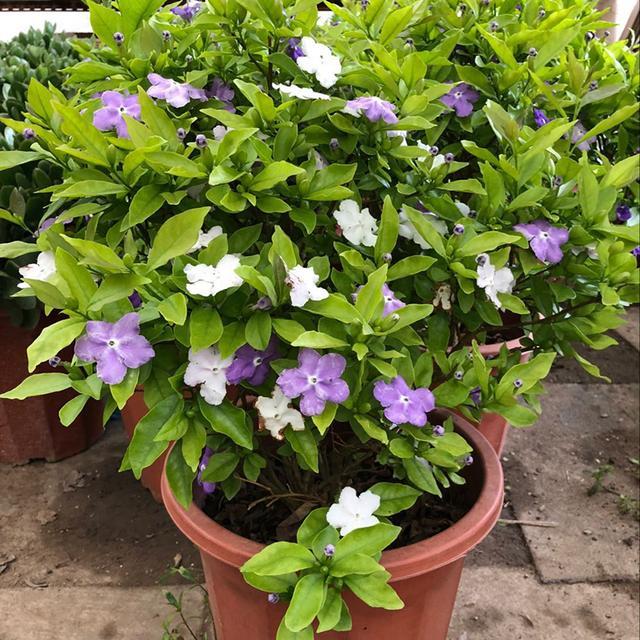
Brunfelsia latifolia (Brunfelsia latifolia) is native to the Americas and is an evergreen shrub of the genus Brunfelsia in the Solanaceae family, 50-100 cm tall, with alternate simple leaves. The flowers are mostly solitary and rarely several clustered together; the corolla is salverform with shallow lobes. The flowering period lasts as long as half a year (April to October), and a single flower blooms for about 5 days. It first opens purple-blue, gradually changes to lavender, and finally turns white. Because the flowers open at different times, purple-blue and white flowers can be seen on the same plant at the same time, and because it has a jasmine fragrance, it is named Brunfelsia latifolia. It is a balcony flower much loved by people. Its cultivation points are as follows:
1. Loose, fertile, acidic soil for planting
Brunfelsia latifolia likes to grow in loose, fertile, slightly acidic sandy loam soil containing more humus. It is best to use a potting soil of 50% leaf mold plus 40% vegetable garden topsoil and 10% sand. It should not be planted in alkaline soil or clay soil. When planting, it is best to place a layer of crushed charcoal or crushed hard plastic foam blocks at the bottom of the pot to enhance air permeability and drainage, prevent root rot, and make it easier to repot and change the soil. It is best to add 100-150 grams of bone meal or NPK compound fertilizer to the potting soil. Repot and change the soil once every early spring.
2. Likes moisture, fears waterlogging, needs more phosphorus and potassium
Brunfelsia latifolia likes to grow in warm and moist places, but fears waterlogging, so during the growing period it should be watered frequently to keep the potting soil slightly on the moist side without becoming waterlogged, and the branches and leaves should often be sprayed with water to increase air humidity and benefit its growth. During the winter dormant period, the potting soil can be slightly moist without being dry; too wet easily causes root rot. It likes fertilizer. During the growing period, apply NPK compound fertilizer once every 10-15 days. Do not apply nitrogen fertilizer alone, otherwise the branches and leaves will grow excessively and there will be few flowers. Do not fertilize during the dormant period.
3. Likes warmth and light, not cold-tolerant
Brunfelsia latifolia is native to the tropical regions of Brazil. It likes a warm and humid climate, fears dry hot winds, and is not cold-tolerant. Therefore, in China, except in the south where it can be planted in the ground as well as in pots, in the Yangtze River basin and areas to its north it is only suitable for pot cultivation and must be brought indoors in winter. During the growing period, it is best to place it in a sunny courtyard or balcony to see more sunlight, but around noon in midsummer it should be slightly shaded; at this time, strong sunlight and exposure can easily yellow the leaves. In winter, growth stalls below 15°C. If kept at 3-5°C for a long time, it is prone to cold damage, so it is best to move it indoors before the lowest temperature drops to 5°C, place it in a sunny spot, and keep the room temperature above 5°C for safe overwintering. If the room temperature reaches 20°C, it can still bloom; at this time, it can be watered appropriately more to keep the potting soil slightly moist. [Jishan Huayao]
4. Moderate pruning for a beautiful plant shape
For household potted Brunfelsia latifolia, especially when placed on a balcony, attention should be paid to pruning. Keeping a rounded crown 30-40 cm high is more beautiful. In early spring, along with repotting and changing the soil, leave about 20 cm of height and prune heavily once. The healthy branches cut off can be used for cuttings propagation. After flowering, cut off the spent flowers, and properly prune the inner branches and overly tall branches.
5. Cuttings and layering can propagate
In spring, along with repotting and changing the soil, cut 2-year-old healthy branches as cuttings. In autumn, cut semi-mature branches of the current year as cuttings; the latter has a higher survival rate. The cuttings are 10-15 cm long. Dip them in muddy VB12 and insert them into plain potting soil, cover with plastic film, and maintain humidity at about 80%. They can take root in about 60 days. For spring cuttings, when the new branches grow to 15 cm, they can be transplanted and established with soil. For autumn cuttings, keep them in the original pot for winter, and pot them with soil the following spring. Alternatively, in spring or autumn, select branches near the pot surface, girdle the bark 1.5-2 cm, and press the girdled part into the soil; they can take root in 50-60 days. For spring layering, cut them from the mother plant in autumn and establish them separately. For autumn layering, cut them from the mother plant the following spring and establish them.