Detailed Explanation of Key Techniques for Raising Cinnamomum camphora Seedlings in Lightweight Substrate Mesh Bags
Research on the Technique of Raising Cinnamomum camphora Seedlings in Lightweight Substrate Mesh Bags
Cinnamomum camphora (L.) Presl. is an evergreen large tree of the family Lauraceae (Lauraceae), and is an excellent spice, valuable timber and street-greening tree species. In recent years, it has gradually become one of the main afforestation tree species in Fujian Province. The seedlings used in traditional Cinnamomum camphora afforestation are one-year-old bare-root seedlings; the afforestation time is restricted by season, the seedling-establishment period is long, and the survival rate is relatively low. Therefore, exploring new models of Cinnamomum camphora seedling raising and cultivating cheap, high-quality Cinnamomum camphora container seedlings has become a new topic for forestry workers [1]. There have been many domestic reports on Cinnamomum camphora seedling-raising and afforestation techniques [2-4], but reports on lightweight substrate mesh bag seedling raising are rare. Through a series of technical measures such as root cutting of Cinnamomum camphora seedlings, treatment of the roots with rooting agent after root cutting, and the mixing ratio of transplanting substrate, this article analyzes and summarizes a technical scheme for raising Cinnamomum camphora seedlings in lightweight substrate mesh bags, for the reference of peers.
1 Materials and Methods
1.1 Overview of the Test Site
The test site is located at the Xichan Forestry Nursery in Wenfeng Town, Pinghe County, Fujian Province. It has a subtropical monsoon humid climate, with an average temperature of 21°C, an average annual relative humidity of 80%, a frost-free period of more than 330 d, average rainfall of about 1 500-1 800 mm, and an average annual sunshine duration of 2 025 h. In terms of transportation, the nursery site has sufficient water sources and a simple shade shed was built. The simple shade shed is 2.5 m high, the shading rate of the shade net is 75%, and the shade net can be retracted and extended.
1.2 Seed Source
The seeds came from the Seed and Seedling Station of the Zhangzhou Municipal Forestry Bureau, with quality reaching Grade II or above as required by GB7908, and were seeds collected in the winter of 2015.
1.3 Test Methods
1.3.1 Seedling Cultivation
Before sowing, the seeds were soaked in a 1 000-fold solution of carbendazim for 10 min, then soaked in 35°C warm water for 40 min, evenly broadcast-sown onto a clean sand bed, and then covered with a layer of river sand, with the thickness of the river sand just covering the seeds. After sowing, rice straw was placed over them to preserve warmth and moisture. When the sprouts broke through the soil, the rice straw was removed. When the seedlings grew to about 8 cm, they could be transplanted.
1.3.2 Seedling Transplanting
Seedlings about 8-10 cm tall on the sand bed were gently pulled up and placed neatly. After root cutting treatment according to the experimental design, the seedling roots were soaked for 1 min in ABT1 rooting agent solutions of different concentrations, and then the seedlings were transplanted into prepared lightweight substrate mesh bags, and enough water was poured to settle the roots. The mesh bag specifications were 5.5 cm in diameter × 10 cm in height, and the mesh bag material was easily degradable non-woven fabric.
1.3.3 Management After Transplanting
Within 5 months after transplanting, shade was provided with a shade net of 75% shading rate to prevent sunburn. After 5 months from transplanting, light was gradually increased, and after 6 months from transplanting, there was no shading. Within 2 months after transplanting, diammonium phosphate (N-P2O5 = 18-46) 1 000-fold solution was applied as a drench once every 15 d. From 2-7 months after transplanting, compound fertilizer (N-P2O5-K2O = 15-15-15) 500-fold solution was applied as a drench once every 15 d. After fertilizing, clear water was used to wash away any fertilizer remaining on the leaves.
1.4 Experimental Design
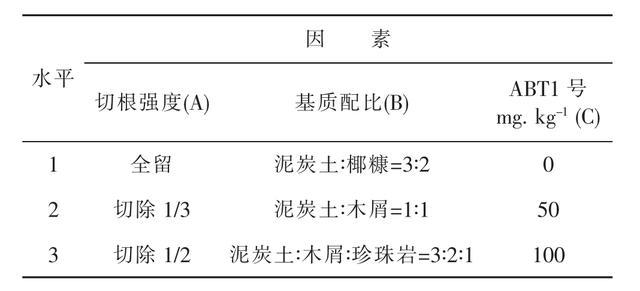
This article used an orthogonal design. Based on years of seedling-raising experience and relevant literature, 3 factors, namely seedling root-cutting intensity, substrate ratio, and ABT1 rooting agent, were taken as experimental factors, with 3 levels for each factor, and an L9(34) orthogonal table was selected for arranging the test [5-6]. The settings of each factor and level are detailed in Table 1. The test indicators were survival rate, seedling height, ground diameter, and the number of first-order lateral roots longer than 5 cm. A total of 9 treatments were designed, with 200 plants planted per treatment. The seedlings were transplanted into bags on April 17, 2016. The survival rate was investigated 100 d after transplanting, with 100 plants investigated per treatment. On February 17, 2017, seedling height, ground diameter, and the number of first-order lateral roots were investigated, with 50 plants investigated per treatment.
Table 1 Experimental Factors and Levels
2 Results and Analysis
2.1 Effects of Different Treatments on the Growth of Cinnamomum camphora Seedlings
It can be seen from Table 2 that the survival rates of Cinnamomum camphora seedlings in all treatments were relatively high, reaching more than 94%, among which treatment 5 was the highest, reaching 99%; seedling heights were all more than 45 cm, among which treatment 4 was the highest, at 54.5 cm; ground diameters were all more than 5 mm, among which treatments 7 and 9 were the largest, both 6.0 cm; and the number of first-order lateral roots longer than 5 cm was more than 14 in all cases, among which treatment 4 had the most, at 18.7.
Table 2 Experimental Scheme and Results
2.2 Effects of Different Factors and Levels on the Growth of Cinnamomum camphora Seedlings
It can be seen from Table 3 that, from the perspective of the effect of root-cutting intensity (factor A), the average survival rate, average seedling height, and average ground diameter of Cinnamomum camphora seedlings were all best under A3, while the average number of first-order lateral roots longer than 5 cm was greatest under A2; from the perspective of the effect of different substrate ratios (factor B), the average survival rate was highest under B2, the average seedling height was highest under B1, the ground diameter was largest under B2, while the number of first-order lateral roots was greatest under B1; from the perspective of the effect of different concentrations of ABT1 rooting promoter (factor C), the survival rate of Cinnamomum camphora seedlings was highest under C3, the average seedling height was highest under C2, the ground diameter was largest under both C2 and C3, both 5.7 cm, while the number of first-order lateral roots was greatest under C3, at 17.2.
Table 3 Analysis of Orthogonal Test Results
In order to further analyze the degree of influence of different factors on the growth of Cinnamomum camphora seedlings in lightweight substrate mesh bags, analysis of variance was performed on the test results in Table 3 to obtain Table 4. It can be seen from Table 4 that factor A had an extremely significant effect on the number of first-order lateral roots of Cinnamomum camphora seedlings, a significant effect on ground diameter, and no significant effect on survival rate or seedling height; factor B had no significant effect on any of the 4 assessment indicators of Cinnamomum camphora seedlings; factor C had a significant effect on the number of first-order lateral roots of Cinnamomum camphora seedlings, and no significant effect on survival rate, seedling height, or ground diameter. Therefore, the order of importance of the 3 factors in this test on the growth of Cinnamomum camphora seedlings was factor A → factor C → factor B, that is, root-cutting intensity → ABT1 concentration → substrate ratio.
Table 4 Degree of Influence of Different Factors on the Growth of Cinnamomum camphora Seedlings
F0.05(2,2)=19,F0.01(2,2)=99。
3 Summary and Discussion
Through a test on the effects of 3 factors at 3 levels, namely root-cutting intensity of Cinnamomum camphora seedlings, substrate ratio, and ABT1 rooting agent concentration, on the growth of Cinnamomum camphora seedlings, the results showed that root-cutting intensity (factor A) [Jishan Huayao] had no obvious effect on the survival rate or seedling height of Cinnamomum camphora seedlings, had a significant effect on ground diameter growth, and had an extremely significant effect on the number of first-order lateral roots, indicating that root-cutting treatment before transplanting Cinnamomum camphora seedlings can promote the growth of ground diameter and lateral roots of Cinnamomum camphora seedlings. Among these, when the root-cutting intensity was 1/2, the average ground diameter of Cinnamomum camphora seedlings was the largest, at 6 mm; when the sprout root-cutting intensity was 1/3, the average number of first-order lateral roots was the greatest, reaching 18, followed by root-cutting intensity 1/2, with an average number of first-order lateral roots of 17.4; and when the sprouts were not subjected to root-cutting treatment, the average number of first-order lateral roots was only 14.7. Substrate ratio (factor B) had no significant effect on survival rate, seedling height, ground diameter, or lateral roots. ABT1 rooting agent (factor B) had no significant effect on the survival rate, seedling height, or ground diameter of Cinnamomum camphora seedlings, but had a significant effect on the number of lateral roots. Among these, when the ABT1 rooting agent concentration was 100 mg.kg-1, the number of lateral roots was the greatest, reaching 17.2, while the seedlings not treated with ABT1 rooting agent had the fewest lateral roots, at 15.8.
The order of importance of the factors in this test on the 4 indicators of Cinnamomum camphora seedling growth was: root-cutting intensity → ABT1 rooting agent concentration → substrate ratio. Among these, the best treatment combination was A2B2C2, that is, excising 1/3 of the main root of the seedling, a substrate ratio of peat soil : sawdust = 1:1, and an ABT1 rooting agent concentration of 100 mg.kg-1, which had the best effect on raising Cinnamomum camphora seedlings in lightweight substrate mesh bags, with a survival rate reaching 99% and well-developed lateral roots.
When lightweight substrate mesh bags are used to cultivate Cinnamomum camphora seedlings, the root system is well developed. After 6 months from transplanting the seedlings, many roots are distributed along the edge of the substrate mesh bag. After 10 months from transplanting, the Cinnamomum camphora root system has already formed a complete root ball with the lightweight substrate mesh bag, and the bag will not come off during handling, transportation, or afforestation. Moreover, it is light in weight, making transportation and going up the mountain for afforestation convenient. Therefore, the technique of raising Cinnamomum camphora seedlings in lightweight substrate mesh bags can be applied and promoted.