Five Vertical Gardening Techniques That Teach You to Grow a Whole Garden and Vegetable Patch from Discarded Bottles
In everyday life, many people want a garden or vegetable patch of their own, but we simply do not have that much space. In this situation, many people just give up, but some veteran gardeners choose another way to make it happen, which is to create vertical vegetable patches and gardens, even using plastic bottles they have picked up.
The first: plastic bottle vertical vegetable garden
The idea below is very simple: just prepare some plastic pots of the same size and slowly stack them up to form a plastic pot vegetable garden.
You need to prepare enough large plastic bottles, preferably ones with a capacity of around 2 liters, plus some metal wire, scissors, a drill bit and a cutting tool.
The method is also very simple. First, cut off the bottom of the bottle, then drill a few holes 5 to 10 cm below the cap as drainage holes, to prevent water from pooling in the soil.
After that, prepare some loose, fertile, well-draining sandy soil, fill the whole plastic bottle with soil, and make some small holes at intervals of 2 to 3 cm from the open end, pushing metal wire through them.
Next, place the new plastic bottles directly over the pots at the bottom. After stacking the plastic bottles one by one, you can lean them against a wall or railing and secure them to the fence with some wire.
Once the plastic bottles are secured, you can drill some large holes in the sides for planting seedlings, and place an empty bottle with no soil on top to store water.
The plastic bottle at the top is used to collect water. The bottle at the bottom must have holes drilled in it, and the sides of the bottles must also have holes drilled in them, to keep the soil well drained.
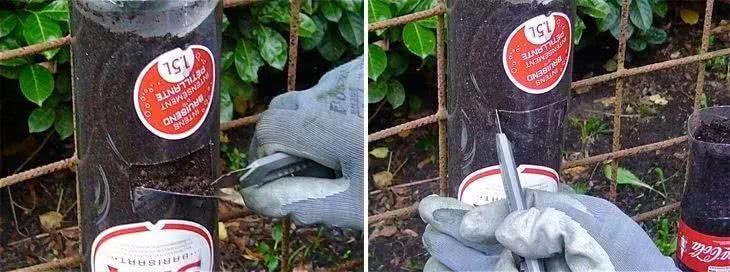
Finally, drill the holes and plant the seedlings. It is best to choose vegetables with a relatively short growing period. As shown in the picture, use a sharp craft knife to cut some larger openings directly in the sides of the plastic bottles.
Then plant the various vegetable seedlings. You can plant cilantro, lettuce, basil, scallions, mint and other plants.
The second: fence vertical garden
The idea above is also very charming: making some cone-shaped vertical planters on a fence, then planting trailing plants on top along with some easy-to-grow small herbaceous flowers, which also looks quite attractive.
First, prepare enough materials: common wooden boards, metal wire, pliers and iron nails, plus some landscaping plastic sheeting and sphagnum moss and plant seedlings.
First, use wire mesh to make some cone-shaped containers. You can use scissors to cut off the excess wire mesh and cut it into a cone shape, so it looks like a triangular prism, to hang on the wall. You also need to prepare a few wooden boards to separate the fence from the wooden frame.
Finally, secure the wire mesh to the wooden board, press the bottom down a little, and fix it to the wooden board with iron nails or other hooks, while the top is fixed to a large wooden board. Making a cone shape is quite difficult when it comes to the vertical aspect.
After that, you can place some of the moss you have at the bottom of the cone-shaped wire mesh. Of course, you can also simply choose artificial turf to grow plants in, and you can even hang it in the air to turn it into a metal tower bonsai.
After laying down a layer of sphagnum moss or other moss, wrap another layer of wire mesh around it, so that two cones are fixed together.
The third: making a flower tower
Ordinary potted plants, with appropriate modification, also have a lot of room for improvement, and can even become a charming flower tower.
Before making a flower tower, you need to prepare enough materials, such as one sq m of galvanized wire fencing, and some plant seedlings. First, make a cylinder suitable for plant growth from the galvanized wire mesh, and make sure it is arranged in a square shape.
Prepare some tweezers to secure all the wire mesh to the edge of the cylinder. Be careful when cutting so you do not hurt your hands. Place the bottom end of the cylinder in the flower pot, and the wire mesh of the cylinder must be inserted at least half the depth of the flower pot.
Then wrap the landscaping plastic sheeting around the edge of the cylindrical wire mesh. Before cutting, measure the length with a ruler, then wrap the landscaping plastic sheeting completely around the whole wire mesh. Leave some space at the top of the plastic sheeting and wrap the entire wire mesh completely.
You need to make some holes in the wire mesh and fix the plastic sheeting completely to the wire mesh, which can be secured with some wire.
After that, you can start adding potting soil. First add about 1/3 of the soil inside the cylindrical wire mesh, then water it thoroughly, then add another 1/3 of the soil and water it thoroughly again, repeating this several times, leaving about 3 to 4 cm of space at the top, then water again, keeping the soil moist but not waterlogged.
Once done, you can cut holes in the sides of the wire mesh. Cut some holes directly in the plastic sheeting, and the wire mesh needs to be cut open with tweezers.
Finally, plant seedlings of various flowers in the small cut openings. You can also plant some plants on top. After planting, water thoroughly and place it in a suitable spot, and eventually they will slowly grow into a vertical garden.
The fourth: vertical wooden board garden
In a yard or on a balcony, you can create some vertical gardens, and you do not even need to prepare much: just install some hooks on the wall and hang the pots on them.
You can prepare some wooden trays, or a wall you can drill holes in. Prepare some hooks for hanging potted plants, some loose, well-draining flower pots with nice patterns, and some wire to secure the potted plants.
Once everything is ready, stand the wooden tray upright, then drill some holes in it and hang the hooks on the wooden tray.
After that, use wire to secure the flower pots to the wooden tray to create a hanging effect.
Finally, add soil and grow various flowers to create a charming vertical potted display.
The fifth: water pipe vertical potted garden
Some leftover PVC pipes can also be used to make a vertical vegetable garden or flower garden. This method is also very simple, though you need to prepare enough pipe elbows.
Prepare some wooden boards so you can secure the PVC pipes to them, prepare some PVC pipe elbows, and prepare some drill bits for drilling holes to maintain good drainage.
To make them more attractive, we first paint the PVC pipes so they have rainbow colors.
Then apply some glue to the openings of the PVC pipes and secure them to the wooden board, or simply drill holes in them and secure them with wire.
The bottom of the water pipes must also have holes drilled in them to maintain good drainage. Once finished, you can put soil into the PVC pipes, and finally you can plant all kinds of potted flowers.