A Complete Analysis of Forest-Style Bonsai Shaping Knowledge
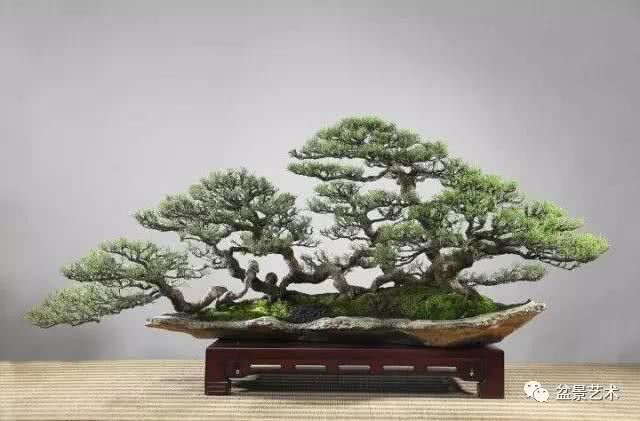
The beauty of the forest structure of tree communities reflected in the forest form, and the beauty of color changes through the four seasons, are unmatched by other bonsai. The ecological mechanism of competition and mutual aid among plants in the natural environment that it embodies is a subtle portrayal of the way life exists in nature.
In the field of bonsai art, how to create more and more beautiful living artworks that reflect forest landscapes is the responsibility and task given to us by the times.
The first requirement of forest-style shaping is that it must fully embody the typical forest structure brought about by the ecological environment, rather than stopping at a generalized concept of forest. For example, riverside and coastal mudflat forests, stream and ravine valley forests, ridge and highland forests, dune and open plain forests, deep mountain primeval forests, village outskirts and field-edge forests, swamp and lowland forests, distant mountain forests after snow clears, and so on, all have different charm and atmosphere. The shaping must express each one's beauty of artistic conception through the background support. In addition, there are also distinctions such as dense forest, sparse forest, young forest, old forest, autumn forest, and cold forest; the pictures reflected from the different angles of quantity, tree age, and seasonal appearance also have different moods. These scenes are all worth pondering and drawing on in shaping.
The main characteristics that cannot be ignored in forest shaping are as follows:
Two trees growing side by side form a combined planting; their trunks must have leaning and upright, and their canopy must have bending and lifting, high and low. The upright one and the tall one are the main. The one emerging to the side is the secondary, and if small trees are interspersed and attached to the left and right, they are companion trees. This is the basic principle of combined planting, and it is also the unit and starting point of forest-style shaping. The multiplication and expansion of combined planting is the forest style. Therefore, the layout of forest shaping should skillfully develop the principle of the main, secondary, and companion three trunks forming a triangular posture, freely adding and reducing changes, so as to organize more units and blend them into the opening, closing, gathering, and releasing of the overall picture.
Forest shaping is the art of weaving the density and sparseness of branch and trunk lines; it should achieve sparseness where a horse can be led through, and density where branches join. To make the plants press close together, one side of the main root can be cut away so that two trees grow side by side. It is also possible to truncate the trunk at a low position and keep more branches to strengthen the density of the local forest interval. Forest shaping is also the art of dividing blank space; it is necessary to reveal "bright spots" within the thick shade, and to read language in the blank areas. A painter once said, when speaking of the technique of dotting the stamens when painting orchids: "Not only should it dot out their texture; the advantage lies even more in the blank space between the dots and lines." These words are also inspiring for forest shaping. If one can weave, from top to bottom and from inside to outside, contrasts between virtual and real realms of various sizes, then there will be spiritual vitality.
The wave-like momentum of the treetops and the slope layers formed by the ground's earth mounds, embedded stones, old roots, moss and fine grass, and ravine springs are the two undulating lines, upper and lower, that must not be neglected in forest shaping. There are commanding heights, low valleys, and also secondary high points; the transitions between them must have a sense of flow. Finally, let the two lines interweave above and below and disappear at the edge of the forest.
The bonsai form that can to the greatest extent express the harmonious beauty of symbiosis and mutual aid among tree communities is indeed none other than forest-style shaping. This beauty is expressed through each plant's competition for living space and mutual yielding, unified as one: for example, in the middle of a dense forest there is a tendency to rise toward the sky and compete in height, while the outer edges must have a leaning-out and escaping posture, and between the various layers there must be adjustment of advance and retreat, bending and lifting. This mood is precisely natural beauty.
Within the forest there should be the artistic conception of being "habitable and wanderable," as if faintly there is a "wild path" that can pass through, so as to deepen its sense of depth.