Detailed Guide to Making and Techniques for Daphne Bonsai
(1) Botanical Knowledge
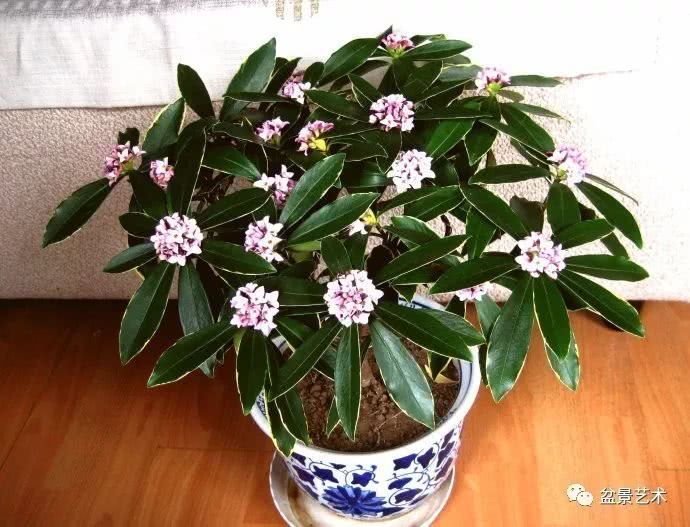
Belongs to the Thymelaeaceae family, Daphne genus. Evergreen shrub, smooth stems. Leaves alternate, oblong, mostly clustered at the branch tips, entire margins, deep green and glossy. Blooms from March to May, capitate inflorescences terminal, corolla yellow-white to pale purple, lilac-shaped, strongly fragrant. The branches of Daphne are graceful and spreading, with soft twigs and thick leaves, elegant and beautiful in posture.
Main Varieties
1. White Daphne, also called white-flowered Daphne, flowers pure white.
2. Golden-edged Daphne, leaf margins golden yellow, fragrance very strong.
3. Rose Daphne, also called pale red Daphne, inner petals white, outer surface slightly red.
4. Hairy Daphne, stems deep purple, flowers white, outer surface of the floral tube covered with grayish-yellow silky hairs.
Daphne is produced in China south of the Yangtze River basin in Jiangxi, Hubei, Hunan, Zhejiang, Sichuan and other provinces. It is also distributed in Japan.
Daphne prefers shade, avoids direct sun exposure, is relatively sensitive to cold, and grows best in fertile, loose, well-drained acidic soil; it does not tolerate waterlogging.
(2) Material Collection and Propagation Measures
Artificial propagation: Daphne is mostly propagated by cuttings and layering, and can also be propagated by water cuttings, division, and sowing. Cuttings can be taken in all four seasons, but early March to late June is the best time for cutting. For spring cuttings, select vigorous one-year-old branches as cuttings, about 5-10 cm long. The day before cutting, use a sharp knife to make a ring cut about 0.1 cm at the branching point to promote healing and rooting. For those ring-cut at the branching point, cut them off at the right time and trim the cut smooth; the upper part of the cutting should retain 2-4 leaves. For those not ring-cut at the branching point, if there are several divisions they can be cut separately. Insert to a depth of about 1/3 or 1/2, not too deep. For home cuttings, a cutting pot can be used; for large-scale cuttings, a seedbed must be used. The seedbed soil should preferably be loose, fertile, well-drained slightly acidic soil. After inserting, a protective shed must be built to prevent sun and rain (bamboo strips can be arched into a 50-60 cm high frame and covered with plastic film). When the temperature is too high, one corner of the film shed must be opened for ventilation, and moisture must be controlled, not too wet. Generally, spring cuttings can root in about 30 days, and can be divided and transplanted in about 2 months. If cutting in summer and autumn, the cuttings must be selected from current-year semi-lignified new branches, choosing vigorous branches about 8 cm long, with a heel on the branch. After inserting, keep the seedbed soil moist, and pay attention to heat preservation when the temperature drops. Generally they can also root in about 40 days, and are transplanted for cultivation after the weather warms in the following spring.
Layering propagation usually can use the air layering method. Air layering is best done from May to June. First select a suitable branch, determine the layering position, use the notching method to make one or two horizontal cuts or girdle the bark at the layered position, with the cut reaching the xylem, then wrap the cut area with a plastic bag or a half-split bamboo tube, tie the lower end tightly, apply growth hormone to the wound, then fill in prepared culture soil and tie the upper end of the bag tightly. Keep the soil in the bag moist and fix the layered branch well to avoid breaking. Generally rooting occurs in about 40-50 days, and after about 2 months it can be cut from the mother branch and potted for cultivation. Propagating Daphne by the water cutting method is simple and easy, and the survival rate is also relatively high.
(3) Potting Process
Pot selection: Daphne is suitable for slightly deep round or square pots; oval or rectangular pots are also acceptable. Purple clay pottery pots are best in texture. Pot color can be chosen as yellow or light gray, to set off the green leaves and white flowers, producing a highlighting effect.
Soil: Daphne likes to grow in fertile, loose, well-drained sandy loam, requiring slightly acidic soil with a pH value between 6 and 6.5. For potting, leaf mold or sun-dried, weathered garden soil mixed with an appropriate amount of rice husk ash or sand can be used.
Planting: Potting is best done in April in spring. At this time the climate is mild and humid, with a small temperature difference between day and night, which is beneficial for Daphne to establish in the pot and grow. Autumn planting is also acceptable; when transplanting, more original soil must be kept, and the branches should be properly pruned.
(4) Shaping Techniques
Processing: Daphne bonsai is suitable for wire training, combined with pruning for shaping. But care must be taken to remove the wire in time, so as not to cause wire bite, affecting appearance and growth. Processing and shaping are best done during the dormant period, and can also be done after flowering.
Tree form: The tree form of Daphne bonsai is suitable to be made into a natural large-tree shape. The branches should be upright, elegant and spreading, and attention should be paid to appropriate density, so as to benefit graceful branches and abundant flowers, rich color and fragrance, and enhance the ornamental effect.